Showing posts with label Michael H. Brown. Show all posts

Friday, April 27, 2018

Our Lady of Montserrat


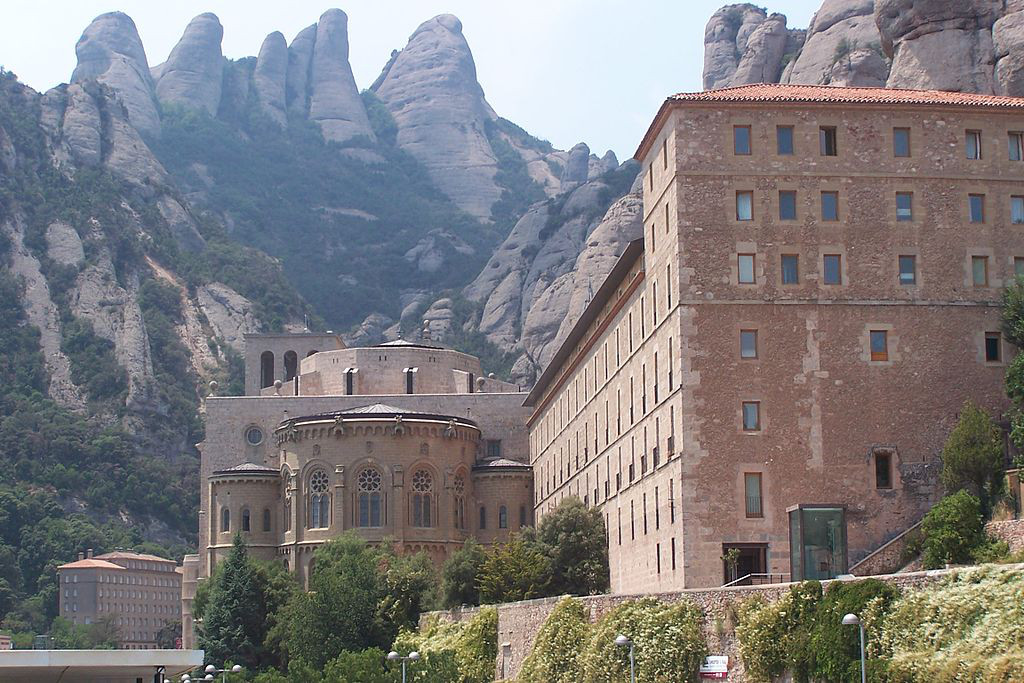
A mountain view of the Benedictine Monastery and basilica at Montserrat, Catalonia, Spain
The Benedictine Monastery at Montserrat, Catalonia, Spain. Photo: Miriadna/Monastery at Montserrat

With today being the Feast of Our Lady of Montserrat, I thought it fitting to publish today's post in honour of the Blessed Virgin Mary.

I first discovered Our Lady of Montserrat many years ago from Michael H. Brown's devotional book, Seven Days With Mary, which some of you may recall from my previous posts on Our Lady of Prompt Succor and Our Lady of Good Counsel. In total, there are seven Marian devotions with the remaining four being: Our Lady of Guadalupe, Our Lady of Lourdes, Our Lady of the Miraculous Medal, and Our Lady of Saragossa; all of which have been officially recognized and sanctioned by the Church.

Montserrat is an impressive, towering mountain in Catalonia, Spain whose majestic height peaks at 4,055 ft, and at approximately two-thirds of the way up (2,846 ft) is the sanctuary: the Benedictine Abbey of Santa Maria de Montserrat and the basilica where the slender statue (Black Madonna) of Mary is located. Brown describes Montserrat as, "...[O]ne of the world's most holiest and august sanctuaries." (16)

Of the ten pages about Our Lady of Montserrat, Brown dedicated the first five pages—the remaining pages consisted of meditations and prayers—to the sharing of his pilgrimage experience at Montserrat, which also included: a brief historical note on the origin of this devotion; the significance of Mary's apparitions and intercession over the centuries; and the importance of miraculous images and statues in the history of the Church.

Citing the example of the Apostle Luke's painting or carving of Our Lady, Brown went on to note that such images are important ways for Heaven to communicate with humans. Accompanying these images have been special graces, heavenly blessings, and Mary's intercession; the statue at the sanctuary in Montserrat is another example of Heaven's communication with us.


A photo of the basilica and monastery at Montserrat.
The basilica and monastery at Montserrat. Photo: Torero from nl [GFDL (http://www.gnu.org/copyleft/fdl.html) or CC-BY-SA-3.0 (http://creativecommons.org/licenses/by-sa/3.0/)], via Wikimedia Commons

The statue in the basilica at Montserrat is known as "Little Dark Lady of Montserrat" or "La Jerosolimitana" (Native of Jerusalem). It is located in an alcove high above the altar where pilgrims are granted access to it by a narrow stairway, allowing each individual to get close to the statue.

At this majestic setting, Brown shared that the time he spent within the "incredible gold-gilded basilica" was one in which he received tangible graces from a statue that is only three feet tall. Describing the statue as Romanesque in style, with a dark Byzantine look of Mary's face, Brown wrote that being in its presence leaves pilgrims in "reverential awe."

The exact origin of the statue is not known, but what is known is that as far back as 718, the statue was hidden in a cave from Arab invaders, where it remained undiscovered for two centuries. In 890, local boys spotted a strange light coming from the eastern part of the mountain, where upon their investigation they heard the sound of music and canticles. The boys informed a local priest in the village of Monistrol, who did not believe them at first, but upon visiting the location, he too experienced the same light and inexplicable music. The priest informed the local bishop in Manresa who headed for the site together with a procession of villagers.


The statue of the Black Madonna in Montserrat, Catalonia, Spain
The Black Madonna in Montserrat. Photo:
Feel the Planet/Montserrat, Catalonia, Spain
Upon arrival at the entrance of the cave, and after having experienced the canticles, lights, and fragrant aroma, the bishop ordered the entry into the cave where the image was discovered. That discovery prompted the bishop to have it placed in the cathedral in Manresa, but when those carrying the statue could no longer move where the basilica and monastery currently exist, it was understood to be a sign for the sanctuary to be built on that very spot.

Among some of the pilgrims who have gone to Montserrat have been: Jaime 1 (El Conquistador), St. Vincent Ferrer, King Louis IV, and St. Ignatius Loyola, who after his time at the sanctuary divested his cloths, gave them to a poor man, and proceeded to spend time alone in a cave near Manresa where he wrote his well known spiritual exercises.

Accompanying Christopher Columbus' voyage to the New World was one of Montserrat's hermits, and after having reached his destination, Columbus dedicated one of the first churches to the Virgin of Montserrat, where today in the Carribean there is an island that bears the same name.

One of the Benedictine abbots from Montserrat, Giuliano ella Rovere, eventually became pope; "the" pope who hired Michaelangelo. 

Brown quoted the Emperor Carlos V who stated, "A certain divinity which I cannot explain flows from the sanctuary of Montserrat all over the mountain." (18) From his own personal experience Brown wrote, "I cannot more highly recommend a sanctuary than Montserrat. I was truly surprised by the strength of its effect. I was impressed by the atmosphere of holiness way up that unique mountain and what it taught me about praying in solitude." (19)

Meditating and praying with Seven Days With Mary, is essentially a time of Divine Intimacy: a personal retreat where one enjoys a constant feeling of peace and receives an abundance of graces. It is an opportunity to draw closer to Mary, to open ourselves and allow Our Lady, in an ever increasing way, to be our light to Christ and show us the path to Jesus.

This is precisely what Mary's role has been and continues to be: to spiritually prepare Her children for Heaven. To do so, Mary wants to have a personal relationship with each one of us, so as to lead us to have a more personal relationship with Jesus. As Brown points out, Mary has something to give each one of us personally, and he expressed his hope that through Seven Days With Mary, each one of us will receive it. To that end Brown suggests, "Meditate on each major appearance that is reviewed in this book and apply the lessons to your own lives. There are hidden meanings. There are hidden lessons...This is a book of how to apply all that we have learned about Mary to our own personal lives." (vii)


A mountain view of Santa Cova, where the Black Madonna statue was found in Monserrat
Santa Cova in the mountains at Montserrat
where the Black Madonna was found. Photo:
Hello Jetlag/Montserrat Monastery and Mountains:

An Easy Day Trip From Barcelona
Brown recommends meditating and praying for seven consecutive days to receive the maximum benefit. As to which particular devotion to begin and end with, it doesn't matter so long as each day is dedicated to only one devotion.

To aid each individual's effort to meditate upon Mary's role, and walk with Her to find our way through the current darkness, Brown arranged it so that each day includes: meditations, litanies, and other prayers related to the individual devotions; an additional brief meditation, contemplation, and ejaculation; and the suggestion to pray the Rosary, especially the Scriptural Rosary. In the chapter dedicated to Our Lady of Montserrat, Brown also included two consecration prayers. Here is a contemplation that Brown provided from that chapter, which spotlights the richness of this devotional book, "However much the world tempts us, we know that it is a passing place and that if we do good, if we help others—most of all, if we are reverential, if love and serve Christ, and if we are humble, hidden as the Virgin's statue was hidden—we will resurface, as at Montserrat, in glory." (23)

The added benefit of this devotional book is the opportunity to seek the aid of Mary for our families, friends, and others that we care about, our respective countries, and the world as a whole.

We don't need to expend a great deal of energy to recognize how the world is in great need of God's Divine Intervention, for which the Church has historically appealed to Mary's intercession. Pope Leo III in his encyclical Supremi Apostolatus Officio wrote about that appeal to Mary, and how the Rosary is instrumental to remedy the many evils of society: the violence of heresy, intolerable moral corruption, and aggressive Islamic attacks by the Ottoman Turks.

Immorality, materialism, and greed have always existed, but as Brown noted in the Preface, our time is an "unusual and special time," one in which "...[T]he level to which our very institutions have fallen gives great pause and recalls corrupt times like those back during the fall of Rome or during the Middle Ages." (vi)

Today's moral disorder has ushered in a Culture of Death: abortion, euthanasia and assisted suicide; contraception; in vitro fertilization; and the desensitization of all threats (including the death penalty in some countries) to the value and inviolability of human life, creating in the process a deep crisis of conscience. We also see the effects of the global sexual revolution: pornography and pornovision; sexually explicit advertising; the LGBTQ agenda; gender mainstreaming; the indoctrination of children and our youth in the education system with sexual immorality, and the list goes on.

But no matter how long that list may be or become, we always have recourse to Mary. From the history of the Catholic Church, we know of Mary's purpose at Her many apparitions: to identify and expose the demonic influence upon people and regions in various parts of the world, to dispel them from both, and lead each individual back to Jesus. 

So numerous are Mary's apparitions—estimated to be in the thousands—in countries like Italy, France, and Spain that today there are literally hundreds of sanctuaries, shrines, monuments, and churches built at those sites in honour of the Blessed Virgin Mary.

In a world that seems increasingly evil and indifferent to it, we need to pray (especially the Rosary, the most powerful prayer) to Our Lady that through Her intercession God's Divine Intervention will uproot and remove the moral disorder in our respective countries and restore them to, as St. John Paul II put it, a "Culture of Life."

We should also seek the comfort of Mary's protective mantle, and implore Her to generously dispense an abundance of graces upon us.

Our Lady of Montserrat, pray for us.


Sunday, December 31, 2017

The God of Healing

Michael H. Brown's book The God of Healing
Michael H. Brown's book, The God of Healing

One of the benefits of the Christmas season is an opportunity to catch up on some reading. This year I decided to read Michael H. Brown's book, The God of Healing.

For those who have been following my blog, you may remember Michael H. Brown (director of the Catholic news website SpiritDaily.com) from my posts on his four informative talks that he gave during the Marian Day Retreat back in May of this year. Those talks not only spawned four blog posts on each respective talk and the rereading and blogging of his book, Prayer of the Warrior, but it also prompted me to acquire four other books he authored: one of which I blogged about in September, Where The Cross Stands: The Last Chance to Reclaim America; two remain on the reading and blog-draft lists; and the other is the focus of today's post.

The God of Healing, is a worthy addition to anyone's reading list that seeks to better understand an increasingly important subject matter in today's world where people are suffering from a multitude of chronic ailments, injuries, and life-threatening diseases.

Yet even in today's Information Age, many are not aware that healing is available to those who put their trust in God; who pray in a spirit of obedience, abandonment, and gratitude, as if the healing had already occurred, much in the same manner as Jesus did when raising Lazarus from the dead. (John 11:42)

Healing happens to those who not only believe that God can heal, but that He actually will heal when asked.

Part of the healing process entails our cooperation: a sincere turning to God in perfect contrition and true repentance; forgiving those who we need to forgive; letting go of hatred, resentment, and bitterness; and seeking to live a virtuous life. We should pray for these gifts and the graces to live them fully, each and every day of our lives.

We also need to spiritually cleanse our homes and lives from demonic influence. Our homes should be blessed by a priest, especially when moving into a new home. The frequent use of sacramentals (holy or exorcised water, salt, and oil) is also important in fighting the spirits of darkness (demonic) that may attempt to silently influence us.

Receiving the Sacrament of Reconciliation or confession is very important to "come clean" with God. Add to this: regularly attendance at Mass (more than once a week, daily if possible); appealing to Our Lady's intercession through the recitation the Rosary (the most powerful prayer next to Mass) and the intercession of the saints; adoration in front of the Blessed Sacrament; fasting (especially on bread and water) which is a powerful spiritual weapon (Mark 9:29) that expels evil and cleanses the body; meditation on the Bible, especially the scriptural passages that deal with healing (half the passages in the first eight chapters of Mark deal with healing); and calling upon our guardian angels and St. Raphael to heal, guide, and protect us.

God can heal anybody of anything! God's healing is not a matter of if, but when: when we act, God acts. The God of Healing is essentially a guide book of what we need to do to put that healing process into motion. 

We must do so with a strong and unwavering faith, drawing from the lessons of Christ to the Apostles who inquired with Jesus after he cast out a demon, why they were unable to do likewise, to which he replied, "...Because of your little faith. For truly I tell you, if you have faith the size of a mustard seed, you will say to this mountain, 'Move from here to there,' and it will move; and nothing will be impossible for you." (Matthew 17:18-20)

For those who have been injured recently, diagnosed with a condition or disease and are terribly worried or perhaps bordering on despair, Brown offers some words of encouragement: "Don't accept an evil report." (16) God is above what any diagnosis and doctor will say about your health. Do not let the Evil One or his demons discourage, dishearten, and depress you! Never despair; there is always hope with God!

In chapter three, Invisible forces, Brown illustrates why we should never accept an "evil report" by citing from the example of St. Pio of Pietrelcina (Padre Pio) who in 1958, was afflicted by bronchial pneumonia. Despite the best efforts of doctors, his condition remained and as tests were conducted, Padre Pio was informed that he had cancer and only had a few months to live. Much to the shock of doctors, Padre Pio burst out laughing and informed them that they didn't know what they were talking about. 

Padre Pio refused the evil report! He refused the doctors' advice for chemotherapy. He prayed in front of a famous pilgrim statue from Fatima, and did so the entire time it remained in the monastery. Eventually the statue was taken away and Padre Pio pleaded with Our Lady, "Dear Mother, ever since you came to Italy, I have been immobilized by sickness. Now that you are leaving, aren't you going to say even a word to me?" At that moment, he felt a surge throughout his body; he leaped out of bed and shouted, "I'm healed." Two weeks later, Padre Pio resumed all his duties. (17)

We would do well to remember what Brown wrote in beginning of the first chapter, Our Creator wants us whole, "There's no doubt whatsoever that God can heal anybody of anything." He is the God of healing. (1)

Throughout the book, Brown refers to how the demonic and unclean spirits can—and many times are—the source of emotional, psychological, and physical problems, but it is in chapter seven, Spirits of Darkness, where he elaborates on this in greater detail.

In that chapter, Brown quoted Dr. Kenneth McAll's—a Christian psychiatrist who claimed to have witness dozens of spirits haunt various locations, causing accidents, disputes, and other negativity—recommendation that upon moving to a new home, "...[I]t is a good idea to have it blessed." (36)

Giotto di Bondone's fresco, The Expulsion of the Devils From Arezzo
McAll's recommendation brought to mind Giotto di Bondone's fresco, The Expulsion of the Devils From Arezzo, which serves as another reminder of how the demonic can influence the lives of those who remain vulnerable to their attacks.

Giotto's fresco depicts Br. Sylvester blessing the town of Arezzo, Italy and in the process expelling all the demons who, up until that time, were urging people on to a "mutual slaughter."

Although not the focus of today's blog post, including the story of what actually happened in Arezzo, may be of interest to those who want to further grasp the reality of the demonic. Here is the account from St. Bonaventure's Major Life of St. Francis (CH VI, NO.9.), The Expulsion of The Devils From Arezzo:
On one occasion St. Francis arrived at Arezzo when the whole town was being torn with faction fights and threatened with destruction. There he was given hospitality in a village near the town and he could see the devils rejoicing over it and urging the people on to mutual slaughter. He was anxious to put the malicious powers of evil to flight and so he sent brother Sylvester, who was a man of dove-like simplicity, telling him to approach the town like a herald. "Go up to the town gate," he said, "and in the name of almighty God command the devils in virtue of obedience to go away immediately." Sylvester was a genuinely obedient man and did what he was told. There and then the town was restored to peace and the townspeople set about reforming the laws governing their mutual rights peacefully. Once the malignant and presumptuous influence of the demons which encompassed the town like a besieging army had been counteracted, it needed only the wisdom of a beggar, that is, Francis' humility, to restore peace and save the day. By the heroic practice of humble obedience Francis had gained complete authority over the rebellious spirits, so that he could crush their frantic efforts and put an end to the violence they attempted.
Further in Spirits of Darkness, Brown refers to Fr. Jose Maniyangat from Jacksonville, Florida who firmly believes that the majority of physical illnesses are rooted in evil. 

Highlighting the hidden aspect of the demonic, Brown wrote, "In the vast majority of cases, spirits aren't recognized and remain hidden (causing 'incurable,' mysterious ailments). Lack of joy and peace—a feeling of despair—is a marker. So is malaise." (38) Brown quoted Fr. Jose on the clandestine aspect of a demonic presence within a home:
It is important to remember, that if the entities manifesting are of a diabolical nature, then they must be driven out in the Name of Jesus...They will always clandestinely affect the persons in the home in a negative manner, one way or the other, whether through sicknesses like heart attacks, headaches and stomach aches, relational problems and division within the family, emotional and psychological illnesses like impatience, anger, and depression, temptations like lust, pride, and sloth with regard to one's prayer life and Christian obligations; weakening of faith in God, as well as failures in businesses and other endeavours. (38)
With respect to souls of the departed that are still earthbound, they too may negatively affect us much in the same manner as demons. Elaborating on this Brown wrote, "Again: Jesus used the term 'unclean' when casting spirits of infirmity out of people. If we'd stop and realize how many 'psychological' illnesses are caused by spiritual influence, we would clear out half of our psychiatric wards." (39)

Further highlighting the clandestine demonic root of mental problems, Brown referred to a patient of Sigmund Freud's who was of the belief that the root cause of her condition was due to an "entity" within her. Brown went on to further note that Freud's assistant agreed with the patient. 

Sadly, there are many in the professional field of psychiatry and psychology that don't understand or believe that demonic influence is the root cause of many conditions or problems. We need not look any further than to the vocabulary used by such professionals, "They call obsession 'neurosis'; oppression 'schizophrenia'; and possession a 'split' personality or 'multiple-personality disorder' (the Lord said 'legion,' Luke 8:30)." (39)

Much if not all of what is going on in our lives can be cleared through confession, repentance, expiation, and forgiveness; all of which sets us on the path to healing.

To aid in the healing process, Brown referred to a few saints that we can pray to for their intercession: St. Lucy, St. Joseph, St. Pio of Pietrelcina, and St. Andre Bessette, the miracle man from Montreal, whose devotion to St. Joseph helped many in the healing process and restoration to normal health.

Brown cited one such case of a woman who was suffering from cancer of the eye, who was told by St. Andre Bessette to, "...[T]ake some oil from the oratory [St. Joseph's Oratory in Montreal] apply it to her eyes, and offer a daily prayer to Saint Joseph, using a medal of him." (40) The women complied with the instructions and even climbed the stairs to the crypt on her knees, spending the rest of the day in prayer. Within weeks the cancer disappeared and a year later, the woman's daughter wrote to St. Joseph's Oratory that her mother was in "excellent health." (40)

We can also cooperate with God's healing by remembering that our bodies are temples of the Holy Spirit, "Or do you not know that your body is a temple of the Holy Spirit within you, which you have from God, and that you are not your own? For you were bought with a price; therefore glorify God in your body." (1Corinthians 6:19-20)

Part of glorifying God in our bodies translates into: eating the right foods, drinking plenty of water, getting the rest we need, and regular exercise.

Brown begins to address the importance of healthy living and expelling stress in our lives in chapter eight, The Power that closes the wounds. In that chapter, he emphasizes that harmony with God and His Creation can lead not only to a healthy life, but a long one. He cited the example of Esmeralda Stavra from Symi, Greece:
I read an account of a woman named Esmeralda Stavra in Symi who was 107 when she died on the island in Greece where they are very physically active, eat the right things, take time for neighbors, get sun, and don't know stress. Her house was at the top of the village steps and even when she was a hundred years old Esmeralda went up and down three or four times a day so she could sell the feta cheese and yogurt she made. She was never ill; never went to the doctor, for so much as a checkup (her children said). She was 'harmonious.' She was in tune with nature. She was connected to God. (44)
Further in the book at chapter eleven, Lean and Clean, Brown encourages the reader to "Invoke the Holy Spirit and do, eat, and drink what He guides you to do, eat, and drink." (57)

At chapter thirteen, Those who live longest, Brown refers to the Hunzas, residents of the Himalayas (northern Pakistan) who experience such longevity that they have been studied for decades. He described their healthy diet:
They are regularly over a hundred, and some are purportedly a decade or more beyond that. Their diet consists of fresh raw carrots, sprouted legumes, cabbage, whole-grain chapattis, unpasteurized  whole milk (yes, they ingest some dairy), a little meat once a week, and lots of pure water...
In the land of the Hunzas, apricots are staples as are cherries, mulberries, and walnuts. Organic vegetables are grown in soil prepared with natural compost. Their proteins come chiefly from beans, legumes, and chickpeas. When meat is taken, it's in small doses from animals ('free-range') that graze in a natural manner. Hunzas also drink that clean glacier water and eat fermented butter and cheese in small quantities. A main drink is apricot oil...(72)
It was Hippocrates who stated, "Let food be your medicine and medicine your food." (74) 

Hippocrates was the first to write about the benefits of garlic as a medicine for eliminating tumors. Brown noted how recent studies have shown that garlic "...[K]ills insects, parasites, bad bacteria, and fungi. It also eliminates various tumors, lowers blood sugar levels, lowers harmful fats in the blood, and prevents clogging of the arteries." (74) 

Further he remarked, "Perhaps this is why a community in southern Italy called Campodimele (halfway between Rome and Naples, and heavy on garlic) is called 'Village of Eternal Youth.' God's medicine is often found in a natural state." (75)

Citing another example Brown referred to those living in Okinawa, Japan, "There the mainstay is whole grains, leafy vegetables, sweet potatoes, and smaller amounts of fish, organic soy products, and pork" (75)

Brown went on to write, "The theme is that people who live long lives are drawing minerals, vitamins, and other nutrients right from the way God fashioned them. They also get sufficient rest..." (75)

God is in total control. Does that mean that everyone who prays will automatically be healed or receive a miracle. It is a matter for God to decide. 

If we don't receive a healing, it might be as Brown suggests because we have yet to pray from the deepest recesses of our hearts. It may be a matter of redemptive suffering; that is, the purification through suffering that a soul must undergo so as to become better suited for Heaven.

Sometimes healing is immediate, but most occur over a period of time. As Brown notes, "Just as natural remedies may take a while, even a long one, to have their effect, so too do spiritual cures. Often, what is profound takes time. It is progressive. There may be unseen matters to resolve." (35)

In the last chapter, Your destiny is the best outcome," Brown states in the first sentence, "Final outcomes are in the Hands of God." (141) To reiterate from earlier in this post, we must never give up hope!

For those that may be tempted into despair, here are some encouraging words from Brown's last chapter:
You can't experience victory if you plan for defeat...Don't be the architect of your own failure. Don't draw up a 'blackprint' of your future. With Jesus and your angels (ask for extra ones) and the Blessed Mother and the Holy Spirit: all will turn out well in what ever way...Everyone goes through angst, which is a trial in life. We worry about how to pay for our health care. We have debts from a home or a car. We fall back in payments. There is tension at work...The right attitude will take you through any 'furnace,' through any oppression, to a higher place. The more things are difficult for you, the greater your chance of enhancing His glory...God puts you in situations so you come out higher (and whiter). When we persist, He takes away what has been holding us back...God puts us in situations that purge what keeps us from Him and our missions. Move forward, always forward. If you are focussed on what's behind you, you are headed backwards. Often, you have to lose something to gain something. When God takes something away, He gives more back. It is only separation from God that should concern us when the 'going gets tough'; for when the going gets tough, the tough—headed for wellness, healing through God—get on their knees. (143)
In the words of St. Pio of Pietrelcina, "Pray, hope, and don't worry."


Thursday, September 14, 2017

Where The Cross Stands: The Last Chance to Reclaim America

Michael H. Brown's book, Where The Cross Stands
If you found the title of this blog post somewhat intriguing, it borrows from a book titled, Where The Cross Stands, written by Michael H. Brown from SpiritDaily.com.

I recently finished reading this book, one that had been on my reading list since May of this year when I attended the Marian Day Retreat here in Toronto, where Brown gave four talks, one of which was dedicated to Reclaiming North America's Christianity.

It seemed fitting to publish today's post on the feast of the Triumph (Exaltation) of the Cross to honour Jesus and in part to honour Our Blessed Mother, whose recent birthday of September 8, was also the day that the huge cross at Saint Augustine, Florida was dedicated in 1965—displayed on the front cover of the book—the location of the first documented Mass (September 8, 1565) in the United States and the first permanent American settlement, Nombre de Dios (Name of God); the official spot where Catholicism entered America.

These facts are among hundreds that Brown includes in his book, which is partly a lesson in US history that begins at America's Catholic origins and continues throughout the centuries that followed where he illustrates how there has been a cultural shift into darkness—in large part due to New Age and occult practices, Hollywood, the turbulent sixties, and other aspects of the Spiritual War waged against America by the demonic—that together with the waning of faith and a nation's descent into moral disorder, has resulted in today's state of affairs: a society that can be aptly described as a "Culture of Death."

As to the further significance of the cross at St. Augustine and its location, Brown suggests that, "Some day in the future—perhaps the not so distant future—this Cross and this area will play a role in the spiritual and temporal survival and revival of America." (1)

In Where The Cross Stands, Brown's latest book, he explains in detail why that revival is so necessary.

America's Catholic Origins and Growth as a Nation

Brown began his timeline of America's Catholic origins with Christopher Columbus and the discovery of America in 1492, who as Brown notes, "...[C]onsidered the evangelization of the New World his primary goal." (13)

So important is Columbus's discovery of America that Brown not only dedicates an entire chapter to it, but provides details in the preceding chapter of how historical events—the finding of Pope Gregory's statue of Our Lady at a location in Spain referred to in the local dialect as, "Guadalupe" or hidden channel—in Spain aided in the eventual discovery of the New World.

It is well known that Columbus was a very devout Catholic, who had a deep devotion to Our Lady. So devout was Columbus that his ship was named, Santa Maria, and on board his ship were fellow Catholics who recited the Hail Mary, and upon arrival in America (New World) they sang the Salve Regina in thanksgiving.

Columbus's arrival in the New World paved the way for other Spanish explorers—Columbus was Italian by birth, but sailed with Spanish ships—to discover other parts of what is now the United States; namely, Florida, which Brown dedicates four chapters to as part of an elaboration of America's Catholic origins.

Florida was originally discovered by Ponce de León in 1513—who had on board his ships, Augustinian, Dominican, and Franciscan clerics—around Easter, and is the reason why he named the land, "La Florida," in recognition of the Paschal flowers and the landscape rich in vegetation. 

Others soon followed such as Don Tristán de Luna y Arellano (who had Dominican priests with him) and Hernando De Soto, who had named the bay he entered, "Espiritu Santu" or "Bay of the Holy Spirit," which was eventually changed to Tampa Bay.

Many of the newly discovered parts of America were originally given Christian names, but eventually changed to something secular: the "Bay of St. Mary" is now the Chesapeake Bay; "Lake of the Blessed Sacrament" is now Lake George; and the mighty "River of the Immaculate Conception" is now the Mississippi.

Another explorer, Menéndez, also arrived on the scene whose central and only goal was to establish a Christian nation. His fleet consisted of nineteen ships and on board were: four Catholic priests, 1500 soldiers, sailors, millers, sheepherders, hunters, and farmers. One of the priests, Father Francisco López de Mendoza Grajales, is depicted in the cover photo of Brown's book: the statue of a man with his arms raised up.

By including these and other facts, Brown makes it crystal clear—a point that he reiterated more than once—that Catholics were the first to settle the United States and establish Christianity. The new-found-land was being sanctified by Catholics decades before Jamestown and eighty years before the Puritans at Plymouth Rock. It is an important point which Brown highlights by asking, "How many modern classrooms would dare to teach this?" (29)

Brown provides many other historical references that illustrate how America continued to develop as a Christian nation: Christianity was reflected in constitutions, laws, and practices; and God was acknowledged, praised and worshipped. Here are some interesting facts worth mentioning.

  • In 1776, all European Americans (except for 2500 Jews) identified themselves as Christian. Benjamin Franklin, Ethan Allen, Thomas Jefferson, John Adams, and Thomas Paine, if not overly devout, were greatly influenced by their Christianity." (53)
  • In 1777, the Continental Congress spent $300,000 for bibles to be distributed throughout the thirteen colonies (56)
  • Christianity formed the very concept of freedom; university law lectures were quoting Saint Thomas Aquinas. (55)
  • In 1782, the United States Congress declared, "The Congress of the United States recommends and approves the Holy Bible for use in all schools." (56)
  • The concept of "separation of Church and state" was not meant to prevent religion from influencing government, but the opposite: from government trying to control religion. As Brown stated, "When there were arguments that involved religion, it was usually about how government could best serve the Christian faith." (53)
  • In 1789, George Washington, in his famous Thanksgiving Day Proclamation stated, " '[I]t was the duty of all nations to acknowledge the providence of Almighty God, to obey His will, to be grateful for His benefits, and humbly to implore His protection and favor,' and recommended '[T]he people of these States to the service of that great and glorious Being, Who is the beneficent Author of all the good that was, that is, or that will be...' "(55) 
  • The first communities in the Northeast were Bible-based commonwealths. (56)
  • Maryland was a haven for Catholics fleeing persecution by the English government. (56)
  • All but two of the 108 universities were Christian, including Yale and Harvard. (56)
  • George Washington on his inauguration day not only kissed the Bible openly after being sworn in office, but gathered Congress and his first Cabinet at the Chapel of St. Paul and consecrated the United States under the protection of the Almighty. (57)

America's Cultural Shift Into Darkness

Brown dedicates several chapters to America's cultural shift into darkness that begins with chapter fifteen, where he highlights the Spiritual War of the "Bell Witch" case in Tennessee: the demonic infestation of the homestead of John, Jesse, and Drewry Bell; all three of whom fought for Andrew Jackson in the Battle of New Orleans.

Expanding upon the demonic influence, he referred to Mormonism, feminism, American Freemasonry and Spiritualism and how it began in Upstate New York; how the era came to be known as the Age of the Medium.

In chapter eighteen, Brown included a short segment of one of America's darkest occultists, Alex Crowley—referred to as "the Beast" by his own mother—who was the inspiration behind the Church of Satan, established in 1966. Devotees included John Whiteside Parsons, a known rocket scientists and close friend of L. Ron Hubbard, the man who started Scientology in 1954, the New Age belief system that is followed by Hollywood actor, Tom Cruise.

At chapter nineteen, Brown introduces the reader to Margaret Sanger, who as he put it, "...[W]as to champion the most dangerous and dark trend of the coming era...the right to abortion." (103)

It was at the same chapter that Brown revealed the truth about the name "Hollywood," and how it refers to "holly" (not holy) wood; a wood that was considered sacred to ancient wizards, used in magic wands with its beginnings traced to pagan rituals in Nordic times. Brown had also mention and elaborated on this during his talk in Toronto: The Current Prophet Pulse.

Chapter twenty spotlights "Godless technology"; that is, the failure of mankind to work with God in the creation of products. Many of today's products do not dissolve back into nature and; thus, are not apart of God's plan because they "hurt" His creation. This in stark contrast to all that God has created which was made to dissolve back into nature.

Brown further elaborated on "Godless technology" by paraphrasing the Venezuelan mystic, Maria Esperanza, "[W]ith God, ingenuity would exceed the imagination while solving problems and disrupting nothing. Instead, our scientists were going their own way without even believing in Him. For years, Esperanza had warned that such misuse of technology—Godless technology, especially human cloning—would be a disaster." (112)

Chapter twenty-one focussed on the warning coming from LaSalette regarding a world that only thinks about amusements. Some of those "amusements" that Brown cited were from the last century, in particular with respect to rock and roll music. 

Further in this same chapter, Brown went on to point out that much of modern rock and roll found its wellspring in a blues singer named Robert Johnson; the significance of which is in the legend of the singer's apparent pact (a classic Faustian pact) with the Devil near the Dockery Plantation in Mississippi. Here is how Brown partly described the midnight meeting in the Deep South, "...[H]e was met by a 'man' who took his guitar, tuned it, and in exchange for his soul, granted him the gift of blues." (115)

Regardless of the veracity of this story, other rock stars such as, Mick Jagger (Rolling Stones), Robert Plant (Led Zeppelin), John Fogerty (Creedence Clearwater Revival) and Eric Clapton, admitted to having gone to that same spot, with success following in their respective careers.

The list of musical artists that have been involved or taken interest in New Age and occult practices might surprise some: John Lennon (The Beatles) had a personal tarot-card reader; Aleister Crowley is among those on the cover of the Beatles' Sergeant Pepper album; the Rolling Stones entitled one of their albums, Their Satanic Majesties Request; Keith Richards (Rolling Stones) has stated that the band received inspiration for their songs at seances.

It gets a little darker with people like Jim Morrison of The Doors, who claimed that the spirit of an Indian boy entered him. Jimmy Hendrix believed he was possessed by a demon. Phoebe Snow claims to have talked to "aliens" via the ouija board.

Brown also includes a segment on how promiscuity was being normalized through such developments as the publishing of pornographic magazines like Playboy, which started in the early 50s, with others that would follow in the decades to come.

It was Playboy magazine that helped to popularize Marilyn Monroe, who was already posing nude for calendars, and whose "career" promoted and injected "free sex" and multiple marriages into mainstream society.

What Brown makes abundantly clear is that American society has changed substantially, not only from its Christian origins, but also from the past century when society was much more family orientated and decent.

So evident is this change today, that Brown asks the question, "Where did you go Ward and June Cleaver?" (283)

Our Lady's Prophetic Warnings and Messages

With America's descent into darkness came the prophetic warnings (chastisements) and messages from Our Lady and the lessons to be learned from them; that is, if enough people pray (the Rosary in particular) and fast—which can stop wars and suspend the laws of nature—America can stave off the chastisements, prevent the unravelling of society, and recover from the damage already done.

To date, many have heeded Our Lady's requests which Brown suspects is the reason why so many chastisements have not come to pass. As he states in chapter forty-two, "In fact, all the judgements can be averted. The whole purpose of God's warning is to turn the wicked to repentance and obedience. There are enough righteous ones in Sodom-America to make the difference, but these must not remain passive." (262)

Our Lady stated to Sister Mildred Mary Neuzil in the 50s, "What happens to the world depends on those who live in it...There must be much more good than evil prevailing in order to prevent the holocaust that is so near approaching." (305)

A common thread that runs throughout Our Lady's warnings and messages is to pray the Rosary. Brown notes the importance, drawing from the Marian apparitions in Medjugorje, where he highlighted Our Lady's warning about Satan's attempts to conquer mankind and how through prayer and fasting, we can be victorious.

Brown went on to ask, "Could America be reclaimed?" The answer comes from Our Lady, "Advance against Satan by means of prayer. Put on the armour for battle and with the Rosary in your hand defeat him!" (263)

If there was ever a time in history to begin a devotion to Our Lady of Prompt Succor, now is certainly that time. So important is this devotion that Brown dedicated an entire chapter to it; a devotion that has proven to be quite effective in American history.

We could all learn from the faithful Ursuline Sisters of New Orleans, who have on numerous occasions implored the intercession of Our Lady of Prompt Succor. Most noteworthy is when Our Lady saved the people of New Orleans in an extraordinary way on two separate occasions: the first was the extinguishing of a raging fire that threatened to destroy the Ursuline Convent in 1812; and the second was the surprising military victory of General Andrew Jackson in 1815, against a larger, better equipped invading British force.

This in addition to the countless times Our Lady has come to the aid of individuals in Louisiana, which as the National Shrine notes on its History of the Devotion page, is so numerous that "We will never know them all."

Brown highlighted the importance of this devotion when he stated, "Such events show us that nothing is beyond the reach of prayer, no problem, no disaster." (66)

As for the future, Brown considers the time frame between 2020 to 2040, as a critical period, which he also mentioned during his Toronto talk; a time frame that also includes mercy!

We can better understand mercy through the Divine Mercy Devotion, in which we not only seek God's mercy, but fulfill the main requirement of the devotion; that is, we too must be merciful with others, always and everywhere.

It was interesting how, at the end of his book, Brown reiterated the potential, future significance of St. Augustine, Florida. He shared his thoughts from an outing, while kayaking past the Cross, that St. Augustine must become America's refuge; a place of pilgrimage. Perhaps others will be encouraged by the original settlers to, as Brown suggests, "...[M]arch across our land and plant crosses again where once they stood..." (318) He goes on to further encourage his fellow Americans, "Come back, America! Pray goodness back." (318)

God bless America.


Sunday, July 23, 2017

Michael H. Brown's Book: Prayer of The Warrior

A photo of Michael H. Brown's book, "Prayer of The Warrior"
Michael H. Brown's book, Prayer of The Warrior

Recently I completed a fresh reading of Michael H. Brown's book, Prayer of The Warrior, spawned by his fairly recent talks at the Marian Day Retreat here in Toronto.

Originally read in early 2003, this latest rereading was not only a rediscovery of Brown's conversion and faith journey, but an opportunity to learn anew about certain aspects of spiritual warfare and how to become a better prayer-warrior.

A common thread that runs throughout the book—which Brown has dedicated the entire first chapter to—is the reality that we are in the midst of a spiritual war; one that requires prayer-warriors.

To aid those seeking to become prayer-warriors, Brown wrote several key chapters that are fundamental to understanding how to fight the good fight: chapter seventeen, The First Prayer of the Warrior, the prayer to the Holy Spirit; chapter twenty-four, Me and Hillary, the prayer of deliverance; chapter twenty-five, The Prayer for Spiritual Wisdom; chapter twenty-six, The Prayer of Fearlessness; and chapter thirty-five, The Prayers of Faith and Love, which also includes the powerful prayers of suffering.

In addition, Prayer of The Warrior, contains valuable information for those new to spiritual warfare: what is to be understood about spiritual warfare; Brown's actual encounters with the demonic; a historical account of the signs of the times; prophetic warnings and messages from the Marian apparitions of Akita, LaSalette, Fatima, and Medjugorje; how the "Rulers of Darkness" (demonic) have influenced many aspects of culture and society as a whole; how to fight the good fight against the Evil One and his demons through regular (daily if possible) Mass attendance, daily recitation of the Rosary, adoration in front of the Blessed Sacrament, regular confession (at least once a month), daily Bible reading, the use of sacramentals (holy water, salt and oil), the wearing of the Brown Scapular; how effective and beneficial it is to have within our homes blessed crucifixes, holy pictures, objects and relics; and regular "house blessings" by a priest.

Michael H. Brown is well known in Catholic circles and throughout the world for his talks, books, articles, blog posts, and his web site, Spirit Daily, where many of his contributions to informing, encouraging, and strengthening fellow Catholics in North America and throughout the world can be found. It is an important web site that provides resources on: the truth, knowledge, and understanding of the Catholic faith journey; current, real, and relevant news; information on the events and signs of our times; and resources on spiritual warfare, healing, and the afterlife.

The narrative of Brown's life is an inspiring example of one man's journey, coming "back home" to his Catholic roots, and how his acceptance and cooperation with the gift of faith transformed him into a prayer-warrior: putting faith into action and fighting the good fight in the spiritual war. It is the fulfillment of Saint Pope John Paul II's directive, from his post-synodal Apostolic Exhortation Christifideles Laici, "It is not permissible for anyone to remain idle." (3)

A Spiritual War

Brown instills in the reader at the very beginning of this book, that we are in the midst of a spiritual war.

It is a war that should concern us because the Evil One is rising as never before. So important is this subject matter that Brown dedicated the entire first chapter to it, aptly entitled, A Spiritual War. It sets the tone for the remainder of this book: the narrative of Brown's conversion; the many positive changes to his personal and professional life; the sharing of his gift of faith, and his knowledge and understanding of the spiritual war, including how to become a prayer-warrior.

Although, Prayer of the Warrior, was published in 1993, Brown provided many examples of the rising influence of the Evil One, and the negative impact upon culture and society as a whole, that today has increased in both intensity and scope.

Here in Canada, we need only look to the growing moral disorder for proof of this and the Culture of Death that it has ushered into mainstream society: abortion available on demand; euthanasia and assisted suicide deceptively packaged as part of palliative care; contraception; in-vitro fertilization; "fertility clinics"; and other threats to the value and inviolability of human life.

In the past couple of decades, we also have experienced the growing negative consequences of the global sexual revolution, including: gender mainstreaming; gender ideology; the LGBTQ agenda; the indoctrination of our children and youth, and the younger generations with sexual immorality in the education system; pornography and pornovision. 

Add to this the infiltration and acceptance of New Age and occult practices into mainstream society. Prime examples are yoga, tai-chi, and reiki, deceptively marketed as health and wellness; and a host of alternative therapies and medicine that are cleverly included within traditionally accepted medical practices. 

It is a growing list of evils that, no doubt mirrors what is happening in many other countries; all of which is drawing God's chastisements upon mankind. Brown spoke about this during two of his talks in Toronto: The Current Prophetic Pulse and Reclaiming North America's Christianity.

Adding to the concerns of God's chastisements, Brown referred to the Marian apparition of Akita, Japan, "At Akita, which has been formally approved in a pastoral letter from the bishop, Mary has warned that if it does not better itself shortly mankind will face a 'great chastisement' that will 'wipe out a great part of humanity.' " (3)

Apparition Hill (Brdo Ukazanja) in Medjugorje, Herzegovina, where Our Lady first appeared to the seers.

Brown also cited from the Marian apparitions in Medjugorje—which continue to this day—where Our Lady has given ten secrets to six visionaries, part of which are warnings of coming chastisements upon the world. It is not a matter of if, but when the chastisements will come: the chastisements are to occur within the life time of the visionaries.

Given the fact that the Medjugorje seers are in their 50s, we should expect major events to occur within twenty-to-thirty years, perhaps forty years from now at the most, which Brown depicted as, "...[A]n exceedingly dangerous time. Satan is pulling all stops. While I don't believe for a minute that we're facing the end of civilization, I do believe that, during the next several decades, we'll see truly major and perhaps unprecedented economic, military, sociological, theological, spiritual, and natural upheavals—if not sooner." (6)

It is Brown's contention that, on a lesser scale, the chastisements have already begun. He goes on to elaborate that we are already under a demonic assault that affects us personally, as seen by the division and confusion we experience; to which Brown highlighted the important point that, "Confusion is his [Evil One's] hallmark." (9) Brown added that the spiritual chastisement is "fully in progress," and may soon be followed by chastisements in the physical realm.

Prayer of the Warrior, is an invitation to each reader to take a personal journey and discover in the process his/her own own fears, struggles, difficulties, and the many challenges to be faced on this earthly pilgrimage. 

Each reader that accepts that invitation will be greatly aided by Brown's personal insights and the sharing of the events, occurrences and people in his life, viewed through the eyes of faith, not as a collection of meaningless coincidences, but part of God's plan for his journey. Brown's life is a quintessential example of Saint Pope John Paul II's quote, "In the designs of Providence, there are no mere coincidences."

Here is how Brown explained the relevance and benefit of this book for each reader:
This is what I want to focus upon: Our own state of spirituality and the personal trials we face as the battle heats up and possible chastisements loom. In God's army we'll win, but we have to know how to be prayer warriors, how to view the events around us, and how to purify ourselves. I want to take you on a more personal journey, I want to discuss you, your temptations, your fears, your difficulties, your struggles against dark forces as I share with you some of my own. This is a more personal book. It will offer a more personal look at certain saints and Church-approved visionaries, along with their insights into the world. It will offer glimpses of the afterlife. It will offer suggestions for spiritual protection. It is an account of both the good and evil I have witnessed as a journalist. (9)
As a further encouragement to accept the invitation, Brown stressed that no one should in any way feel depressed or fearful about the spiritual war. Rather, each individual should respond to it with action, a desire for purification, and an excitement to face the challenges ahead, enlisting in the "army of the living God," in the process. (10)

Brown's Conversion

Brown's conversion began one night with a powerful dream of Saint Michael and other angels coming to his aid against the Evil One, who was literally at the front door of his apartment. 

The dream led Brown to question its meaning for his life and so began his spiritual journey back to God, back to his Catholic roots. Soon thereafter he became a daily communicant where the Mass provided him with "relief, refreshment, and strength."

It also began an awareness of the spiritual war. As his new life began to unfold, that awareness increased and so did incidences and encounters with the demonic.

Brown's new journey also prompted a life review: an opportunity to reflect upon the personal mistakes in his life and his spiritual negligence, which led him to question some of the occurrences in his life and how they were related to the supernatural.


Our Lady of Good Counsel, Brown's local
church during the early days of his
conversion. Photo: The New York
City Chapter of the American Guild of
Organists /Our Lady of Good Counsel
Chapter five, The Bells of Good Counsel, begins with what proved to be a standard fixture throughout this book, a prayer for the reader. This particular prayer highlights how Brown wants the reader to truly benefit from this book and be protected from the knowledge gained about spiritual warfare. Here is that prayer, "Lord Jesus, cleanse us of all evil. Wash us of all spiritual grit. Let us all learn from my experiences, and from our own experiences. Let us review certain aspects of evil but without becoming enticed or obsessed by them. Let this be for all an experience of the Holy Spirit and of His sure deliverance." (26)

Brown recounted how some of his experiences, such as the encounters with New Agers he described in chapter four, The House in Chelseaand the short time he spent with a mafia hitman researching a story, detailed in chapter three, A Brush With the Mafia, made him realize that he was "Not lucky, but blessed," to have walked away unscathed.

I recall from my original reading how I took note of Brown's specific wording, that it was not a matter of luck, but the opposite, God's blessings of protection over his life. Sadly today, many people use the words, "luck" and "blessing," interchangeably when in fact they have very different meanings. To consider oneself lucky is a departure from faith in God—who is the true source of all goodness in one's life—and attributes and places value in something other than God to explain a postive occurrence, development, or event in one's life, which many times is a form of superstition.

Brown's faith was nourished by his daily attendance at a local church, Our Lady of Good Counsel, only half a block away from his apartment at 230 East 90th Street. It proved to be a place of refuge; just part of many gifts Brown received from God during the early days of his conversion. Here is how Brown described this gift:
To me it wasn't just a church but a fort and refuge. I would hear the bells at noon and rush out my door down the elevator and past the doorman for Mass. Most of the time there were just a handful of us, and I was the only one under the age of sixty, sitting there amid the sweet white-haired women with fraying sweaters and Irish brogues. Usually, I sat in the right wing, near the statue of a saint who became very important to me, Saint Joseph.
As I said, it was a fort, and that's just what I needed. I was under attack. For whatever reason—or reasons, plural—the devil was openly showing himself. He was on the attack, and God was granting me the grace to see it and do something about it. (28) 
Brown attributed a lot of his spiritual problems to the evil he exposed as a journalist. In particular his writing on the toxic waste that was dumped throughout America, on land and in water systems. He shared some of those details including how many corporations were not pleased with him, and in some cases it resulted in heated exchanges with executives. One executive even went so far as to hire the nation's leading libel attorney, Louis Nizer, in an attempt to stop the publication of Brown's book, Laying Waste: The Poisoning of America by Toxic Chemicals.

Part of Brown's spiritual problems also stemmed from the fact that he had a temporary fascination with the New Age. He notes in chapter three, A Brush With the Mafia, how he stopped being a practicing Catholic during high school and even more so when he went to Fordham University.

Elaborating a little further, Brown described how secular he had become that during his university days religion was not apart of his vocabulary, and he never dated any "religious orientated" women. Add to this his side interest in extrasensory perception (ESP) and articles he wrote about thermal noise and nuclear random-event generators, and it is not difficult to ascertain why the demonic was drawn to him.

Brown reviewed the secular time of his life, during and after university, and came to the conclusion that he was under demonic attack and didn't even know it. Here is how he described it:
No doubt. Without knowing it, I had been under spiritual attack. Michael [St. Michael the Archangel] must have been watching out for me all along. Michael was my patron, he was the archangel who threw Satan out of Heaven, and he was showing me that, along with everything else, my unhealthy interest in parapsychology, which we now call 'New Age,' as well as my battles with chemical companies and my brushes with the mob types, without adequate spiritual armor, had brought the devil to my doorstep. (30)
Brown's gift of faith and the new awareness of the spiritual war he was in, brought with it greater torment, anxiety, loneliness, and the temptation to distance himself from Jesus. The closer he drew to God, the more he was attacked. This did not deter him from moving forward in his faith journey, which he was able to do with the recitation of the Rosary; an essential weapon for the daily spiritual battle. Brown shared how important the Rosary was in fighting off the attacks, "When I was under attack, the attack would immediately dissipate—the gritty tension would flee—after the recitation of the Rosary. (31)

Brown's recounting of the effectiveness of the Rosary in repelling the attacks of the demonic is an important lesson for all of us. This holds true especially for those Catholics who have considerably waned in their faith: those who don't pray the Rosary, don't attend Mass, don't read the Bible and books on the lives of the saints, don't read and pray with spiritual meditations (Divine Intimacy or My Daily Bread), and think that they are "okay" because of financial wealth, social status or some other mistakenly perceived security. This means nothing to the demonic: they attack regardless of how much money you have; what you do for a living; who you associate with; and irrespective of any other aspect of your life.

In addition to the Rosary, Brown also mentioned how important it was for him to invoke St. Michael and other angels, to praise Jesus, and to read Scripture, which typically ended the demonic attacks. Here is what he wrote, "No matter how fiercely I was being assaulted, I could lie down, and if I spent enough time with the Rosary or reading Scripture, the demonic attack would lift and anxiety would be replaced with peace, comfort and warmth." (32)

Brown was becoming a prayer-warrior! Prayer permeated his entire day, "I started praying throughout the day, whenever I wasn't at the computer writing or on the phone. I prayed taking a shower and in the kitchenette and in the elevator. I prayed up and down Third Avenue." (32)

The First Prayer of the Warrior, Prayer to the Holy Spirit

Come Holy Spirit, is the first prayer of the prayer-warrior which Brown dedicated an entire chapter to, The First Prayer of the Warrior. It is an especially important prayer for our spiritual life as the Holy Spirit addresses all of our needs: discernment, health, enlightenment, guidance, protection, and teaches us how to pray. Brown elaborated on the importance:
I found out quickly that the Holy Spirit is a better instructor than any book or preacher. 'Pray to the Holy Spirit for enlightenment.' He will lead us to where we should go for information and will help us choose the books to read. Passages from the Bible become more vivid and meaningful when they are read with His help. 'Come Holy Spirit.' (111)
Brown went on to further point out that, prayer that begins with an invocation to the Holy Spirit, is much better and beneficial because as he notes, "When the Holy Spirit comes, everything changes around us." (111) 

Prayer to the Holy Spirit is praying for the spirit of truth! With the Holy Spirit we are less likely to be deceived and we are released from errors and bondages. As Brown notes, "It is the Holy Spirit who illuminates and lifts our blindness." (111) This is important to protect us against attacks of the demonic, who attempt to deceive us masqueraded as "holy spirits."

Brown further stated that with our spiritual blindness "cured," we can better perceive the spiritual world around us with an enhanced sensitivity. This ables us to, "...[D]ifferentiate angels from deceiving spirits—this is crucial, for the number of deceiving spirits seems virtually countless." (111)

When we do call upon the Holy Spirit, we should so with complete spontaneity; a truly heartfelt invocation for help and protection, one that "pierces through the clouds." Further elaborating on this Brown wrote, "God likes us to speak to Him as we speak to friends and neighbors. Come Holy Spirit. It is the prayer of guidance and the prayer of protection. The Holy Spirit can break through any darkness, and He provides answers we could never think up ourselves." (110)

Our Lady in Medjugorje has stated on numerous occasions how important it is to pray to the Holy Spirit. Brown referred to one of Her messages from May 23, 1985, "Open your hearts to the Holy Spirit. Especially during these days the Holy Spirit is working through you. Open your hearts and surrender your life to Jesus." (111)

Prayer is essential in spiritual warfare and those who intend to fight the good fight should begin their day with the prayer to the Holy Spirit, Come Holy Spirit. Brown emphasized the importance of this, "The weapons and shields, the equipment of battle, all lay in prayer, and prayer to the Holy Spirit is the first prayer of the prayer-warrior." (113)

The Second Prayer of the Warrior, the Prayer of Deliverance

The second prayer of the prayer-warrior is the prayer of deliverance, to which Brown dedicated another chapter, Me an Hillary.

Brown began this chapter by providing a prayer of deliverance that invokes the Holy Spirit to send the Archangel Michael, Saint Francis of Assisi, the dragonslayer Saint George and a battalion of angels. It implores the Holy Spirit to break all demonic bondages and purge us from them, as well as to free us from oppression, depression, discouragement, and every mental torment.

Deliverance prayers are important to expel demons, but it is also important to know how and why they come to us. Citing an example from the life of Saint Francis of Assisi, Brown illustrated how demons entered into a church through the sinful thoughts of a friar:
...Francis of Assisi, who had a vision one day in which he saw his favorite place of prayer, the chapel of Portiuncula, besieged by devils--a great army. He watched them hovering about the chapel but noticed that they were not able to enter. They couldn't because the friars praying inside were so holy. However, soon one of the friars was stirred to anger with a second friar and began thinking vengeful thoughts. As Saint Francis watched, the protective grace around the chapel was breached, the grace was lifted, the gate of virtue abandoned, and the door of wickedness allow the devils in. They left only after the friar acknowledged his faults and humbly asked for forgiveness, which once again points up the importance of Confession and its power of deliverance. (155)
Elaborating somewhat on the example of the friars, Brown pointed out that this is exactly how demons—the unseen enemies—negatively affect us through bad temper, a lack of forgiveness, or envy.

To further highlight how sin draws demons to us, Brown asks the reader, "Want a demon to latch and sting? Try lying, cheating, stealing, or sexual immorality." (155)

Demons can perch on to us and, in some cases, it is difficult to expel them without a complete internal cleansing and prayers to the Holy Spirit. Brown included how this can also affect an entire nation due to its collective immorality, citing the example of his own country, the United States of America. 

This shouldn't discourage or depress us in any way because as Brown pointed out, there is an opportunity to rid America of demonic influence through prayer. This applies to any country: the opportunity to mitigate the punishments from God for the evils that so many in society have accepted and been deceived by, comes in the form of prayer! 

Such an "antidote" to the many evils in society comes to us through prophetic warnings and hope from Our Lady in LaSalette, Fatima, and Medjugorje.

The Prayer for Spiritual Wisdom

Brown begins chapter twenty-five, The Prayer for Spiritual Wisdom, with a brief continuation of how his professional life changed after his conversion, highlighting in the process the need to pray for spiritual wisdom. 

Brown was a noticeably changed man, so much so, that contacts in the secular media along with those in the publishing field began to take note. Brown was very cognizant of the change in his professional relationships, especially with those who were atheists and New Agers—who Brown no longer tolerated—as he put it, "Our spirits clashed."

The sharing of these changes in his professional life highlighted an important point about the battle of good versus evil; that is, it is not limited to a societal level, but also waged on a personal level. Elaborating on this Brown stated:
...Demons and angels fight over every person and family. That is essentially the condition on earth. At each turn in life, every hour, often every walking minute, we are given two different paths of thought and action, good or evil, and when we make the wrong choice—which is usually the easiest or most immediately pleasurable choice—we attract forces of darkness. (163)
It is important to note that not all that happens to us should be attributed to the demonic; sometimes it is simply a matter of life: a sickness due to biology; stress due to fatigue; and general mishaps and accidents. (163) 

At the same time, we must not think of demonic influence upon us as some sort of general, abstract idea: these unseen enemies do attempt to influence us!

To help us distinguish between regular life occurrences and realities brought on from demonic influence, Brown includes a prayer for wisdom. The prayer implores Jesus: to bind the demonic that come against us; to open our spiritual eyes; to understand what should be understood; for wisdom; and to carry forth with our Christian duty without undue curiousity. It is an ideal prayer to recite daily!

The danger of a lack of spiritual wisdom is an increase in sin and demonic bondage. As Brown notes, the demonic try to "cling" to us; we are in a constant battle with them. He goes on to state, "They watch us just as guardian angels watch us—but always looking for an opportunity to tempt us and find another pathway inside." (165)

If you are wondering just how the demonic try to cling to us, Brown listed a few examples: drugs, alcoholism, jealousy and anger, illicit sex, unhealthy literature, bad habits, and the wrong movies.

Most people, as Brown pointed out, have no idea that their lives and mood swings are influenced by the demonic, who can cause: fear, doubt, lust, addiction and other compulsions, and especially pride.

Brown also pointed out that forgiveness is a most powerful tool of deliverance, "...[W]e must let go of past slights, rejections, or insults before we attain full spiritual freedom." (166)

Perhaps one of the most salient points that we need to remember about deliverance is that almost everyone needs some form of deliverance! Deliverance is not necessarily a dramatic, combative event with the demonic, but rather, a quiet, soft, and quick occurrence that is accomplished through the Sacrament of the Eucharist (Mass) and the Sacrament of Reconciliation (Confession). He highlighted the importance of confession by stating:
Confession is a key to deliverance. When we confess our sins we are acknowledging the evil we have invited into our lives, and we are renouncing that evil. Renunciation of evils does a simple and yet extraordinarily powerful thing: it breaks our bondage to the evil. Confession and prayers of purification, in which we specifically pray to break each bondage brought into our lives through sin, open the clear path to full joy and deliverance. (167)
The rest of chapter twenty-five, Brown dedicated to explaining the different levels of demons and how they attach to and influence: entire territories, such as cities and countries, as well as to specific neighbourhoods, homes, and even rooms where "poignant sin" has occurred; objects, occult books or jewelry; and to each individual.

What I found particularly noteworthy was the mention of how demonic bondage can occur through obsession over money, emotional hurts, relationships, sexual tendencies, work, superstition, and people in general.

Brown also mentions a list of occult practices that we should avoid, as they open the door to demons: mediums, ouija board, pendulums, tarot cards, clairvoyance, and channeling. The result of such demonic influence is: deception, oppression, depression, obsession, and the ultimate goal of possession.

The Prayer of Fearlessness

Being a prayer-warrior entails that one be fearless in fighting the good fight.

Brown elaborated as to why this is, but first premised that explanation by reminding us that we are already victorious in Christ because He defeated Satan 2000 years ago; what remains is for us to reclaim that victory.

Quoting the Bible, Brown referred to the scripture passage in Luke 10:18-19, highlighting in the process how we have also been given the power to expel demons from our midst, which he spoke about and included in his talk in Toronto, Spiritual Warfare and Family Healing

A key sign of fear is anxiety and Brown warns the reader that if there is any anxiety, "...[T]hat means the devil has a piece of us and is feeding off that nervous energy." (172) He continues to warn that if we fear the devil, we give him power because fearing him is fearing his nefarious power.

Also important is to not become obsessed with the Evil One and his demons because like fear, obsession can lead to serving their power. To help readers avoid becoming obsessed, Brown included prayers to Jesus and the Blessed Virgin Mary.

The prayer to Jesus asks that: our path in life, including our families, leads to the correct path of deliverance; that we be given the right prayer companions and ministers; that we receive the information we need to have; and the gift of powerful prayer.

The prayer is to the Blessed Virgin Mary is a plea for her intercession: that we not give undue attention to the demonic; that we learn what we need to learn about evil and move on with our focus always on Jesus; and for the gift to see our own pride so as to not serve the "Prince of Pride."

Then there is a third prayer, one recited from Brown's heart, for the need to focus on the glory and truth of Jesus.

Brown adds to all this with his recommendation that, "Before we advance forward we must first pray to the Holy Spirit for total freedom from any fears or obsessions." (172)

The importance of being fearless also extends to the Evil One's human instruments; that is, those who are New Agers, involved in the occult, and any practitioners of black magic.

As to why that is, Brown explained that when we are in a state of grace and grow closer to God, we wear what he described as, "...[T]he breastplate of righteousness, the shield of faith, and the helmet of salvation." (172) Any attempts by the demonic to fire their "darts" at us fall to the ground. As to what Brown meant by "darts," he stated the following:
The enemy's darts? We encounter them every day. You know how it is: Everything will be going well, and your mind will be happy and at peace, when suddenly an anxious thought will come flying into your head from nowhere.
Or the actions and words of someone will sting you, burn you, create aggravation or apprehension.
That's what demons are constantly poised to do: disrupt you and especially take away your peace and equilibrium.
Or tempt you. They will lead you away from discipline. They will make you too antsy or too busy to pray or to read the Bible. They'll lead you back to bad habits, or to unclean thoughts, or to confusion and doubt. Confusion and lust especially. Lust and arrogance, which really opens us to snares. (173)
It is important to be armed against the demonic and recognize their wiles and deceptions, otherwise they, "...[C]an often fester within us and cause us to sin or lead us into discouragement." (173)

Spiritual warfare is a lifelong struggle, a daily challenge that can be defeated with: faith, humility, self-discipline, Bible reading, and prayer.

Brown concludes the chapter with a short list of questions that is sure to go to the core of every individual's conscience, helping each one of us to root out pride and vanity, "Are we mired in pride? Do we think we are smarter or more spiritual than others? Do we judge? Are our egos easily riled? Are we concerned about status? Do we gauge a person's worth on a material or reputational basis? Are we jealous?" (175)

If "yes" is the answer to any of these questions, then we must pray to free ourselves from such pride. Brown goes on to state that, "...[A] person free of pride, or at least of most pride, is the toughest prayer-warrior." (175)

The added benefit of having no or very little pride is that we are not easily deceived because we are, "...[A]fforded special armor—special fearlessness—against the gathering enemy." (175)

The Prayers of Suffering, Faith, and Love

Brown dedicates an entire chapter to the prayers of faith, love, and suffering, chapter thirty-five, The Prayers of Faith and Love.

Brown begins the chapter by stating that the most powerful prayers are those of faith, love, and suffering; powerful against the Evil One and his demons, and powerful to appease God's chastisements for all the evil we have allowed and participated in. Here is how Brown explained it:
Most powerful are the prayers of faith, love, and suffering. The devil always flees when rebuked by those soft of heart. He flees from humbleness. He flees especially from the powerful prayers of the suffering. He flees from the prayers of those in wheelchairs, or those battling cancer. He flees from those who offer up their depression or mourning. He flees from those who offer up their suffering asking nothing in return. God lessens chastisement when we suffer for purification, just as He responded when the residents of Nineveh donned sackcloth. As one mystical revelation said, 'A faithful soul is more powerful than Hell, but a crucified soul is more powerful than a thousand hells.' (228)
These types of prayers are beneficial to us on a personal level, as Brown noted, "It is through those battles, those times of pain and loneliness, those times of suffering, and fasting, that we are strengthened and draw nearer to Him." (229)

Brown also emphasized that those who suffer and fast serve as "our best prayer-warriors," and lessen their own time in Purgatory. He goes on to explain the different levels of Purgatory and the respective suffering at each level.

Fasting is a fundamental weapon in spiritual warfare, just one of five "Little Stonesthat Our Lady in Medjugorje has given to us. Brown elaborated on the importance of fasting:
Fasting helps us approach Heaven and ward off evil attacks. There are few things which are more powerful against Satan. It is no coincidence that Jesus fasted for forty days before publicly entering the spiritual combat. With fasting we are made stronger and purified. It breaks demonic bondages and sets us free from past dabblings in the occult, wrongful sexual dalliances, and other transgressions. (230)
Brown also reminds the reader that we should also pray for other souls already in Purgatory, especially for those who have no one to pray for them. He further highlighted the importance and need to pray for the souls in Purgatory by quoting Our Lady in Medjugorje, who told the visionaries on July 21, 1982:
There are many souls in Purgatory. There are also persons who have been consecrated to God—some priests, some religious. Pray for their intentions, at least the Lord's Prayer, the Hail Mary, and Glory Be, seven times each, and the Creed. I recommend it to you. There is a large number of souls who have been in Purgatory for a long time because no one prays for them. (230)
Prayers of faith are those that "...[S]oundly defeat the harassing presence of demons." (231) Having faith translates into having no fear of the devil and his demons, for to fear them is to inadvertently express faith in their power, which is not comparable to that of God's! 

That is not to say that the Evil One won't try to intimidate you, as he did with Brown, whose experienced a fire in his house that resulted in the loss of his clothes, computer, holy pictures, tape recorders and just about everything he owned. Brown's learned to laugh at this harassment, which in addition to despising and ridiculing the Evil One, makes him flee.

The fire incident proved to be an opportunity for Brown to put his faith into action through his recitation of the Rosary and adoration in front of the Blessed Sacrament. It was time well spent because all that Brown lost in the fire, he got back and more than before. It illustrated what Brown further reiterated with regard to the importance of having faith in God:
When we have faith in God we rise above the storm clouds, we transcend the maelstrom, instead of looking up at the clouds and listening fretfully to the echoes of thunder, with our feet mired in the mud. When we have faith, the proper level of faith, the faith that maintains itself beyond little disappointments, beyond the trials that seek to rob us of that faith, we become one with the power of Eternity. (232)
Faith in God does require vigilance! Brown provided an example of the need to be faithful and vigilant, drawing from his own personal experience while in Italy, on his way to spend time at Monte San Angelo and San Giovanni Rotundo.

The time in Italy was part of his research for his book, The Final Hour, in which he required the use of a Xerox machine for the purpose of photocopying his notebook. It was a necessary precaution against the possibility of it being confiscated in Croatia, his next planned location, which at that time was under attack by the Serbs. His budget only allowed him to spend $25/day for a room, so he prayed earnestly with faith that God would provide. 

It just so happened that as he suspected, when he arrived in San Giovanni Rotundo, there was no occupancy available. He considered the possibility that he might have to sleep in his car that night. Brown kept on praying.

He searched each hotel, but to no avail. When he got to the last one, he was met by the night clerk who informed Brown that he was not going back to sleep, so he could have his room for a discounted price of $25; God provides for those who pray with faith and are vigilant!

Prayers of love is what Brown referred to as the "final prayer of the warrior." You have heard the expression, "love conquers all," well it applies to spiritual warfare as well. Here is what Brown wrote about it:
That is the final prayer of the warrior: love. There is nothing more powerful. Love has dominance over every evil and hatred. We love when we work at longsuffering, patience, tolerance, kindness, humility, and forgiveness. Humility is the bridge to Heaven and love is the wood. We win the war when we work at loving every single person we see in the course of the day, every friend, every stranger, no matter how much they irritate us. We win when we avoid pride, envy and jealousy, which are subtle forms of hatred. (234)
Brown recommends that to win with faith, we need to consecrate ourselves to the Immaculate Heart of Mary and the Sacred Heart of Jesus, which he provided the prayers to do just that.

Praying with love is something we should pray for—certainly include as an intention in our daily Rosary—and thank God for the gift of His love. For Catholics, the best way to do this is at Mass.

Love is especially important for our eternal salvation as Brown noted in the last paragraph of the book:
And we must love. For Heaven is love. God is love. The light visionaries see upon entrance to Heaven is the light of love, and whether we are allowed into that light, at the moment of judgement, will depend, more than anything, more than any ritual or prayers, more even than suffering, on how often and much we have loved our fellow humans and most importantly how much we have loved and fought for the Eternal God. (236)
If you have made it to the end of this blog post, perhaps you will take reading about, Prayer of The Warrior, one step further and purchase your own copy. You won't regret it if you do.

Reading this book is "food for the soul" and serves as an ideal reading for those newly converted to the Catholic faith.

It also will greatly benefit those Catholics who have neglected their faith with very little, if any, spiritual readings, and desire to be brought "up to speed" on spiritual warfare.