Showing posts with label Prayer. Show all posts

Friday, April 27, 2018

Our Lady of Montserrat


A mountain view of the Benedictine Monastery and basilica at Montserrat, Catalonia, Spain
The Benedictine Monastery at Montserrat, Catalonia, Spain. Photo: Miriadna/Monastery at Montserrat

With today being the Feast of Our Lady of Montserrat, I thought it fitting to publish today's post in honour of the Blessed Virgin Mary.

I first discovered Our Lady of Montserrat many years ago from Michael H. Brown's devotional book, Seven Days With Mary, which some of you may recall from my previous posts on Our Lady of Prompt Succor and Our Lady of Good Counsel. In total, there are seven Marian devotions with the remaining four being: Our Lady of Guadalupe, Our Lady of Lourdes, Our Lady of the Miraculous Medal, and Our Lady of Saragossa; all of which have been officially recognized and sanctioned by the Church.

Montserrat is an impressive, towering mountain in Catalonia, Spain whose majestic height peaks at 4,055 ft, and at approximately two-thirds of the way up (2,846 ft) is the sanctuary: the Benedictine Abbey of Santa Maria de Montserrat and the basilica where the slender statue (Black Madonna) of Mary is located. Brown describes Montserrat as, "...[O]ne of the world's most holiest and august sanctuaries." (16)

Of the ten pages about Our Lady of Montserrat, Brown dedicated the first five pages—the remaining pages consisted of meditations and prayers—to the sharing of his pilgrimage experience at Montserrat, which also included: a brief historical note on the origin of this devotion; the significance of Mary's apparitions and intercession over the centuries; and the importance of miraculous images and statues in the history of the Church.

Citing the example of the Apostle Luke's painting or carving of Our Lady, Brown went on to note that such images are important ways for Heaven to communicate with humans. Accompanying these images have been special graces, heavenly blessings, and Mary's intercession; the statue at the sanctuary in Montserrat is another example of Heaven's communication with us.
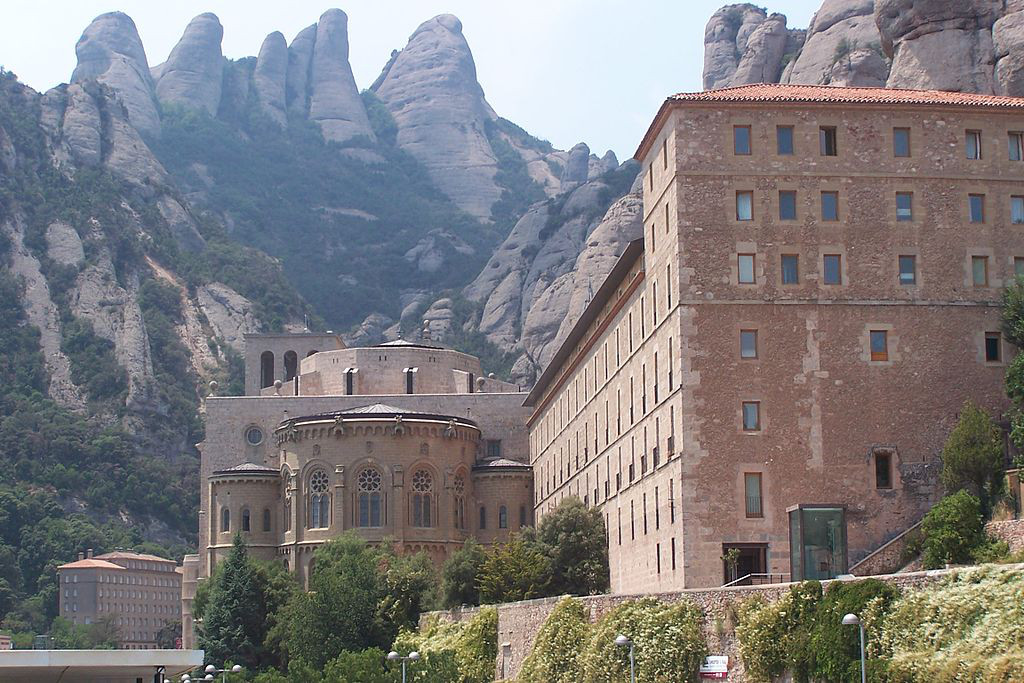

A photo of the basilica and monastery at Montserrat.
The basilica and monastery at Montserrat. Photo: Torero from nl [GFDL (http://www.gnu.org/copyleft/fdl.html) or CC-BY-SA-3.0 (http://creativecommons.org/licenses/by-sa/3.0/)], via Wikimedia Commons

The statue in the basilica at Montserrat is known as "Little Dark Lady of Montserrat" or "La Jerosolimitana" (Native of Jerusalem). It is located in an alcove high above the altar where pilgrims are granted access to it by a narrow stairway, allowing each individual to get close to the statue.

At this majestic setting, Brown shared that the time he spent within the "incredible gold-gilded basilica" was one in which he received tangible graces from a statue that is only three feet tall. Describing the statue as Romanesque in style, with a dark Byzantine look of Mary's face, Brown wrote that being in its presence leaves pilgrims in "reverential awe."

The exact origin of the statue is not known, but what is known is that as far back as 718, the statue was hidden in a cave from Arab invaders, where it remained undiscovered for two centuries. In 890, local boys spotted a strange light coming from the eastern part of the mountain, where upon their investigation they heard the sound of music and canticles. The boys informed a local priest in the village of Monistrol, who did not believe them at first, but upon visiting the location, he too experienced the same light and inexplicable music. The priest informed the local bishop in Manresa who headed for the site together with a procession of villagers.


The statue of the Black Madonna in Montserrat, Catalonia, Spain
The Black Madonna in Montserrat. Photo:
Feel the Planet/Montserrat, Catalonia, Spain
Upon arrival at the entrance of the cave, and after having experienced the canticles, lights, and fragrant aroma, the bishop ordered the entry into the cave where the image was discovered. That discovery prompted the bishop to have it placed in the cathedral in Manresa, but when those carrying the statue could no longer move where the basilica and monastery currently exist, it was understood to be a sign for the sanctuary to be built on that very spot.

Among some of the pilgrims who have gone to Montserrat have been: Jaime 1 (El Conquistador), St. Vincent Ferrer, King Louis IV, and St. Ignatius Loyola, who after his time at the sanctuary divested his cloths, gave them to a poor man, and proceeded to spend time alone in a cave near Manresa where he wrote his well known spiritual exercises.

Accompanying Christopher Columbus' voyage to the New World was one of Montserrat's hermits, and after having reached his destination, Columbus dedicated one of the first churches to the Virgin of Montserrat, where today in the Carribean there is an island that bears the same name.

One of the Benedictine abbots from Montserrat, Giuliano ella Rovere, eventually became pope; "the" pope who hired Michaelangelo. 

Brown quoted the Emperor Carlos V who stated, "A certain divinity which I cannot explain flows from the sanctuary of Montserrat all over the mountain." (18) From his own personal experience Brown wrote, "I cannot more highly recommend a sanctuary than Montserrat. I was truly surprised by the strength of its effect. I was impressed by the atmosphere of holiness way up that unique mountain and what it taught me about praying in solitude." (19)

Meditating and praying with Seven Days With Mary, is essentially a time of Divine Intimacy: a personal retreat where one enjoys a constant feeling of peace and receives an abundance of graces. It is an opportunity to draw closer to Mary, to open ourselves and allow Our Lady, in an ever increasing way, to be our light to Christ and show us the path to Jesus.

This is precisely what Mary's role has been and continues to be: to spiritually prepare Her children for Heaven. To do so, Mary wants to have a personal relationship with each one of us, so as to lead us to have a more personal relationship with Jesus. As Brown points out, Mary has something to give each one of us personally, and he expressed his hope that through Seven Days With Mary, each one of us will receive it. To that end Brown suggests, "Meditate on each major appearance that is reviewed in this book and apply the lessons to your own lives. There are hidden meanings. There are hidden lessons...This is a book of how to apply all that we have learned about Mary to our own personal lives." (vii)


A mountain view of Santa Cova, where the Black Madonna statue was found in Monserrat
Santa Cova in the mountains at Montserrat
where the Black Madonna was found. Photo:
Hello Jetlag/Montserrat Monastery and Mountains:

An Easy Day Trip From Barcelona
Brown recommends meditating and praying for seven consecutive days to receive the maximum benefit. As to which particular devotion to begin and end with, it doesn't matter so long as each day is dedicated to only one devotion.

To aid each individual's effort to meditate upon Mary's role, and walk with Her to find our way through the current darkness, Brown arranged it so that each day includes: meditations, litanies, and other prayers related to the individual devotions; an additional brief meditation, contemplation, and ejaculation; and the suggestion to pray the Rosary, especially the Scriptural Rosary. In the chapter dedicated to Our Lady of Montserrat, Brown also included two consecration prayers. Here is a contemplation that Brown provided from that chapter, which spotlights the richness of this devotional book, "However much the world tempts us, we know that it is a passing place and that if we do good, if we help others—most of all, if we are reverential, if love and serve Christ, and if we are humble, hidden as the Virgin's statue was hidden—we will resurface, as at Montserrat, in glory." (23)

The added benefit of this devotional book is the opportunity to seek the aid of Mary for our families, friends, and others that we care about, our respective countries, and the world as a whole.

We don't need to expend a great deal of energy to recognize how the world is in great need of God's Divine Intervention, for which the Church has historically appealed to Mary's intercession. Pope Leo III in his encyclical Supremi Apostolatus Officio wrote about that appeal to Mary, and how the Rosary is instrumental to remedy the many evils of society: the violence of heresy, intolerable moral corruption, and aggressive Islamic attacks by the Ottoman Turks.

Immorality, materialism, and greed have always existed, but as Brown noted in the Preface, our time is an "unusual and special time," one in which "...[T]he level to which our very institutions have fallen gives great pause and recalls corrupt times like those back during the fall of Rome or during the Middle Ages." (vi)

Today's moral disorder has ushered in a Culture of Death: abortion, euthanasia and assisted suicide; contraception; in vitro fertilization; and the desensitization of all threats (including the death penalty in some countries) to the value and inviolability of human life, creating in the process a deep crisis of conscience. We also see the effects of the global sexual revolution: pornography and pornovision; sexually explicit advertising; the LGBTQ agenda; gender mainstreaming; the indoctrination of children and our youth in the education system with sexual immorality, and the list goes on.

But no matter how long that list may be or become, we always have recourse to Mary. From the history of the Catholic Church, we know of Mary's purpose at Her many apparitions: to identify and expose the demonic influence upon people and regions in various parts of the world, to dispel them from both, and lead each individual back to Jesus. 

So numerous are Mary's apparitions—estimated to be in the thousands—in countries like Italy, France, and Spain that today there are literally hundreds of sanctuaries, shrines, monuments, and churches built at those sites in honour of the Blessed Virgin Mary.

In a world that seems increasingly evil and indifferent to it, we need to pray (especially the Rosary, the most powerful prayer) to Our Lady that through Her intercession God's Divine Intervention will uproot and remove the moral disorder in our respective countries and restore them to, as St. John Paul II put it, a "Culture of Life."

We should also seek the comfort of Mary's protective mantle, and implore Her to generously dispense an abundance of graces upon us.

Our Lady of Montserrat, pray for us.


Tuesday, December 12, 2017

Pray to Our Lady of Guadalupe for the Unborn

Our Lady of Guadalupe's image on St. Juan Diego's tilma
The image of Our Lady of Guadalupe
on St. Juan Diego's tilma
Today's feast of Our Lady of Guadalupe is an especially important one for millions of Catholics in the Americas and around the world who pray to the Blessed Virgin Mary for the protection of human life, especially for developing human beings in the womb: the unborn children who are faced with the danger of abortion.

The pregnant aspect of Our Lady's image on Saint Juan Diego's tilma (cactus cloth) has made Our Lady of Guadalupe a symbol for the plight of the unborn. It is a constant reminder of God's mercy and Divine Intervention in the world, and Our Lady's continued work for the salvation of souls that includes exposing the deception of the Evil One and his demons.

It is for that very purpose that Our Lady has appeared in so many places throughout the centuries: to eradicate pagan worship, debauchery, New Age and occult practices, and all other types of evil, and in the process has been, and continues to be, our light to Christ, showing us the path to Jesus.

The image of Our Lady of Guadalupe, was revealed in 1531, when St. Juan Diego unfolded his tilma (full of flowers) in front the local bishop and as the flowers fell to the floor, the exquisitely detailed painting of Our Lady was seen by all present. 

Our Lady's image also draws our attention to its supernatural power and the fact that it caused the conversion of eight million Aztecs and other indigenous people in less than ten years, in the area that is known today as Mexico

Saint Juan Diego was himself converted to the Catholic faith some time between 1524-1525, and was baptized by a Franciscan priest, Fr. Peter da Gand, one of the first Franciscan missionaries.

Praying for conversions is an important aspect in the fight against abortion, euthanasia and assisted suicide, contraception, in vitro fertilization, the death penalty, and all other threats to the value and inviolability of human life. Our Lady of Guadalupe is the powerful intercessor that we have recourse to in the fight against the Culture of Death.

It is important to remember that the fight to protect the unborn is primarily a spiritual battle that must be fought with spiritual weapons, of which the Holy Mass and group recitation of the Rosary—the two most powerful forms of prayer—are essential weapons in the spiritual arsenal to fight the good fight.

In addition to the Mass, Rosary, and your own personal prayers, you may want to consider the following selected prayers taken from Michael Brown's Marian devotional book, Seven Days With Mary, in which he dedicates one of the seven days to Our Lady of Guadalupe:
Prayer of John Paul II
Virgin of Guadalupe, Mother of the Americas, grant to our homes the grace of loving and respecting life in its beginnings, with the same love which you conceived in your womb the life of the Son of God. Blessed Virgin Mary, Mother of Fair Love, protect our families, so that they may always be united, and bless the upbringing of our children. We beg you grant us a great love for all the holy Sacraments, which are, as it were, the signs that your Son left us on earth. Thus, Most Holy Mother, with the peace of God in our conscience, with our hearts free from evil and hatred, we will be able to bring to all true joy and true peace, which come to us from your Son, Our Lord Jesus Christ, Who with God the Father and the Holy Spirit, lives and reigns forever and ever. Amen. (47)
Morning Offering
Immaculate Heart of Mary, heart of my mother, Our Lady of Guadalupe, I unite to thy purity, thy sanctity, thy zeal, and thy love, all my thoughts, words, acts, and suffering this day, that there may be nothing in me that does not become through thee a pleasure to Jesus, a gain for souls, and an act of reparation for the offenses against thy heart. (49)
Closing Prayer
Remember, O most gracious Virgin of Guadalupe, that in your apparitions on Mount Tepeyac you promised to show pity and compassion to all who, loving and trusting you, seek your help and protection.
Accordingly, listen now to our supplications and grant us consolation and relief. We are full of hope that, relying on your help, nothing can trouble or affect us. As you have remained with us through your admirable image, so now obtain for us the graces we need. Amen. (51)  
So important is Our Lady of Guadalupe in the Americas that in 1945, Pope Pius XII decreed Our Lady of Guadalupe to be “Patroness of all the Americas,” and today in Mexico, it is a Holy Day of Obligation.

In more recent times during his pastoral visit to Mexico, Saint John Paul II, in his homily at the Basilica of Our Lady of Guadalupe, Mexico City on Saturday, January 23, 1999, entrusted the future of the continent and the Church to the Blessed Virgin Mary, imploring the Holy Virgin of Guadalupe to, "Save the nations and peoples of this continent. Teach everyone, political leaders and citizens, to live in true freedom and to act according to the requirements of justice and respect for human rights, so that peace may thus be established once and for all." (9)

Saint John Paul II, who was well known as a staunch defender of human life, stated during that homily, “...[T]he Church must proclaim the Gospel of life and speak out with prophetic force against the culture of death.” (8)

It was in 1995, only four years prior to that homily, that St. John Paul II released his encyclical on the Gospel of Life, Evangelium Vitae; an essential reading for anyone who wants to understand the Church's teaching on the value and inviolability of human life, and the many threats to it. For those who are somewhat new to the life of St. John Paul II, here is an excerpt from Evangelium Vitae that captures the richness of this encyclical and his commitment to the protection of the unborn:
"Your eyes beheld my unformed substance" (Ps 139:16): the unspeakable crime of abortion 
Among all the crimes which can be committed against life, procured abortion has characteristics making it particularly serious and deplorable. The Second Vatican Council defines abortion, together with infanticide, as an "unspeakable crime".
But today, in many people's consciences, the perception of its gravity has become progressively obscured. The acceptance of abortion in the popular mind, in behaviour and even in law itself, is a telling sign of an extremely dangerous crisis of the moral sense, which is becoming more and more incapable of distinguishing between good and evil, even when the fundamental right to life is at stake. Given such a grave situation, we need now more than ever to have the courage to look the truth in the eye and to call things by their proper name, without yielding to convenient compromises or to the temptation of self-deception. In this regard the reproach of the Prophet is extremely straightforward: "Woe to those who call evil good and good evil, who put darkness for light and light for darkness" (Is 5:20). Especially in the case of abortion there is a widespread use of ambiguous terminology, such as "interruption of pregnancy", which tends to hide abortion's true nature and to attenuate its seriousness in public opinion. Perhaps this linguistic phenomenon is itself a symptom of an uneasiness of conscience. But no word has the power to change the reality of things: procured abortion is the deliberate and direct killing, by whatever means it is carried out, of a human being in the initial phase of his or her existence, extending from conception to birth. (58)
If we look to the human sacrifices of St. Juan Diego's time (1500s) and our modern times, we can easily draw a parallel between the demonic worship during the Aztec era with that of today's abortions: the mass murder of innocent human beings in the womb performed in hospitals, "health care centers," "women's care clinics," and so-called "family-planning facilities" such as Planned Parenthood.

The Aztecs offered human sacrifices as part of their worship to two chief Aztec gods (demons), Huitzilopochtli and Tezcatlipocawhich, of which the most popular was the brutal ritual performed on top of Aztec pyramids. The Our Lady of Guadalupe web site at sancta.org details this:
Perhaps the most popular of the public rituals was taking the victims to the tops of the Aztec pyramids where they were laid on top of a flat stone. There, the priests cut open their chests and their hearts were ripped out. The bodies were then thrown down the steps of the pyramid.
After the bodies tumbled down the stairs, the priests removed the limbs, cooked and ate them. Specially hands and thighs were considered the best delicacies. The heads were placed in skull racks for public exhibition.
The atrocities committed in our modern times against human life, as during the Aztec era, are inspired and influenced by the demonic. Just as the Aztecs intentionally offered their human sacrifices to their gods (demons), so too are people today intentionally performing abortions as part of a blood sacrifice and offering to Satan.

Here in Canada, where abortion is available on demand, we are in great need of God's Divine Intervention and Our Lady of Guadalupe's intercession to eradicate abortion and all other threats to human life (euthanasia and assisted suicide, contraception, in vitro fertilization) from the landscape.

Sadly, Canada is a country whose political leaders have failed the nation by consistently rejecting God’s plan for humanity, and in the process ignored Canada’s Christian heritage, history, and identity. This failure dates back to Prime Minister Pierre Elliot Trudeau and the infamous 1969 Omnibus Bill that ushered in "therapeutic abortions" performed in hospitals, which eventually paved the way for Dr. Henry Morgantaler's 1988 constitutional challenge that resulted in abortion being made available on demand across the nation.

Our current Prime Minister, Justin Trudeau (supposedly a Catholic like his father Pierre Elliot Trudeau) has stated on more than one occasion that anyone seeking to join the Liberal Party of Canada must support abortion. This fact alone is a telling sign of the ongoing moral crisis in Canada that seems to be increasing with each new generation.

God's Holy Law clearly states in the Fifth Commandment, "You Shall Not Kill." The Catechism of the Catholic Church elaborates on this Commandment, "Human life is sacred because from its beginning it involves the creative action of God and it remains for ever in a special relationship with the Creator, who is its sole end. God alone is the Lord of life from its beginning until its end: no one can under any circumstance claim for himself the right directly to destroy an innocent human being." (2258)

None of this has meant anything to Canada's prime ministers since Pierre Elliot Trudeau; the result of which has seen a growing moral disorder in Canada and with it the establishment of a Culture of Death.

I respectfully urge my fellow Canadians to pray to Our Lady of Guadalupe for the protection of the unborn, and for God's Divine Intervention, that the moral disorder that has taken root over the past five decades may be eradicated from the land and that Canada be restored to a Culture of Life.


Our Lady of Guadalupe, pray for us!


Tuesday, November 14, 2017

Ireland's Rosary on the Coast for Life and Faith

Coastline along the Slea Head Peninsula, the westernmost part of the Dingle Peninsula, located in the barony of Corca Dhuibhne in southwest County Kerry, Ireland. Photo: Pam Brophy/[CC BY-SA 2.0 (https://creativecommons.org/licenses/by-sa/2.0)], via Wikimedia Commons

On Sunday, November 26, at 9:30am (2:30pm local time in Ireland), I will be uniting my recitation of the Rosary to the faithful Catholics in Ireland participating in the Rosary on the Coast for Life and Faith: a national prayer effort that will encircle Ireland with a "Human Rosary." 

Drawing inspiration from Poland's Rosary at the Borders and a similar Italian effort, participants will be praying for the preservation of the faith and the protection of life at all stages, including the developing human being in the womb.

It also draws encouragement from Matthew's Gospel, "For where two or three are gathered in my name, I am there among them. (Matt 18:20)

Organized by a small, but faithful team of Catholics, this national prayer effort calls on all Catholics (the clergy, those in religious Orders, and the laity) to take part by selecting locations along the coast which they are prepared to travel to. It is a call that has been heard and well received throughout Ireland as much of the coastline is quickly filling up with several locations.

To form the "Human Rosary," organizers initially sought fifty-three locations for all the Hail Mary's of the Glorious Mysteries (including the three in the introductory prayers) and additional locations for the Apostles' Creed, Our Fathers, Glory Be, and the Fatima prayers. As of this blog post, there are almost 200 designated locations on the coast, and that number is growing. 

The date for this event was not randomly selected, but specifically chosen to be held on the Solemnity of Christ the King, which has a special significance for Ireland: Ireland was the first nation to be consecrated to Christ the King in the 1930s. As to the importance of this solemnity, the organizers point out that, "Acknowledging Christ as King has relevance for the spiritual, social, cultural, legal, and political life of Ireland. When we honour Christ as King, we are immediately brought to His Queen, Mary and her Immaculate Heart!"

It is Mary's Immaculate Heart that all participants will be appealing to for Her intercession to restore Ireland to a Culture of Life and rid the landscape of the moral disorder that has taken root in the past few decades.

Such an appeal highlights the importance and need for prayer, which organizers for this event have prepared an impressive prayer program that includes: recitation of the Glorious Mysteries of the Rosary beginning at 2:30pm (local time in Ireland), in honour of Christ the King and His Queen the Immaculate Heart of Mary; prayer to Saint Patrick, the martyrs, saints and holy souls who preserved the faith through the years; prayer to Saint Michael, the angel of Ireland, and the guardian angels of the Irish living and dead; prayer for the protection of life in Ireland; prayer for the preservation of faith in Ireland; prayer of consecration to Christ the King; prayer of consecration to the Immaculate Heart of Mary; prayer for the blessing of Ireland; the Divine Mercy Chaplet at 3:00pm; and the planting of Miraculous Medals around the coast.

The Rosary on the Coast for Life and Faith is also an appeal, in particular, to the Catholic laity in Ireland, one that echoes the words of Saint Pope John Paul II's homily—during his Apostolic Journey to Irelandon October 1, 1979, at the Greenpark Racecourse, Limerick:
Lay people today are called to a strong Christian commitment: to permeate society with the leaven of the Gospel, for Ireland is at a point of decision in her history. The Irish people have to choose today their way forward. Will it be the transformation of all strata of humanity into a new creation, or the way that many nations have gone, giving excessive importance to economic growth and material possessions while neglecting the things of the spirit? The way of substituting a new ethic of temporal enjoyment for the law of God? The way of false freedom which is only slavery to decadence? Will it be the way of subjugating the dignity of the human person to the totalitarian domination of the State? The way of violent struggle between classes? The way of extolling revolution over God? 
Ireland must choose. You the present generation of Irish people must decide; your choice must be clear and your decision firm. Let the voice of your forefathers, who suffered so much to maintain their faith in Christ and thus to preserve Ireland's soul, resound today in your ears through the voice of the Pope when he repeats the words of Christ: "What will it profit a man, if he gains the whole world, and forfeits his life?" (Mt 16 :26). What would it profit Ireland to go the easy way of the world and suffer the loss of her own soul? (3)
Your country seems in a sense to be living again the temptations of Christ: Ireland is being asked to prefer the "kingdoms of the world and their splendour" to the Kingdom of God (cf. Mt 4 :8). Satan, the Tempter, the Adversary of Christ, will use all his might and all his deceptions to win Ireland for the way of the world. What a victory he would gain, what a blow he would inflict on the Body of Christ in the world, if he could seduce Irish men and women away from Christ. Now is the time of testing for Ireland. This generation is once more a generation of decision. (4)
Saint Pope John Paul II's homily is ever more relevant today; a relevance that is also understood by many faithful Catholics from around the world. With each passing day, the Rosary on the Coast for Life and Faith is not only gaining momentum, but increased international attention and support. Bishop John Keenan of Paisley, Scotland has urged Scottish Catholics to follow in Ireland’s footsteps.


Confirmed locations as of November 14, 2017.
The Daughters of Mary Mother of Healing Love in the United States will be uniting their Rosary—and asking others especially of Irish descent to do likewise—encouraging everyone to "...[O]ffer this gift in honor of our Irish ancestors who suffered so much to hand on the great treasure of the Catholic faith to us!" 

Joining the effort will also be faithful Catholics from England: the Missionaries of Charity in London, and at the Basilica of Our Lady of Walsingham in Houghton Saint Giles, Norfolk.

The Catholic Herald in England also has reported on this national prayer effort with an article entitled, Irish Catholics plan mass-rosary prayer along coast.

Here in Canada, LifeSiteNews has reported this event with Dorothy Cummings McLean's article, Thousands to pray rosary on Irish coasts to protect nation from abortion.

This is an especially important time for Ireland; secularism has done much to wane and remove the faith from the hearts of minds of many, providing an opportunity for those—including international globalist and billionaire George Soros through his Open Society Foundation—who seek to usher in a Culture of Death and drastically change Ireland's Christian identity and culture.

Part of what the Rosary on the Coast for Life and Faith seeks to accomplish is the defeat of the Eighth Amendment repeal referendum scheduled for May or June 2018. Abortion advocates are hoping that a "successful" referendum will remove the pro-life provision in the constitution which reads, “The State acknowledges the right to life of the unborn and, with due regard to the equal right to life of the mother, guarantees in its laws to respect, and, as far as practicable, by its laws to defend and vindicate that right.”

The Eighth Amendment was approved by 67% of the Irish population in a referendum on September 7, 1983. It came into effect on October 7, 1983, the feast of Our Lady of the Rosary.

Next year's referendum will be an opportunity for Ireland to, once again, positively respond to St. John Paul's homily of October 1, 1979, in Limerick:
And so I say to all, have an absolute and holy respect for the sacredness of human life from the first moment of its conception. Abortion, as the Vatican Council stated, is one of the "abominable crimes" (Gaudium et Spes, 51). To attack unborn life at any moment from its conception is to undermine the whole moral order which is the true guardian of the well-being of man. The defence of the absolute inviolability of unborn life is part of the defence of human rights and human dignity. May Ireland never weaken in her witness, before Europe and before the whole world, to the dignity and sacredness of all human life, from conception until death. (6) 
As to why all this is happening in Ireland one need only look to Ireland's history stemming from the last century up until the last few decades. It is not difficult to ascertain how the forces of darkness (the Evil One and his demons) have been waging a war to usher in a moral disorder that includes a Culture of Death:

  • Contraceptive devices and birth control pills have been available for decades
  • A referendum in 1992, resulted in the option for women to travel to another country (England) in order to have an abortion, as well as the availability of information regarding abortion "services" in other countries.
  • In 1995, Ireland's ban on divorce was removed through another referendum.
  • The referendum of 2015, ushered in "same-sex marriage." 
  • In 2016, the Irish government set up a "Citizens' Assembly" to "consider" the future of the Eight Amendment, which concluded in April 2017, that the Eight Amendment should be repealed. They voted overwhelmingly for abortion to be permitted on the grounds of a mental or physical threat to the life of the mother, in cases of disability, and for socio-economic reasons.

Those interested in further information about Ireland's moral decline, including a detailed report available for download, please read Voice of the Family's article, Ireland's Tragic Abandonment of Catholic Teaching.

The Eight Amendment repeal referendum is a disturbing development, but no matter what the problem, issue, or crisis may be, we as Catholics always have recourse to Divine Intervention through Our Lady of the Rosary who, throughout the history of the Catholic Church, has provided Her assistance to those who have put their trust in Her intercession.

Rosary on the Coast for Life and Faith speaks volumes about the trust in Our Lady's intercession, as well as to the understanding that the battle for Ireland is primarily a spiritual battle that must be fought with spiritual weapons; 
that a most efficacious way to fight the good fight is through group recitation of the Rosary.

Saint Louis De Montfort stated in his book, The Secret of the Rosary, Forty-Sixth Rose: Group Recitation, that not only is group recitation of the Rosary the method of prayer that the devil fears the most, but "...[I]t is far more formidable to the devil than one said privately, because in this public prayer it is an army that is attacking him." (98)

Utilizing the Rosary as a spiritual weapon has long been understood by the Church from the very beginning of its origin, when it was given to St. Dominic by Our Lady in 1214—which St. Louis De Montfort details in the same book, Second Rose: Origin—as a powerful means of converting the Albigensians and other sinners.

I cannot help but also think of Pope Leo XIII's encyclical, Supremi Apostolatus Officio, on devotion to the Rosary and its efficaciousness as a remedy for the many evils of society, who wrote, "It has always been the habit of Catholics in danger and in troublous times to fly for refuge to Mary, and to seek for peace in her maternal goodness; showing that the Catholic Church has always, and with justice, put all her hope and trust in the Mother of God." (2)

Written in 1883, Pope Leo XIII's encyclical not only encouraged devotion to the Rosary, but spotlighted how important it has been in the history of the Catholic Church when faced with several threats; namely, the violence of heresy, intolerable moral corruption, and aggressive Islamic attacks by the Ottoman Turks.

This encyclical is a historical lesson that has not lost its relevance for the many evils of today's world. It is in my view, a worthy addition to anyone's reading list on the Rosary that is sure to inspire Catholics in Ireland to join Rosary on the Coast for Life and Faith at a time in Ireland's history that is so dependent upon the intercession of the Blessed Virgin Mary.

May this national prayer effort inspire Catholics in Ireland—and throughout the world—to be united in prayer on November 26; that this day may draw God's Divine Intervention upon the nation, uproot and remove the moral disorder from the Irish landscape, and restore Ireland to a Culture of Life.


Thursday, September 14, 2017

Where The Cross Stands: The Last Chance to Reclaim America

Michael H. Brown's book, Where The Cross Stands
If you found the title of this blog post somewhat intriguing, it borrows from a book titled, Where The Cross Stands, written by Michael H. Brown from SpiritDaily.com.

I recently finished reading this book, one that had been on my reading list since May of this year when I attended the Marian Day Retreat here in Toronto, where Brown gave four talks, one of which was dedicated to Reclaiming North America's Christianity.

It seemed fitting to publish today's post on the feast of the Triumph (Exaltation) of the Cross to honour Jesus and in part to honour Our Blessed Mother, whose recent birthday of September 8, was also the day that the huge cross at Saint Augustine, Florida was dedicated in 1965—displayed on the front cover of the book—the location of the first documented Mass (September 8, 1565) in the United States and the first permanent American settlement, Nombre de Dios (Name of God); the official spot where Catholicism entered America.

These facts are among hundreds that Brown includes in his book, which is partly a lesson in US history that begins at America's Catholic origins and continues throughout the centuries that followed where he illustrates how there has been a cultural shift into darkness—in large part due to New Age and occult practices, Hollywood, the turbulent sixties, and other aspects of the Spiritual War waged against America by the demonic—that together with the waning of faith and a nation's descent into moral disorder, has resulted in today's state of affairs: a society that can be aptly described as a "Culture of Death."

As to the further significance of the cross at St. Augustine and its location, Brown suggests that, "Some day in the future—perhaps the not so distant future—this Cross and this area will play a role in the spiritual and temporal survival and revival of America." (1)

In Where The Cross Stands, Brown's latest book, he explains in detail why that revival is so necessary.

America's Catholic Origins and Growth as a Nation

Brown began his timeline of America's Catholic origins with Christopher Columbus and the discovery of America in 1492, who as Brown notes, "...[C]onsidered the evangelization of the New World his primary goal." (13)

So important is Columbus's discovery of America that Brown not only dedicates an entire chapter to it, but provides details in the preceding chapter of how historical events—the finding of Pope Gregory's statue of Our Lady at a location in Spain referred to in the local dialect as, "Guadalupe" or hidden channel—in Spain aided in the eventual discovery of the New World.

It is well known that Columbus was a very devout Catholic, who had a deep devotion to Our Lady. So devout was Columbus that his ship was named, Santa Maria, and on board his ship were fellow Catholics who recited the Hail Mary, and upon arrival in America (New World) they sang the Salve Regina in thanksgiving.

Columbus's arrival in the New World paved the way for other Spanish explorers—Columbus was Italian by birth, but sailed with Spanish ships—to discover other parts of what is now the United States; namely, Florida, which Brown dedicates four chapters to as part of an elaboration of America's Catholic origins.

Florida was originally discovered by Ponce de León in 1513—who had on board his ships, Augustinian, Dominican, and Franciscan clerics—around Easter, and is the reason why he named the land, "La Florida," in recognition of the Paschal flowers and the landscape rich in vegetation. 

Others soon followed such as Don Tristán de Luna y Arellano (who had Dominican priests with him) and Hernando De Soto, who had named the bay he entered, "Espiritu Santu" or "Bay of the Holy Spirit," which was eventually changed to Tampa Bay.

Many of the newly discovered parts of America were originally given Christian names, but eventually changed to something secular: the "Bay of St. Mary" is now the Chesapeake Bay; "Lake of the Blessed Sacrament" is now Lake George; and the mighty "River of the Immaculate Conception" is now the Mississippi.

Another explorer, Menéndez, also arrived on the scene whose central and only goal was to establish a Christian nation. His fleet consisted of nineteen ships and on board were: four Catholic priests, 1500 soldiers, sailors, millers, sheepherders, hunters, and farmers. One of the priests, Father Francisco López de Mendoza Grajales, is depicted in the cover photo of Brown's book: the statue of a man with his arms raised up.

By including these and other facts, Brown makes it crystal clear—a point that he reiterated more than once—that Catholics were the first to settle the United States and establish Christianity. The new-found-land was being sanctified by Catholics decades before Jamestown and eighty years before the Puritans at Plymouth Rock. It is an important point which Brown highlights by asking, "How many modern classrooms would dare to teach this?" (29)

Brown provides many other historical references that illustrate how America continued to develop as a Christian nation: Christianity was reflected in constitutions, laws, and practices; and God was acknowledged, praised and worshipped. Here are some interesting facts worth mentioning.

  • In 1776, all European Americans (except for 2500 Jews) identified themselves as Christian. Benjamin Franklin, Ethan Allen, Thomas Jefferson, John Adams, and Thomas Paine, if not overly devout, were greatly influenced by their Christianity." (53)
  • In 1777, the Continental Congress spent $300,000 for bibles to be distributed throughout the thirteen colonies (56)
  • Christianity formed the very concept of freedom; university law lectures were quoting Saint Thomas Aquinas. (55)
  • In 1782, the United States Congress declared, "The Congress of the United States recommends and approves the Holy Bible for use in all schools." (56)
  • The concept of "separation of Church and state" was not meant to prevent religion from influencing government, but the opposite: from government trying to control religion. As Brown stated, "When there were arguments that involved religion, it was usually about how government could best serve the Christian faith." (53)
  • In 1789, George Washington, in his famous Thanksgiving Day Proclamation stated, " '[I]t was the duty of all nations to acknowledge the providence of Almighty God, to obey His will, to be grateful for His benefits, and humbly to implore His protection and favor,' and recommended '[T]he people of these States to the service of that great and glorious Being, Who is the beneficent Author of all the good that was, that is, or that will be...' "(55) 
  • The first communities in the Northeast were Bible-based commonwealths. (56)
  • Maryland was a haven for Catholics fleeing persecution by the English government. (56)
  • All but two of the 108 universities were Christian, including Yale and Harvard. (56)
  • George Washington on his inauguration day not only kissed the Bible openly after being sworn in office, but gathered Congress and his first Cabinet at the Chapel of St. Paul and consecrated the United States under the protection of the Almighty. (57)

America's Cultural Shift Into Darkness

Brown dedicates several chapters to America's cultural shift into darkness that begins with chapter fifteen, where he highlights the Spiritual War of the "Bell Witch" case in Tennessee: the demonic infestation of the homestead of John, Jesse, and Drewry Bell; all three of whom fought for Andrew Jackson in the Battle of New Orleans.

Expanding upon the demonic influence, he referred to Mormonism, feminism, American Freemasonry and Spiritualism and how it began in Upstate New York; how the era came to be known as the Age of the Medium.

In chapter eighteen, Brown included a short segment of one of America's darkest occultists, Alex Crowley—referred to as "the Beast" by his own mother—who was the inspiration behind the Church of Satan, established in 1966. Devotees included John Whiteside Parsons, a known rocket scientists and close friend of L. Ron Hubbard, the man who started Scientology in 1954, the New Age belief system that is followed by Hollywood actor, Tom Cruise.

At chapter nineteen, Brown introduces the reader to Margaret Sanger, who as he put it, "...[W]as to champion the most dangerous and dark trend of the coming era...the right to abortion." (103)

It was at the same chapter that Brown revealed the truth about the name "Hollywood," and how it refers to "holly" (not holy) wood; a wood that was considered sacred to ancient wizards, used in magic wands with its beginnings traced to pagan rituals in Nordic times. Brown had also mention and elaborated on this during his talk in Toronto: The Current Prophet Pulse.

Chapter twenty spotlights "Godless technology"; that is, the failure of mankind to work with God in the creation of products. Many of today's products do not dissolve back into nature and; thus, are not apart of God's plan because they "hurt" His creation. This in stark contrast to all that God has created which was made to dissolve back into nature.

Brown further elaborated on "Godless technology" by paraphrasing the Venezuelan mystic, Maria Esperanza, "[W]ith God, ingenuity would exceed the imagination while solving problems and disrupting nothing. Instead, our scientists were going their own way without even believing in Him. For years, Esperanza had warned that such misuse of technology—Godless technology, especially human cloning—would be a disaster." (112)

Chapter twenty-one focussed on the warning coming from LaSalette regarding a world that only thinks about amusements. Some of those "amusements" that Brown cited were from the last century, in particular with respect to rock and roll music. 

Further in this same chapter, Brown went on to point out that much of modern rock and roll found its wellspring in a blues singer named Robert Johnson; the significance of which is in the legend of the singer's apparent pact (a classic Faustian pact) with the Devil near the Dockery Plantation in Mississippi. Here is how Brown partly described the midnight meeting in the Deep South, "...[H]e was met by a 'man' who took his guitar, tuned it, and in exchange for his soul, granted him the gift of blues." (115)

Regardless of the veracity of this story, other rock stars such as, Mick Jagger (Rolling Stones), Robert Plant (Led Zeppelin), John Fogerty (Creedence Clearwater Revival) and Eric Clapton, admitted to having gone to that same spot, with success following in their respective careers.

The list of musical artists that have been involved or taken interest in New Age and occult practices might surprise some: John Lennon (The Beatles) had a personal tarot-card reader; Aleister Crowley is among those on the cover of the Beatles' Sergeant Pepper album; the Rolling Stones entitled one of their albums, Their Satanic Majesties Request; Keith Richards (Rolling Stones) has stated that the band received inspiration for their songs at seances.

It gets a little darker with people like Jim Morrison of The Doors, who claimed that the spirit of an Indian boy entered him. Jimmy Hendrix believed he was possessed by a demon. Phoebe Snow claims to have talked to "aliens" via the ouija board.

Brown also includes a segment on how promiscuity was being normalized through such developments as the publishing of pornographic magazines like Playboy, which started in the early 50s, with others that would follow in the decades to come.

It was Playboy magazine that helped to popularize Marilyn Monroe, who was already posing nude for calendars, and whose "career" promoted and injected "free sex" and multiple marriages into mainstream society.

What Brown makes abundantly clear is that American society has changed substantially, not only from its Christian origins, but also from the past century when society was much more family orientated and decent.

So evident is this change today, that Brown asks the question, "Where did you go Ward and June Cleaver?" (283)

Our Lady's Prophetic Warnings and Messages

With America's descent into darkness came the prophetic warnings (chastisements) and messages from Our Lady and the lessons to be learned from them; that is, if enough people pray (the Rosary in particular) and fast—which can stop wars and suspend the laws of nature—America can stave off the chastisements, prevent the unravelling of society, and recover from the damage already done.

To date, many have heeded Our Lady's requests which Brown suspects is the reason why so many chastisements have not come to pass. As he states in chapter forty-two, "In fact, all the judgements can be averted. The whole purpose of God's warning is to turn the wicked to repentance and obedience. There are enough righteous ones in Sodom-America to make the difference, but these must not remain passive." (262)

Our Lady stated to Sister Mildred Mary Neuzil in the 50s, "What happens to the world depends on those who live in it...There must be much more good than evil prevailing in order to prevent the holocaust that is so near approaching." (305)

A common thread that runs throughout Our Lady's warnings and messages is to pray the Rosary. Brown notes the importance, drawing from the Marian apparitions in Medjugorje, where he highlighted Our Lady's warning about Satan's attempts to conquer mankind and how through prayer and fasting, we can be victorious.

Brown went on to ask, "Could America be reclaimed?" The answer comes from Our Lady, "Advance against Satan by means of prayer. Put on the armour for battle and with the Rosary in your hand defeat him!" (263)

If there was ever a time in history to begin a devotion to Our Lady of Prompt Succor, now is certainly that time. So important is this devotion that Brown dedicated an entire chapter to it; a devotion that has proven to be quite effective in American history.

We could all learn from the faithful Ursuline Sisters of New Orleans, who have on numerous occasions implored the intercession of Our Lady of Prompt Succor. Most noteworthy is when Our Lady saved the people of New Orleans in an extraordinary way on two separate occasions: the first was the extinguishing of a raging fire that threatened to destroy the Ursuline Convent in 1812; and the second was the surprising military victory of General Andrew Jackson in 1815, against a larger, better equipped invading British force.

This in addition to the countless times Our Lady has come to the aid of individuals in Louisiana, which as the National Shrine notes on its History of the Devotion page, is so numerous that "We will never know them all."

Brown highlighted the importance of this devotion when he stated, "Such events show us that nothing is beyond the reach of prayer, no problem, no disaster." (66)

As for the future, Brown considers the time frame between 2020 to 2040, as a critical period, which he also mentioned during his Toronto talk; a time frame that also includes mercy!

We can better understand mercy through the Divine Mercy Devotion, in which we not only seek God's mercy, but fulfill the main requirement of the devotion; that is, we too must be merciful with others, always and everywhere.

It was interesting how, at the end of his book, Brown reiterated the potential, future significance of St. Augustine, Florida. He shared his thoughts from an outing, while kayaking past the Cross, that St. Augustine must become America's refuge; a place of pilgrimage. Perhaps others will be encouraged by the original settlers to, as Brown suggests, "...[M]arch across our land and plant crosses again where once they stood..." (318) He goes on to further encourage his fellow Americans, "Come back, America! Pray goodness back." (318)

God bless America.


Monday, August 28, 2017

My Daily Bread: A Treasure Trove of the Spiritual Life

My Daily Bread reading, reflection, and prayer: A Right Intention in All Things
Book One, The Way of Purification, Part One, Chapter 3, Conversion: A Right Intention in All Things

Living a Spiritual LIfe is not something that is so readily understood. Some may consider going to Mass once a week on Sunday and the recitation of a few prayers as sufficient to live such a life, but there is much more to it than that. Consider the following questions: 

  • Have you ever made a resolution to improve your Spiritual Life at Confession, during Mass, at a retreat, during a pilgrimage or some other moment of grace and failed to follow through on it?
  • Have you been struggling to give Christ an honest, daily effort in following Him?
  • Do you seem to lack a genuine compunction of heart?
  • Are you going through spiritual tepidity?
  • Do you seek a closer friendship with God?
  • Are you finding it difficult to conquer bad habits?
  • Would you like to have a true devotion to Jesus?
  • Are certain sins exceptionally difficult to overcome?
  • Would you like to live a Spiritual Life, but do not know what that entails?
  • Do you lack the knowledge and understanding about the spiritual combat, life's daily warfare?

If you have answered "yes" to one or more of these questions, then you may want to seriously consider purchasing a copy of My Daily Bread.

For conscientious Catholics striving to follow Christ with a greater love and fidelity, this book is a treasure trove to draw from; a summary of the Spiritual Life made simple and easy to follow with daily readings, reflections and prayer. 

The book was authored by Rev. Anthony J. Paone, S.J. and was first published in 1954. It is considered a Christian classic that to date has sold over 1 million copies.

So many people have had the opportunity to purchase this book due to the efforts of the Confraternity of the Precious Blood in Brooklyn, New York—originally founded in 1890, and dedicated to supporting the historic Monastery of the Precious Blood in Brooklyn, and the religious sisters who call it home—who are well known for publishing many other pocket devotionals including: My Daily Life, My Imitation of Christ, and My Meditation on the Gospel.

One of the many benefits of making My Daily Bread your prayer companion is the noticeable, lived-experience of a deep interior life. As it states in the Foreword, "This book must be read, not only with the head, but with the heart. We must think and pray. This daily exercise will transform belief into realization, theory into practice."

In addition to better understanding your faults, imperfections, and sins, this book invites each individual to lead a virtuous life and to grow in God's grace; explained like no other book that I have ever read, reflected upon, and prayed about.

My Daily Bread is divided into three books that treat respectively the three ways of the Spiritual Life: Purification, Imitation, and Union. Each book is further divided into various parts that begin with a brief introduction, setting the tone for the many chapters that follow. It is during the chapter readings that each individual is invited to, "listen, think and answer Him."

Whether you are newly converted to the Catholic faith, a daily communicant or somewhere in between, My Daily Bread, is perhaps "the" book to acquire to truly understand and live the Spiritual Life.

The Way of Purification

The Way of Purification is the first stage of the Spiritual Life; a life long task and a daily goal.

Purification is a process whereby we reform what has been deformed in us by sin. It consists of five parts: Conversion, After ConversionTemptation, Conquering Bad Habits, and Self-Conquest Through Mortification.

The daily effort entails that each individual strive to rid oneself of all serious sin and any predominant venial faults that may lead to mortal sin. By doing so a foundation is laid for the development of virtues, which will be practiced in a more positive manner rather than in opposition to present faults.

To get a sense of the "treasure trove" contained within this book, below is an excerpt from Part One, Conversion, Chapter Three, A Right Intention in All Things:
[Christ] MY CHILD, In all things I want you to have a right intention. This means I want you to have a supernatural purpose in whatever you think, do, or say...
A right intention, however, may have different degrees of perfection. Thus, when you do something simply to please Me, your intention is higher than if you think of your own advantage. Still, whatever be the degree of your right intention, it always seeks to fulfill My Will, and it always brings you a greater good than any intention which seeks only your earthly welfare.
Regardless of feelings, moods, prejudices, or preferences, strive to maintain a right intention at all times...
Do not let life's daily events disturb nor affect you too much. Seek to know My Will and to accept it in all things. With this pure intention, you will have a deep interior peace. This is my gift to those who let Me govern their lives...(6)

The Way of Imitation

This second stage invites the reader to a greater following of Christ and consists of four parts: Following Jesus in Daily LIfe; Virtues Leading Directly to God; Man's Relation With His Neighbour and With Himself; and The Spiritual Combat.

Previously in the first stage, the advancement of virtue occurred by resisting one's faults that the virtues were opposed to. In the second stage, one is lead to rise to a higher degree of union with God by imitating the example which Jesus gave us.

This second level is referred to as the "illuminative way, the way of enlightenment." One is drawn closer to God and comes to understand God more clearly, and appreciate Him more fully.

As in notes in Book Two, "Jesus said, 'I am the Way, the Truth, and the Life...Learn of Me...' Christ's follower must now take his eyes away from himself for longer periods, so that he may concentrate more and more upon his King and Model." (222)

The development of virtue is now aimed at demonstrating a greater love and fidelity to Christ. Here is an excerpt from Part One, Following Jesus in Daily LIfe, Chapter 2, The Divine Teacher:
[Christ] MY CHILD, My grace is richer, deeper, grander, and more glorious than any other possession or achievement on earth. It shows you what is better and more profitable for your eternal success. It strengthens you against all earthly attractions and makes you the true master of your own life...
I speak to different persons in different ways, according to their background, abilities, and efforts. I do not always use words when I speak within your soul. Often My message is received and understood in an instant. In your reading, reflecting, and prayer, I often speak to you. I help you to understand more clearly what you read in books or hear in sermons. The grandest sermon would be just so many words if I did not bless it with My grace. It is I who enable the listeners to understand it, desire it, and live it. (226)

The Way of Union

The third stage consists of three parts: Striving for Closer Union; Union Through the Holy Eucharist; Union Throughout the Day.

At this stage, the follower of Christ is now purified of all serious faults and most of the lesser defects, and after having proven to be unselfish and loyal, there is a longing for a more intimate union with God. 

The follower of Christ strives to give oneself completely to God, which He in due time, generously rewards by raising the soul to the highest spiritual level: The Way of Union.

As it states in Book Three, "The man in this stage of spiritual perfection finds his thoughts turning more frequently and more easily to God. He is constantly aware of God's nearness. His predominant desire in all his activities, is to give more of himself to God, by whatever form of self-sacrifice his daily obligations will permit." (365)

It is during this stage that one experiences a supernatural friendship with God and among all of life's trials and difficulties, Christ's generous followers experience peace and joy, a foretaste of Heaven.

The following is an excerpt from Part One, Striving for Closer Union, Chapter 3, Intimacy with God:
[Christ] MY CHILD, learn to converse with Me as a child talks with its mother. Let there be no barriers between you and Me. Why should you find it easier to talk to human beings than to Me? I know you better than anyone else.
Nowhere will you find the understanding, sympathy, and appreciation which I have. Nobody else is as interested in you as I am. I love you infinitely more than anyone else does.
You are never alone. I am always with you, ready to share your burdens and solve your problems. I walk with you at every step. No human being is capable of giving you the perfect friendship which I offer you. (371) 

The Ideal Standard, Jesus Christ

What the contents of My Daily Bread point to is the ideal standard, Jesus Christ. It is the only standard with which we should measure how we are living our lives and how to better live it; the one standard alone that will stand the test on judgement day.

Jesus gave us His example and teachings to follow; all that remains is for each individual to decide for Christ and follow His example. It doesn't matter how successful you are, because Jesus does not look at this, but rather, He looks at how much effort you put forth: did you give Jesus your honest daily effort to follow Him?

My Daily Bread, details how to do just that, encouraging each follower to, as it notes at the How to Use This Book page, "dream of becoming a better person." (VI)

Who amongst us does not want to become a better person? We can become that better person if we spend time listening to His precious words of wisdom, peace, and joy.

Jesus speaks to us far more often than we listen; He is much closer to us than we realize. We would go far in self-perfection if we, "...[P]laced ourselves at His feet for a few minutes each day, and heard Him tell us how to improve our daily lives." (VI)

Those who sincerely endeavour to remain at His feet each day will experience a time of divine intimacy. As in notes in the book, "Often, between the lines, He will give you a message which is meant for you alone. This will be the grace of that chapter." (VI)

It is through God's grace that we will be shown how to live a better life each day, and be given the strength and the resolve to do so. If we use these graces well, God will grant us even greater ones. Daily we will become more like Christ and less like our old self.

May many strive to follow the ideal standard and live the Spiritual Life.