Showing posts with label Truth. Show all posts

Monday, March 26, 2018

Rerum Novarum: Pope Leo XIII's Encyclical on Capital and Labour

A photomontage of Pope Leo XIII and his encyclical "Rerum Novarum"
Pope Leo XIII and the encyclical Rerum Novarum.

Having recently read Pope Leo XIII's Rerum Novarum, it is not surprising that this encyclical has been given much attention over the many decades since its release in 1891. It not only highlights the intelligence and wisdom of Pope Leo XIII, but also illustrates the great effort he put forth to detail and explain the condition of the working classes. In doing so, Pope Leo XIII identified the many issues and problems of late nineteenth century's economic and political life, to which he responded with guidelines and solutions based on the principles of truth and justice as proposed by the Church.

Many know of Pope Leo XIII as the "Rosary Pope"—due to his many writings on devotion to the Rosary and its efficaciousness as a remedy to the evils of the world—or from the fact that the Church received the St. Michael the Archangel prayer through a vision he had after having celebrated Mass. What may not be so well known is the fact that it was during Pope Leo XIII's papacy (1878-1903) that the Church made a transition from Counter-Reformation Catholicism to Evangelical Catholicism.

During his papacy Pope Leo XIII set out to create the conditions for a new Catholic engagement with modern culture in the political, economic, and social life; the launching of the Church's modern social doctrine in Rerum Novarum, as its title ("new things") suggests, was part of that engagement with modernity.

Rerum Novarum continues to remain relevant today as a valuable resource to draw from especially in those parts of the world where the condition of the working classes mirrors those during Pope Leo XIII's time: the exploitation of workers who, due to their vulnerability, are subjected to conditions that reflect a lack of respect for the dignity of the human person.

Pope Leo XIII characterized the times he was living in as one of "revolutionary change," where the "elements of conflict" were raging: the vast expansion of industrial pursuits; marvellous discoveries of science; a noticeable change in the relationship between masters and workman; enormous fortunes had accumulated in the hands of a few leaving the masses in utter poverty; increased self reliance; the closer, mutual combination of the working classes; and a prevailing moral degeneracy had taken root in society. (1)

At thirty pages, Pope Leo XIII provided a thorough analysis that included: the realities that brought misery and wretchedness upon the working classes; a lengthy critique of socialism's false solutions; the inviolability of private property to alleviate the condition of the masses; that no practical solution can be found apart from the intervention of religion and the Church; human society can only be healed by a return to Christian life and Christian institutions; the responsibilities of the State; the importance of man's spiritual dimension and how it relates to work; putting God first in any association or organization; and the need to re-establish Christian morals to destroy every evil at its root.

Part of what brought on the "misery and wretchedness" upon the working classes was the fact that workingmen's guilds had been abolished in the previous century with no other protective replacement, and public institutions and laws had discarded religion. Pope Leo XIII noted that as a result working men, who had become isolated and helpless, were in effect "surrendered" to hard-hearted employers. Making matters worse was the greed of unchecked competition, the increase in "rapacious usury," and the hiring of labour controlled by the "hands of comparatively few." The pope referred to such conditions as being slightly better than slavery.

Making the point that socialism was not the answer to society's problems, Pope Leo XIII dedicated several sections (four to fifteen) to dismantling the "solutions" of socialism—which at its core sought to do away with private property as individual possessions would become the common property of all—in which he noted that if ever the "solutions" of socialism were to be implemented, the working man would be the first to suffer. Moreover, he stated that the contentions of socialism are, "...[E]mphatically unjust, for they would rob the lawful possessor, distort the functions of the State, and create utter confusion in the community." (4)

The solutions needed to remedy the "misery and wretchedness" of the working classes—to which the overwhelming majority of people belong—must include the opportunity to own private property. The "inviolability of private property" the pope argued is the first and foremost fundamental principal to alleviate the condition of the masses. From section sixteen until the end of the encyclical, Pope Leo XIII detailed the Church's proposal on how that remedy is to be found.

If there was going to be any practical solution to the problems of his times, Pope Leo XIII made it clear that it can only be achieved through the intervention of religion and the Church:
But We affirm without hesitation that all the striving of men will be vain if they leave out the Church. It is the Church that insists, on the authority of the Gospel, upon those teachings whereby the conflict can be brought to an end, or rendered, at least, far less bitter; the Church uses her efforts not only to enlighten the mind, but to direct by her precepts the life and conduct of each and all; the Church improves and betters the condition of the working man by means of numerous organizations; does her best to enlist the services of all classes in discussing and endeavoring to further in the most practical way, the interests of the working classes; and considers that for this purpose recourse should be had, in due measure and degree, to the intervention of the law and of State authority. (16) 
The pope went on to state that when it came to the need of an intermediary between the rich and the working class, there is none more powerful than the Church to remind each of its duties to the other and of the obligations of justice. (19) Of the many duties of workers, Pope Leo XIII stated: 
Of these duties, the following bind the proletarian and the worker: fully and faithfully to perform the work which has been freely and equitably agreed upon; never to injure the property, nor to outrage the person, of an employer; never to resort to violence in defending their own cause, nor to engage in riot or disorder; and to have nothing to do with men of evil principles, who work upon the people with artful promises of great results, and excite foolish hopes which usually end in useless regrets and grievous loss. (20)
As to the duties of the wealthy and employers, Pope Leo XIII stated: 
The following duties bind the wealthy owner and the employer: not to look upon their work people as their bondsmen, but to respect in every man his dignity as a person ennobled by Christian character. They are reminded that, according to natural reason and Christian philosophy, working for gain is creditable, not shameful, to a man, since it enables him to earn an honorable livelihood; but to misuse men as though they were things in the pursuit of gain, or to value them solely for their physical powers - that is truly shameful and inhuman. Again justice demands that, in dealing with the working man, religion and the good of his soul must be kept in mind. Hence, the employer is bound to see that the worker has time for his religious duties; that he be not exposed to corrupting influences and dangerous occasions; and that he be not led away to neglect his home and family, or to squander his earnings. (20) 
Citing from scripture Pope Leo XIII provided a stern warning to the wealthy and employers with regard to the defrauding of anyone's wages, that such is a "great crime" which cries to Heaven for vengeance (James 5:4).

In another warning to whom "fortune favors," Pope Leo XIII stated that, "...[R]iches do not bring freedom from sorrow and are of no avail for eternal happiness, but rather are obstacles; that the rich should tremble at the threatenings of Jesus Christ..." (22)

Private ownership, Pope Leo XIII contends, is a natural right of man, and for man to exercise that right is not only lawful, but necessary for his existence. Reinforcing this point the pope referred to St. Thomas Aquinas's Summa Theologica, " 'It is lawful,' says St. Thomas Aquinas, 'for a man to hold private property; and it is also necessary for the carrying on of human existence.' " (22) As to what should be the proper understanding of man's possessions and their use, Pope Leo XIII again cited from Summa Theologica, "But if the question be asked: How must one's possessions be used? - the Church replies without hesitation in the words of the same holy Doctor: 'Man should not consider his material possessions as his own, but as common to all, so as to share them without hesitation when others are in need.' " (22)

Regarding man's true worth, Pope Leo XIII pointed out that it is not based on his material possession, but in his moral qualities; that is, in virtue which is the common inheritance of men, "...[E]qually within the reach of high and low, rich and poor; and that virtue, and virtue alone, wherever found, will be followed by the rewards of everlasting happiness." (24)

At section twenty-six, Pope Leo XIII stated that the Church is not content with simply pointing out the remedies for the working classes, but with their implementation as well. Part of that implementation comes in the form of the training and education of men so they will diffuse the teachings of the Church to everyone; striving to influence the hearts and minds of all, formed and guided by the commandments of God.

Drawing upon history, Pope Leo XIII emphasized that it was through the Church and its institutions that the human race was "renovated," strengthened, and renewed. If human society is to be healed it can only happen, as the pope stated, by a return to Christian life and through the help of Christian institutions. (27)

Pope Leo XIII emphasized that the Church is not only concerned with the spiritual dimension of man's existence, but his temporal and earthly interests; and especially the poor, that they rise above their poverty to a better condition in life. Calling men to live a virtuous life encourages that rise:
Christian morality, when adequately and completely practiced, leads of itself to temporal prosperity, for it merits the blessing of that God who is the source of all blessings; it powerfully restrains the greed of possession and the thirst for pleasure-twin plagues, which too often make a man who is void of self-restraint miserable in the midst of abundance; it makes men supply for the lack of means through economy, teaching them to be content with frugal living, and further, keeping them out of the reach of those vices which devour not small incomes merely, but large fortunes, and dissipate many a goodly inheritance. (28)
The responsibilities of the State was given much attention in Rerum Novarum, to which Pope Leo XIII dedicated several sections. The foremost duty of the State, as the pope pointed out was to, "...[M]ake sure that the laws and institutions, the general character and administration of the commonwealth, shall be such as of themselves to realize public well-being and private prosperity." (32) Moreover, he stated that a State prospers and thrives, "...[T]hrough moral rule, well-regulated family life, respect for religion and justice, the moderation and fair imposing of public taxes, the progress of the arts and of trade, the abundant yield of the land-through everything, in fact, which makes the citizens better and happier." (32)

Pope Leo XIII stressed that there was something deeper that "must not be lost sight of": the State should consider the interests of all as equal, and since the majority are the working class, it is incumbent upon the State to provide for their welfare and comfort. To do otherwise as the pope pointed out, would violate the law of justice. (33)

The State's primary responsibility is to ensure the safety and security of the citizenry. Pope Leo XIII emphasized this very point, "Rulers should, nevertheless, anxiously safeguard the community and all its members; the community, because the conservation thereof is so emphatically the business of the supreme power, that the safety of the commonwealth is not only the first law, but it is a government's whole reason of existence..." (35) 

At section thirty-six, addressing the threats to the general interest or the suffering of any particular class, Pope Leo XIII wrote that it is the duty of the public authority to intervene should it be a matter that cannot be met and prevented. 

As for the establishment of peace and good order—which is in the interest of the community and the individual—Pope Leo XIII stressed that it should be done in accordance with God's laws and those of nature. Elaborating on the specifics, he stated: 
...[T]he discipline of family life should be observed and that religion should be obeyed; that a high standard of morality should prevail, both in public and private life; that justice should be held sacred and that no one should injure another with impunity; that the members of the commonwealth should grow up to man's estate strong and robust, and capable, if need be, of guarding and defending their country. If by a strike of workers or concerted interruption of work there should be imminent danger of disturbance to the public peace; or if circumstances were such as that among the working class the ties of family life were relaxed; if religion were found to suffer through the workers not having time and opportunity afforded them to practice its duties; if in workshops and factories there were danger to morals through the mixing of the sexes or from other harmful occasions of evil; or if employers laid burdens upon their workmen which were unjust, or degraded them with conditions repugnant to their dignity as human beings; finally, if health were endangered by excessive labor, or by work unsuited to sex or age - in such cases, there can be no question but that, within certain limits, it would be right to invoke the aid and authority of the law. The limits must be determined by the nature of the occasion which calls for the law's interference - the principle being that the law must not undertake more, nor proceed further, than is required for the remedy of the evil or the removal of the mischief. (36)
In the interests of the working man's soul, Pope Leo XIII dedicated section forty-one to the importance of keeping the Lord's Day holy. Work as he went on to write should not be performed on Sundays and certain holy days. Sundays the pope emphasized are not just days of rest, but rest that is hallowed by religion: rest together with religious observances disposes a man to forget about the concerns of everyday life and turn his attention to heavenly things. (41) 

At section forty-two, Pope Leo XIII warned against greed and the exploitation of women and children. He also highlighted the need for proper rest so that men are not ground down with excessive labour that will stupefy their minds and wear out their bodies. 

On the subject of wages, Pope Leo XIII dedicated sections forty-three to forty-six, in which he wrote about the free consent between employers and workers and how injustice would result if employers failed to pay the full amount of wages or if workmen did not complete assigned work. Under such circumstances, the pope considered it necessary for the "public authority" to intervene, so as to ensure that each party "obtains his due."

There are two considerations of man's labour that Pope Leo XIII highlighted, "First of all, it is personal, inasmuch as the force which acts is bound up with the personality and is the exclusive property of him who acts, and, further, was given to him for his advantage. Secondly, man's labor is necessary; for without the result of labor a man cannot live, and self-preservation is a law of nature, which it is wrong to disobey." (44)

With respect to the agreements between employers and workers, Pope Leo XIII stressed that due consideration should be given to workers so that "...[W]ages ought not to be insufficient to support a frugal and well-behaved wage-earner." (45) 

Pope Leo XIII warned that if workers—through necessity or fear—were subjected to miserable working conditions and if employers refused to alleviate that misery, workers would rightly be considered victims of force and injustice.

To help ensure the safeguarding and interests of wage-earners, Pope Leo XIII recommended the establishment of "societies or boards" that would deal with proper hours of labour, sanitary precautions in factories and workshops, and other matters pertaining to working conditions as a way to supersede "undue interference on the part of the State." (45) 

As workmen build up savings from wages that afford them to comfortably provide for themselves and their families, Pope Leo XIII emphasized that the law should favour, "...[O]wnership, and its policy should be to induce as many as possible of the people to become owners." (46)

Ownership of property Pope Leo XIII argued, will lead to many "excellent results." First, property will become more equitably divided as more and more workman acquire it; thus, reducing the "wide chasm" separating the wealthy and the working classes. As a direct result the two classes will be brought nearer to one another. Second, ownership will encourage and result in the "great abundance of the fruits of the earth." Elaborating on this second point, Pope Leo XIII stated:
Men always work harder and more readily when they work on that which belongs to them; nay, they learn to love the very soil that yields in response to the labor of their hands, not only food to eat, but an abundance of good things for themselves and those that are dear to them. That such a spirit of willing labor would add to the produce of the earth and to the wealth of the community is self evident. (47)
A third advantage of ownership of property is that men that own land will for the most part remain in their country. As Pope Leo XIII noted, "...[N]o one would exchange his country for a foreign land if his own afforded him the means of living a decent and happy life." (47)

The three excellent results would be dependent upon the State's duty and responsibility not to burden the working classes with excessive taxation:
These three important benefits, however, can be reckoned on only provided that a man's means be not drained and exhausted by excessive taxation. The right to possess private property is derived from nature, not from man; and the State has the right to control its use in the interests of the public good alone, but by no means to absorb it altogether. The State would therefore be unjust and cruel if under the name of taxation it were to deprive the private owner of more than is fair. (47)
Pope Leo XIII went on to write about the support for the working classes that can be acquired through associations, organizations, and unions to which he dedicated sections forty-eight and forty-nine.

Most noteworthy was section fifty, where Pope Leo XIII emphasized that man needs help and he is not alone in seeking it. Quoting from two scriptural passages he wrote, " 'It is better that two should be together than one; for they have the advantage of their society. If one fall he shall be supported by the other. Woe to him that is alone, for when he falleth he hath none to lift him up' [Eccle 4:9-10]...A brother that is helped by his brother is like a strong city' [Prov 18:19]." (50) Pope Leo XIII went on to mention and elaborate on the options of "private societies," confraternities, religious orders, and organizations that help to ensure that man is not alone. 

Solutions to the condition of the working classes, as the pope went on to point out, can be easily provided and implemented if Christian working men form associations, select wise individuals, and follow the path of previous generations that was advantageous to the common good. With respect to the integrity of associations and putting God first, Pope Leo XIII provided details on the specifics of the "general and lasting law":
To sum up, then, We may lay it down as a general and lasting law that working men's associations should be so organized and governed as to furnish the best and most suitable means for attaining what is aimed at, that is to say, for helping each individual member to better his condition to the utmost in body, soul, and property. It is clear that they must pay special and chief attention to the duties of religion and morality, and that social betterment should have this chiefly in view; otherwise they would lose wholly their special character, and end by becoming little better than those societies which take no account whatever of religion. What advantage can it be to a working man to obtain by means of a society material well-being, if he endangers his soul for lack of spiritual food? "What doth it profit a man, if he gain the whole world and suffer the loss of his soul?"(39)This, as our Lord teaches, is the mark or character that distinguishes the Christian from the heathen. "After all these things do the heathen seek . . . Seek ye first the Kingdom of God and His justice: and all these things shall be added unto you."(40)Let our associations, then, look first and before all things to God; let religious instruction have therein the foremost place, each one being carefully taught what is his duty to God, what he has to believe, what to hope for, and how he is to work out his salvation; and let all be warned and strengthened with special care against wrong principles and false teaching. Let the working man be urged and led to the worship of God, to the earnest practice of religion, and, among other things, to the keeping holy of Sundays and holy days. Let him learn to reverence and love holy Church, the common Mother of us all; and hence to obey the precepts of the Church, and to frequent the sacraments, since they are the means ordained by God for obtaining forgiveness of sin and fox leading a holy life. (57)
Near the end of the encyclical at section sixty, the pope reiterated that the condition of the working classes is the pressing matter of the time and that, "...[N]othing can be of higher interest to all classes of the State than that it should be rightly and reasonably settled." (60) It was a reiteration from a point he made at the beginning of the encyclical that set the tone for its reading, "But in the present letter, the responsibility of the apostolic office urges Us to treat the question of set purpose [the condition of the working classes] and in detail, in order that no misapprehension may exist as to the principles which truth and justice dictate for its settlement." (2)

It is at the very end of this encyclical that Pope Leo XIII reminded both the wealthy and the working classes of doing their part to ensure the remedies to the condition of the working classes can and will be implemented, "Every one should put his hand to the work which falls to his share, and that at once and straightway, lest the evil which is already so great become through delay absolutely beyond remedy." (62) Addressing the evil in society, Pope Leo XIII made it crystal clear that it is religion alone that can destroy evil at its root, and as such, "...[A]ll men should rest persuaded that main thing needed is to re-establish Christian morals, apart which all the plans and devices of the wisest will prove of little avail." (62)

Rerum Novarum is one of many of Pope Leo XIII's writings that are available at the Vatican's dedicated Pope Leo XIII page. I hope that today's post will encourage you to visit that page: doing so will be time well spent.




Friday, February 23, 2018

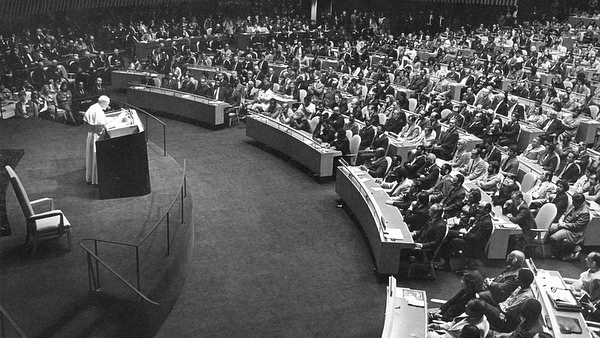
St. John Paul II's Address to the United Nations in 1979: A "Stunning Speech" Indeed

A black and white photo of St. John Paul II giving his address to the UN in 1979.
St. John Paul II during his address at the United Nations in 1979. Photo: Catholic News Service via Salt and Light Media

Recently I had finished reading George Weigel's book, Lessons in Hope: My Unexpected Life With St. John Paul II, where he described Saint John Paul II's address to the United Nations (UN) in 1979, as a "stunning speech." As with many of Weigel's writings on St. John Paul II, they lead to further readings from his many references, citations, extensive endnotes, and bibliographies. Being somewhat intrigued by that description, I had decided to add the speech to my blog-draft list. 

The speech is twelve pages printed and like so many of Saint John Paul II's writings, it contains a dense amount of
information that requires the reader's full and undivided attention. After having read it twice, I completely agree with Weigel's description: it is indeed a stunning speech!

At the core of Saint John Paul II's speech is the human person: the importance of each individual's dignity and inalienable rights, and how all threats to peace can ultimately be identified and measured by the manner in which States fail to safeguard and ensure man's freedom and ability to live his human dimension to the fullest.

The hour-long speech began with Saint John Paul II's gratitude to the general assembly and in particular to the Secretary-General of the United Nations Organization, Dr. Kurt Waldheim, for inviting him to address the thirty-fourth general assembly. Saint John Paul II then segued into the formal reason for his intervention: the special bond of cooperation that links the Apostolic See with the United Nations—indicated by the presence of the Holy See's Permanent Observer—one that is held in high esteem by the Holy See.

In addition to that bond, Saint John Paul II highlighted the Apostolic See's esteem for the United Nations as a "supreme forum for international life of humanity today," which received much attention in papal messages, encyclicals, in documents of the Catholic episcopate, and in the Second Vatican Council. 

Drawing upon his predecessors' (Popes John XXIII and Paul VI) "look of confidence" on the UN as a "promising sign of our times," Saint John Paul II reinforced that confidence and conviction, which as he stated did not stem from merely political reasons, but of the ...[R]eligious and moral character of the mission of the Roman Catholic Church." (4)

Moreover, Saint John Paul II pointed out the Catholic Church, as a universal community of faithful that exists in almost all countries and continents, "...[I]s deeply interested in the existence and activity of the Organization whose very name tells us that it unites and associates nations and States." (4) Elaborating further, he stated, "It seeks out the ways for understanding and peaceful collaboration, and endeavours with the means at its disposal and the methods in its power to exclude war, division, and mutual destruction within the great family of humanity today." (4)

This was the "real reason, the essential reason" for Saint John Paul II's presence at the UN that day in October 1979. 

The speech was not without scriptural passages. Referring to the occasion when Jesus was before the tribunal of the Roman judge Pilate, where He declared that the purpose of His existence in the world was to bear witness to the truth (John 18:37), Saint John Paul II made it clear that, as the Vicar of Christ, his mission was to do likewise.

Saint John Paul II expressed his gratitude once again and then congratulated the general assembly for the opportunity to speak that day, which as he stated, "...[S]hows that the United Nations Organization accepts and respects the religious and moral dimension of those human problems that the Church attends to, in view of the message of truth and love that it is her duty to bring to the world." (5)

By no means was the address limited to those in the UN General Assembly building. Saint John Paul II extended his greetings to all men and women living on the planet; a greeting that placed an important focus on the human person.

Highlighting the importance of the human person, Saint John Paul II emphasized that although members of the UN represent a particular State, system, and political structure, they represent above all "individual human beings," of which each one is endowed with dignity as a human person, with "...[H]is or her own culture, experiences and aspirations, tensions and sufferings, and legitimate expectations." (6)

Saint John Paul II reminded the representatives that political activity "comes from man, is exercised by man and is for man," and what justifies any political activity is service to man; one that has a responsibility and concern for the essential problems and duties of "...[H]is earthly existence in its social dimension and significance, on which also the good of each person depends." (6)

Several minutes (almost two pages worth) was dedicated to the UN's Universal Declaration of Human Rights, in which Saint John Paul II referred to it not only as a "fundamental document," but a "real milestone on the path of the moral progress of humanity." (7) Defining progress, he went on to state that, "The progress of humanity must be measured not only by the progress of science and technology, which shows man's uniqueness with regard to nature, but also and chiefly by the primacy given to spiritual values and by the progress of moral life." (7)

Acknowledging the importance of unity, Saint John Paul II highlighted how nations have understood that if they are not to go to war, they must unite and associate with each other. Moreover, he stressed that the "real and fundamental way" to achieve this was through "...[E]ach human being, through the definition and recognition of and respect for the inalienable rights of individuals and of the communities of peoples. (7)

Saint John Paul II also provided what has proven to be a prophetic warning; that is, if the truths and principles contained in the Universal Declaration of Human Rights were forgotten or ignored, the UN would be faced with the threat of a new destruction. Elaborating on how this new destruction would come about he stated:
This is what would happen if the simple yet powerful eloquence of the Universal Declaration of Human Rights were decisively subjugated by what is wrongly called political interest, but often really means no more than one-sided gain and advantage to the detriment of others, or a thirst for power regardless of the needs of others—everything which by its nature is opposed to the spirit of the Declaration. 'Political interest' understood in this sense, if you pardon me, ladies and gentlemen, dishonours the noble and difficult mission of your service for the good of your countries and of all humanity. (9)
"No more war, war never again!" Saint John Paul II spoke these words, citing from his predecessor, Pope Paul VI, who fourteen years earlier addressed the UN from the same podium. In 1979, there was great cause for concern of war breaking out throughout the world: it was only in 1978—through direct intervention from the Vatican that successfully mediated a solution to the Beagle Channel boundary dispute—that a war was averted between Argentina and Chile; not to mention the Middle East crises which not only persist to this day, but have increased.

Saint John Paul II's concern about the possibilities of wars breaking out was also merited by "troubling reports" of weaponry being developed beyond the size and means of war, and how such realities seriously endangered humanity by the threat of destruction.

Avoiding war requires energetic and continuous efforts to ensure that attitudes, convictions, intentions, and aspirations of governments are not geared toward the possibility of provoking war. Saint John Paul II reminded the UN that this is a duty for every society, regime, and government.

The Universal Declaration of Human Rights as Saint John Paul II pointed out, "...[S]truck a real blow against the many deep roots of war, since the spirit of war, in its basic primordial meaning, springs up and grows to maturity where the inalienable rights of man are violated." (11)

Examining the principle tensions that can weaken peace, Saint John Paul II made what is perhaps one of "the" most salient points in the speech, "Every analysis must necessarily start from the premise that—although each person lives in a particular concrete social historical context—every human being is endowed with a dignity that must never be lessened, impaired or destroyed but must instead be respected and safeguarded, if peace is really to be built up." (12)

As to the many inalienable rights Saint John Paul II enumerated some of the most important ones that are universally recognized:
...[T]he right to life, liberty and security of person; the right to food, clothing, housing, sufficient health care, rest and leisure; the right to freedom of expression, education and culture; the right to freedom of thought, conscience and religion, and the right to manifest one's religion either individually or in community, in public or in private; the right to choose a state of life, to found a family and to enjoy all conditions necessary for family life; the right to property and work, to adequate working conditions and a just wage; the right of assembly and association; the right to freedom of movement, to internal and external migration; the right to nationality and residence; the right to political participation and the right to participate in the free choice of the political system of the people to which one belongs. (13)
Moreover, Saint John Paul II pointed out that these human rights are, "...[I]n keeping with the substance of the dignity of the human being, understood in his entirety, not as reduced to one dimension only. These rights concern the satisfaction of man's essential needs, the exercise of his freedoms, and his relationship with others; but always and everywhere they concern man, they concern man's full human dimension. (13)

Saint John Paul II reminded the general assembly that man lives in the world with both material and spiritual values with the latter having a "pre-eminence": the values of the spirit define the proper sense of earthly material goods and the way to use them. When material and technical development, and the development of civilization as a whole are guided by the pre-eminence of spiritual values, they not only serve what constitutes man, but form the basis of a just peace. (14)

Having distinguished material and spiritual values, Saint John Paul II then proceeded with a critical analysis of our modern civilization, in which he not only highlighted how the world has experienced the development of material goods as has never seen before, but also pointed to the rise in attitudes of "insensitivity to the spiritual dimension of human existence." (15) In his analysis, Saint John Paul II identified two main systematic threats against human rights: the distribution of material goods, and the various forms of injustice in the field of the spirit.

The distribution of goods as Saint John Paul II pointed out, is "...[F]requently unjust both within individual societies and on the planet as a whole." (17) Nature's bounty allows man to possess and enjoy many goods but when the inequality of possession of material goods occurs (and in their enjoyment), it can result in injustice and social injury. (17)

Saint John Paul II then went on to describe how economic tensions between States and even entire continents, can contain "substantial elements" that can "restrict or violate human rights." Expanding on this point, he stated:
Such elements are the exploitation of labour and many other abuses that affect the dignity of the human person. It follows that the fundamental criterion for comparing social, economic and political systems is not, and cannot be, the criterion of hegemony and imperialism; it can be, and indeed it must be, the humanistic criterion, namely the measure in which each system is really capable of reducing, restraining and eliminating as far as possible the various forms of exploitation of man and of ensuring for him, through work, not only the just distribution of the indispensable material goods, but also a participation, in keeping with his dignity, in the whole process of production and in the social life that grows up around that process. Let us not forget that, although man depends on the resources of the material world for his life, he cannot be their slave, but he must be their master. The words of the book of Genesis, "Fill the earth and subdue it" (Gen 1 :28), are in a sense a primary and essential directive in the field of economy and of labour policy. (17)
Another aspect of this first systematic threat against human rights is the "frightful disparities" between the excessively rich and those who are extremely poor, even destitute. Saint John Paul II referred to this disparity as an "abyss" which is not only a grave symptom in the life of any society, but also separates countries and regions of the earth.

To remedy such disparities will require a unified and coordinated effort by all countries that must be based on what Saint John Paul II referred to as "an authentic perspective of peace":
Everything will depend on whether these differences and contrasts in the sphere of the "possession" of goods will be systematically reduced through truly effective means, on whether the belts of hunger, malnutrition, destitution, underdevelopment, disease and illiteracy will disappear from the economic map of the earth, and on whether peaceful cooperation will avoid imposing conditions of exploitation and economic or political dependence, which would only be a form of neocolonialism. (18)
With regard to the second, main systemic threat to human rights in the modern world—the various forms of injustice in the field of the spirit—Saint John Paul II focussed on how man can be wounded in his inner relationship with truth: in his conscience; in his most personal belief; his view of the world; in his religious faith; and in the sphere of civil liberties.

Fundamental to civil liberties is the equality of rights without discrimination—on the grounds of origin, race, religion, nationality, sex, and political convictions—which Saint John Paul II went on to define as, "...[T]he exclusion of the various forms of privilege for some and discrimination against others, whether they are people born in the same country or people from different backgrounds of history, nationality, race and ideology." (19) He also point out that despite the "thrust of civilization" giving life to political societies that safeguard the objective rights of the spirit—human conscience and creativity, and man's relationship with God—there are recurring threats and violations against these rights, often with, "...[No] possibility of appealing to a higher authority or of obtaining an effective remedy." (19)

Drawing attention to another problem with political systems that safeguard freedom of the spirit (freedom of thought, expression, conscience, and religious freedom) Saint John Paul II stressed that within those systems exist social structures that "condemns" man to become a second-class or third-class citizen, which can be identified by compromised advancement in the social and professional life, and in the inability of families to freely educate their children. Moreover, he stated, "It is a question of the highest importance that in internal social life, as well as in international life, all human beings in every nation and country should be able to enjoy effectively their full rights under any political regime or system." (19)

Religious freedom is absolutely essential to the cause of peace. Highlighting the importance of religious freedom, Saint John Paul II cited from the Second Vatican Council's Declaration, Dignitatis Humanae (on the right of the person and communities to social and civil freedoms in matters religious):
In accordance with their dignity, all human beings, because they are persons, that is, beings endowed with reason and free will and therefore bearing personal responsibility, are both impelled by their nature and bound by a moral obligation to seek the truth, especially religious truth. They are also bound to adhere to the truth once they come to know it and to direct their whole lives in accordance with its demands (Dignitatis Humanae, 2). (20)
The United Nations proclaimed 1979, to be the "Year of the Child." Saint John Paul II expressed his joy on the subject of children. He also reminded the delegates that a child's life begins at conception, "Concern for the child, even before birth, from the first moment of conception and then throughout the years of infancy and youth, is the primary and fundamental test of the relationship of one human being to another." (21) He went on to further state, "And so, what better wish can I express for every nation and the whole of mankind, and for all the children of the world than a better future in which respect for human rights will become a complete reality throughout the third millennium, which is drawing near." (21)

At the close of his address, Saint John Paul II expressed his hope for peace, justice, and freedom for all peoples of the world, and that the United Nations would continue to be, "...[A]n authentic seat of freedom of peoples and individuals in their longing for a better future. (23)

Attending the thirty-fourth general assembly must have been quite the experience for State representatives, the press, and others. George Weigel was one such individual—a "newbie columnist" on his first major assignment: Saint John Paul II's papal pilgrimage to the United States in October 1979. It was a speech that Weigel would come to analyze and write about twenty years later.

In Witness to Hope, the first of three seminal works on the life and papacy of Saint John Paul II, Weigel dedicated three and a half pages (chapter ten, The Ways of Freedom) to Saint John Paul II's 1979 UN address. Although it was written and published many years prior to Lessons in Hope, that information and in particular the concluding paragraph serves as another resource of just how stunning a speech it truly was:
The delegates to the General Assembly had listened to John Paul's address in silence. No one had wandered about the floor of the General Assembly, as often happened during normal business. However they construed its meaning, the representatives of the worlds of power knew that they had been listening to a force to be reckoned with. (350)
Saint John Paul II's speech is perhaps more relevant today than when it was first delivered in 1979. If one reads the Universal Declaration of Human Rights and compares it to the many UN resolutions passed and the initiatives undertaken over the past few decades it will not take much time or effort to conclude that the United Nations has significantly deviated from its origins. What was once an international forum that staunchly defended the human person, and each individual's dignity and inalienable rights has today become a battlefield for the social engineering of States—heavily influenced by non-governmental organizations (NGO) and lobbyists, funded by globalist billionaires—with agendas that bring about a moral disorder in society and a Culture of Death.

The details of what the United Nations has become today can be read at C-Fam: Center for Family and Human Rights.

Saint John Paul II's address is a treasure trove of clarity, knowledge, and understanding about the truth of the human person and how each individual's dignity and inalienable rights are inseparable from freedom and peace in the world.


Thursday, November 30, 2017

Saint John Paul II's Apostolic Letter Dies Domini on Keeping the Lord's Day Holy

Saint Pope John Paul II in Krakow, Poland, September 13, 1991
Saint John Paul II in Krakow, Poland, September 13, 1991. Photo: Grzegorz Gałązka via TotusTuus 2010 Calendar, Postulation of the Cause for the Beatification and Canonization of the Servant of God John Paul II.

Coming off a fresh reading of Dies Domini, Saint John Paul II's apostolic letter on keeping the Lord's Day holy, I thought if fitting to publish today's post on what I consider to be an essential reading for anyone seeking to understand the Lord's Day.

Released on May 31, 1998, on the Solemnity of Pentecost, Dies Domini, was written in part to support the pastoral efforts of bishops around the world, and for the laity as a continuation of St. John Paul II's "lively exchange" with the faithful, inviting the laity to rediscover the full meaning of Sunday with a new intensity in the changing circumstances of the times and the "new situations" that had arisen from them.

Spotlighting the changing socio-economic conditions and the profound modifications in social behaviour St. John Paul II stressed the need to distinguish between the special character of the Lord's Day from the more widespread "custom of the weekend."

Although St. John Paul II acknowledged that there are positive aspects of the weekend's cultural, political, and sporting activities, he encouraged the disciples of Christ to, "...[A]void any confusion between the celebration of Sunday, which should truly be a way of keeping the Lord's Day holy, and the 'weekend', understood as a time of simple rest and relaxation." (4)

Drawing from the First Letter of Peter (1 Pt 3:15), St. John Paul II noted that avoiding such confusion will require a "genuine spiritual maturity" allowing Christians to, "...'[B]e what they are' in full accordance with the gift of faith, always ready to give an account of the hope which is in them." (4)

Another new situation that St. John Paul II spotlighted was the strikingly low attendance at the Sunday liturgy, which he attributed to sociological pressures, weakened faith, and the lack of priests in both mission countries and countries evangelized long ago.

Recognizing that some young Churches have illustrated how fervently Sunday can be celebrated, St. John Paul II presented what he believed to be the main causes for decreasing Mass attendance on the Lord's Day, "In the minds of many of the faithful, not only the sense of the centrality of the Eucharist but even the sense of the duty to give thanks to the Lord and to pray to him with others in the community of the Church, seems to be diminishing." (5)

Given these situations and the questions they have prompted, it was St. John Paul II's belief that there was an ever increasing necessity to recover the deep doctrinal foundations underlying the Church's precepts, so that the, "...[A]biding value of Sunday in the Christian life will be clear to all the faithful." (6)

It is through Dies Domini that St. John Paul II sought to do just that, identifying and elaborating on the many aspects of the Lord's Day and the duty to keep Sunday holy: the importance to remember God's creative work for six days, that He rested on the seventh day, blessed it and made it holy; the sacred value to rest in the Lord; keeping the Lord's Day holy by means of prayer, works of charity, and abstention from work; the Sunday obligation to attend Mass as stipulated in the Code of Cannon Law; and how the Lord's Day is a day of joy and solidarity.

Amongst the many different aspects of Dies Domini, one that stood out in my mind was—perhaps one of the most salient aspects considering the increasing secular landscape of so many Christian countries—the fact that keeping the Lord's Day holy is a Commandment, the Third Commandment to be precise which can be found in the Catechism of the Catholic Church: "Remember the sabbath day, to keep it holy. Six days you shall labor, and do all your work; but the seventh day is a sabbath to the Lord your God; in it you shall not do any work."

Referring to the Third Commandment in the first chapter under the subheading, "God blessed the seventh day and made it holy" (Gn 2:3) , Saint John Paul II emphasized that the Lord's Day was so important for God's plan that it was included the Ten Commandments. Adding to this, he wrote the Lord's Day is a "...[D]efining and indelible expression of our relationship with God," and it is from this perspective that "...Christians need to rediscover the Sabbath precept today." (13)

Stressing how important that relationship is with God, Saint John Paul II wrote further in the same section, "...But man's relationship with God also demands times of explicit prayer, in which the relationship becomes an intense dialogue, involving every dimension of the person. 'The Lord's Day' is the day of this relationship par excellence when men and women raise their song to God and become the voice of all creation." (15)

It is worth mentioning that St. John Paul II dedicated the importance and sacredness of rest in sections 64-68 under the subheading, The Day of Rest. It is an especially important aspect for the Christian fulfillment to keep the Lord's Day holy. To get a sense of the richness of Dies Domini, here are a few excerpts from those respective sections:
...rest is something 'sacred', because it is man's way of withdrawing from the sometimes excessively demanding cycle of earthly tasks in order to renew his awareness that everything is the work of God. There is a risk that the prodigious power over creation which God gives to man can lead him to forget that God is the Creator upon whom everything depends. It is all the more urgent to recognize this dependence in our own time, when science and technology have so incredibly increased the power which man exercises through his work. (65)
In our own historical context there remains the obligation to ensure that everyone can enjoy the freedom, rest and relaxation which human dignity requires, together with the associated religious, family, cultural and interpersonal needs which are difficult to meet if there is no guarantee of at least one day of the week on which people can both rest and celebrate. (66)
Through Sunday rest, daily concerns and tasks can find their proper perspective: the material things about which we worry give way to spiritual values; in a moment of encounter and less pressured exchange, we see the true face of the people with whom we live. Even the beauties of nature — too often marred by the desire to exploit, which turns against man himself — can be rediscovered and enjoyed to the full.
Therefore, also in the particular circumstances of our own time, Christians will naturally strive to ensure that civil legislation respects their duty to keep Sunday holy. In any case, they are obliged in conscience to arrange their Sunday rest in a way which allows them to take part in the Eucharist, refraining from work and activities which are incompatible with the sanctification of the Lord's Day, with its characteristic joy and necessary rest for spirit and body. (67)
In order that rest may not degenerate into emptiness or boredom, it must offer spiritual enrichment, greater freedom, opportunities for contemplation and fraternal communion. Therefore, among the forms of culture and entertainment which society offers, the faithful should choose those which are most in keeping with a life lived in obedience to the precepts of the Gospel. (68)
During his inaugural homily in October 1978, Saint John Paul II encouraged the Church and the world, "Do not be afraid! Open, open wide the doors to Christ!" In Dies Domini, he renews that encouragement specifically with respect to the rediscovery of Sunday, "...Do not be afraid to give your time to Christ! Yes, let us open our time to Christ, that he may cast light upon it and give it direction." (7)

The rediscovery of the Lord's Day is a grace that one should pray for, which St. John Paul II specifically noted in the introduction:
The rediscovery of this day is a grace which we must implore, not only so that we may live the demands of faith to the full, but also so that we may respond concretely to the deepest human yearnings. Time given to Christ is never time lost, but is rather time gained, so that our relationships and indeed our whole life may become more profoundly human. (7)
This latest reading of Dies Domini proved to be just as intriguing when I first read it in May 2002. Given the growing secularism in Canada and so many other Christian countries around the world, this apostolic letter is even more relevant today.

May your reading of Dies Domini strengthen your resolve to "rest and remember" on the Lord's Day.


Sunday, July 23, 2017

Michael H. Brown's Book: Prayer of The Warrior

A photo of Michael H. Brown's book, "Prayer of The Warrior"
Michael H. Brown's book, Prayer of The Warrior

Recently I completed a fresh reading of Michael H. Brown's book, Prayer of The Warrior, spawned by his fairly recent talks at the Marian Day Retreat here in Toronto.

Originally read in early 2003, this latest rereading was not only a rediscovery of Brown's conversion and faith journey, but an opportunity to learn anew about certain aspects of spiritual warfare and how to become a better prayer-warrior.

A common thread that runs throughout the book—which Brown has dedicated the entire first chapter to—is the reality that we are in the midst of a spiritual war; one that requires prayer-warriors.

To aid those seeking to become prayer-warriors, Brown wrote several key chapters that are fundamental to understanding how to fight the good fight: chapter seventeen, The First Prayer of the Warrior, the prayer to the Holy Spirit; chapter twenty-four, Me and Hillary, the prayer of deliverance; chapter twenty-five, The Prayer for Spiritual Wisdom; chapter twenty-six, The Prayer of Fearlessness; and chapter thirty-five, The Prayers of Faith and Love, which also includes the powerful prayers of suffering.

In addition, Prayer of The Warrior, contains valuable information for those new to spiritual warfare: what is to be understood about spiritual warfare; Brown's actual encounters with the demonic; a historical account of the signs of the times; prophetic warnings and messages from the Marian apparitions of Akita, LaSalette, Fatima, and Medjugorje; how the "Rulers of Darkness" (demonic) have influenced many aspects of culture and society as a whole; how to fight the good fight against the Evil One and his demons through regular (daily if possible) Mass attendance, daily recitation of the Rosary, adoration in front of the Blessed Sacrament, regular confession (at least once a month), daily Bible reading, the use of sacramentals (holy water, salt and oil), the wearing of the Brown Scapular; how effective and beneficial it is to have within our homes blessed crucifixes, holy pictures, objects and relics; and regular "house blessings" by a priest.

Michael H. Brown is well known in Catholic circles and throughout the world for his talks, books, articles, blog posts, and his web site, Spirit Daily, where many of his contributions to informing, encouraging, and strengthening fellow Catholics in North America and throughout the world can be found. It is an important web site that provides resources on: the truth, knowledge, and understanding of the Catholic faith journey; current, real, and relevant news; information on the events and signs of our times; and resources on spiritual warfare, healing, and the afterlife.

The narrative of Brown's life is an inspiring example of one man's journey, coming "back home" to his Catholic roots, and how his acceptance and cooperation with the gift of faith transformed him into a prayer-warrior: putting faith into action and fighting the good fight in the spiritual war. It is the fulfillment of Saint Pope John Paul II's directive, from his post-synodal Apostolic Exhortation Christifideles Laici, "It is not permissible for anyone to remain idle." (3)

A Spiritual War

Brown instills in the reader at the very beginning of this book, that we are in the midst of a spiritual war.

It is a war that should concern us because the Evil One is rising as never before. So important is this subject matter that Brown dedicated the entire first chapter to it, aptly entitled, A Spiritual War. It sets the tone for the remainder of this book: the narrative of Brown's conversion; the many positive changes to his personal and professional life; the sharing of his gift of faith, and his knowledge and understanding of the spiritual war, including how to become a prayer-warrior.

Although, Prayer of the Warrior, was published in 1993, Brown provided many examples of the rising influence of the Evil One, and the negative impact upon culture and society as a whole, that today has increased in both intensity and scope.

Here in Canada, we need only look to the growing moral disorder for proof of this and the Culture of Death that it has ushered into mainstream society: abortion available on demand; euthanasia and assisted suicide deceptively packaged as part of palliative care; contraception; in-vitro fertilization; "fertility clinics"; and other threats to the value and inviolability of human life.

In the past couple of decades, we also have experienced the growing negative consequences of the global sexual revolution, including: gender mainstreaming; gender ideology; the LGBTQ agenda; the indoctrination of our children and youth, and the younger generations with sexual immorality in the education system; pornography and pornovision. 

Add to this the infiltration and acceptance of New Age and occult practices into mainstream society. Prime examples are yoga, tai-chi, and reiki, deceptively marketed as health and wellness; and a host of alternative therapies and medicine that are cleverly included within traditionally accepted medical practices. 

It is a growing list of evils that, no doubt mirrors what is happening in many other countries; all of which is drawing God's chastisements upon mankind. Brown spoke about this during two of his talks in Toronto: The Current Prophetic Pulse and Reclaiming North America's Christianity.

Adding to the concerns of God's chastisements, Brown referred to the Marian apparition of Akita, Japan, "At Akita, which has been formally approved in a pastoral letter from the bishop, Mary has warned that if it does not better itself shortly mankind will face a 'great chastisement' that will 'wipe out a great part of humanity.' " (3)

Apparition Hill (Brdo Ukazanja) in Medjugorje, Herzegovina, where Our Lady first appeared to the seers.

Brown also cited from the Marian apparitions in Medjugorje—which continue to this day—where Our Lady has given ten secrets to six visionaries, part of which are warnings of coming chastisements upon the world. It is not a matter of if, but when the chastisements will come: the chastisements are to occur within the life time of the visionaries.

Given the fact that the Medjugorje seers are in their 50s, we should expect major events to occur within twenty-to-thirty years, perhaps forty years from now at the most, which Brown depicted as, "...[A]n exceedingly dangerous time. Satan is pulling all stops. While I don't believe for a minute that we're facing the end of civilization, I do believe that, during the next several decades, we'll see truly major and perhaps unprecedented economic, military, sociological, theological, spiritual, and natural upheavals—if not sooner." (6)

It is Brown's contention that, on a lesser scale, the chastisements have already begun. He goes on to elaborate that we are already under a demonic assault that affects us personally, as seen by the division and confusion we experience; to which Brown highlighted the important point that, "Confusion is his [Evil One's] hallmark." (9) Brown added that the spiritual chastisement is "fully in progress," and may soon be followed by chastisements in the physical realm.

Prayer of the Warrior, is an invitation to each reader to take a personal journey and discover in the process his/her own own fears, struggles, difficulties, and the many challenges to be faced on this earthly pilgrimage. 

Each reader that accepts that invitation will be greatly aided by Brown's personal insights and the sharing of the events, occurrences and people in his life, viewed through the eyes of faith, not as a collection of meaningless coincidences, but part of God's plan for his journey. Brown's life is a quintessential example of Saint Pope John Paul II's quote, "In the designs of Providence, there are no mere coincidences."

Here is how Brown explained the relevance and benefit of this book for each reader:
This is what I want to focus upon: Our own state of spirituality and the personal trials we face as the battle heats up and possible chastisements loom. In God's army we'll win, but we have to know how to be prayer warriors, how to view the events around us, and how to purify ourselves. I want to take you on a more personal journey, I want to discuss you, your temptations, your fears, your difficulties, your struggles against dark forces as I share with you some of my own. This is a more personal book. It will offer a more personal look at certain saints and Church-approved visionaries, along with their insights into the world. It will offer glimpses of the afterlife. It will offer suggestions for spiritual protection. It is an account of both the good and evil I have witnessed as a journalist. (9)
As a further encouragement to accept the invitation, Brown stressed that no one should in any way feel depressed or fearful about the spiritual war. Rather, each individual should respond to it with action, a desire for purification, and an excitement to face the challenges ahead, enlisting in the "army of the living God," in the process. (10)

Brown's Conversion

Brown's conversion began one night with a powerful dream of Saint Michael and other angels coming to his aid against the Evil One, who was literally at the front door of his apartment. 

The dream led Brown to question its meaning for his life and so began his spiritual journey back to God, back to his Catholic roots. Soon thereafter he became a daily communicant where the Mass provided him with "relief, refreshment, and strength."

It also began an awareness of the spiritual war. As his new life began to unfold, that awareness increased and so did incidences and encounters with the demonic.

Brown's new journey also prompted a life review: an opportunity to reflect upon the personal mistakes in his life and his spiritual negligence, which led him to question some of the occurrences in his life and how they were related to the supernatural.


Our Lady of Good Counsel, Brown's local
church during the early days of his
conversion. Photo: The New York
City Chapter of the American Guild of
Organists /Our Lady of Good Counsel
Chapter five, The Bells of Good Counsel, begins with what proved to be a standard fixture throughout this book, a prayer for the reader. This particular prayer highlights how Brown wants the reader to truly benefit from this book and be protected from the knowledge gained about spiritual warfare. Here is that prayer, "Lord Jesus, cleanse us of all evil. Wash us of all spiritual grit. Let us all learn from my experiences, and from our own experiences. Let us review certain aspects of evil but without becoming enticed or obsessed by them. Let this be for all an experience of the Holy Spirit and of His sure deliverance." (26)

Brown recounted how some of his experiences, such as the encounters with New Agers he described in chapter four, The House in Chelsea, and the short time he spent with a mafia hitman researching a story, detailed in chapter three, A Brush With the Mafia, made him realize that he was "Not lucky, but blessed," to have walked away unscathed.

I recall from my original reading how I took note of Brown's specific wording, that it was not a matter of luck, but the opposite, God's blessings of protection over his life. Sadly today, many people use the words, "luck" and "blessing," interchangeably when in fact they have very different meanings. To consider oneself lucky is a departure from faith in God—who is the true source of all goodness in one's life—and attributes and places value in something other than God to explain a postive occurrence, development, or event in one's life, which many times is a form of superstition.

Brown's faith was nourished by his daily attendance at a local church, Our Lady of Good Counsel, only half a block away from his apartment at 230 East 90th Street. It proved to be a place of refuge; just part of many gifts Brown received from God during the early days of his conversion. Here is how Brown described this gift:
To me it wasn't just a church but a fort and refuge. I would hear the bells at noon and rush out my door down the elevator and past the doorman for Mass. Most of the time there were just a handful of us, and I was the only one under the age of sixty, sitting there amid the sweet white-haired women with fraying sweaters and Irish brogues. Usually, I sat in the right wing, near the statue of a saint who became very important to me, Saint Joseph.
As I said, it was a fort, and that's just what I needed. I was under attack. For whatever reason—or reasons, plural—the devil was openly showing himself. He was on the attack, and God was granting me the grace to see it and do something about it. (28) 
Brown attributed a lot of his spiritual problems to the evil he exposed as a journalist. In particular his writing on the toxic waste that was dumped throughout America, on land and in water systems. He shared some of those details including how many corporations were not pleased with him, and in some cases it resulted in heated exchanges with executives. One executive even went so far as to hire the nation's leading libel attorney, Louis Nizer, in an attempt to stop the publication of Brown's book, Laying Waste: The Poisoning of America by Toxic Chemicals.

Part of Brown's spiritual problems also stemmed from the fact that he had a temporary fascination with the New Age. He notes in chapter three, A Brush With the Mafia, how he stopped being a practicing Catholic during high school and even more so when he went to Fordham University.

Elaborating a little further, Brown described how secular he had become that during his university days religion was not apart of his vocabulary, and he never dated any "religious orientated" women. Add to this his side interest in extrasensory perception (ESP) and articles he wrote about thermal noise and nuclear random-event generators, and it is not difficult to ascertain why the demonic was drawn to him.

Brown reviewed the secular time of his life, during and after university, and came to the conclusion that he was under demonic attack and didn't even know it. Here is how he described it:
No doubt. Without knowing it, I had been under spiritual attack. Michael [St. Michael the Archangel] must have been watching out for me all along. Michael was my patron, he was the archangel who threw Satan out of Heaven, and he was showing me that, along with everything else, my unhealthy interest in parapsychology, which we now call 'New Age,' as well as my battles with chemical companies and my brushes with the mob types, without adequate spiritual armor, had brought the devil to my doorstep. (30)
Brown's gift of faith and the new awareness of the spiritual war he was in, brought with it greater torment, anxiety, loneliness, and the temptation to distance himself from Jesus. The closer he drew to God, the more he was attacked. This did not deter him from moving forward in his faith journey, which he was able to do with the recitation of the Rosary; an essential weapon for the daily spiritual battle. Brown shared how important the Rosary was in fighting off the attacks, "When I was under attack, the attack would immediately dissipate—the gritty tension would flee—after the recitation of the Rosary. (31)

Brown's recounting of the effectiveness of the Rosary in repelling the attacks of the demonic is an important lesson for all of us. This holds true especially for those Catholics who have considerably waned in their faith: those who don't pray the Rosary, don't attend Mass, don't read the Bible and books on the lives of the saints, don't read and pray with spiritual meditations (Divine Intimacy or My Daily Bread), and think that they are "okay" because of financial wealth, social status or some other mistakenly perceived security. This means nothing to the demonic: they attack regardless of how much money you have; what you do for a living; who you associate with; and irrespective of any other aspect of your life.

In addition to the Rosary, Brown also mentioned how important it was for him to invoke St. Michael and other angels, to praise Jesus, and to read Scripture, which typically ended the demonic attacks. Here is what he wrote, "No matter how fiercely I was being assaulted, I could lie down, and if I spent enough time with the Rosary or reading Scripture, the demonic attack would lift and anxiety would be replaced with peace, comfort and warmth." (32)

Brown was becoming a prayer-warrior! Prayer permeated his entire day, "I started praying throughout the day, whenever I wasn't at the computer writing or on the phone. I prayed taking a shower and in the kitchenette and in the elevator. I prayed up and down Third Avenue." (32)

The First Prayer of the Warrior, Prayer to the Holy Spirit

Come Holy Spirit, is the first prayer of the prayer-warrior which Brown dedicated an entire chapter to, The First Prayer of the Warrior. It is an especially important prayer for our spiritual life as the Holy Spirit addresses all of our needs: discernment, health, enlightenment, guidance, protection, and teaches us how to pray. Brown elaborated on the importance:
I found out quickly that the Holy Spirit is a better instructor than any book or preacher. 'Pray to the Holy Spirit for enlightenment.' He will lead us to where we should go for information and will help us choose the books to read. Passages from the Bible become more vivid and meaningful when they are read with His help. 'Come Holy Spirit.' (111)
Brown went on to further point out that, prayer that begins with an invocation to the Holy Spirit, is much better and beneficial because as he notes, "When the Holy Spirit comes, everything changes around us." (111) 

Prayer to the Holy Spirit is praying for the spirit of truth! With the Holy Spirit we are less likely to be deceived and we are released from errors and bondages. As Brown notes, "It is the Holy Spirit who illuminates and lifts our blindness." (111) This is important to protect us against attacks of the demonic, who attempt to deceive us masqueraded as "holy spirits."

Brown further stated that with our spiritual blindness "cured," we can better perceive the spiritual world around us with an enhanced sensitivity. This ables us to, "...[D]ifferentiate angels from deceiving spirits—this is crucial, for the number of deceiving spirits seems virtually countless." (111)

When we do call upon the Holy Spirit, we should so with complete spontaneity; a truly heartfelt invocation for help and protection, one that "pierces through the clouds." Further elaborating on this Brown wrote, "God likes us to speak to Him as we speak to friends and neighbors. Come Holy Spirit. It is the prayer of guidance and the prayer of protection. The Holy Spirit can break through any darkness, and He provides answers we could never think up ourselves." (110)

Our Lady in Medjugorje has stated on numerous occasions how important it is to pray to the Holy Spirit. Brown referred to one of Her messages from May 23, 1985, "Open your hearts to the Holy Spirit. Especially during these days the Holy Spirit is working through you. Open your hearts and surrender your life to Jesus." (111)

Prayer is essential in spiritual warfare and those who intend to fight the good fight should begin their day with the prayer to the Holy Spirit, Come Holy Spirit. Brown emphasized the importance of this, "The weapons and shields, the equipment of battle, all lay in prayer, and prayer to the Holy Spirit is the first prayer of the prayer-warrior." (113)

The Second Prayer of the Warrior, the Prayer of Deliverance

The second prayer of the prayer-warrior is the prayer of deliverance, to which Brown dedicated another chapter, Me an Hillary.

Brown began this chapter by providing a prayer of deliverance that invokes the Holy Spirit to send the Archangel Michael, Saint Francis of Assisi, the dragonslayer Saint George and a battalion of angels. It implores the Holy Spirit to break all demonic bondages and purge us from them, as well as to free us from oppression, depression, discouragement, and every mental torment.

Deliverance prayers are important to expel demons, but it is also important to know how and why they come to us. Citing an example from the life of Saint Francis of Assisi, Brown illustrated how demons entered into a church through the sinful thoughts of a friar:
...Francis of Assisi, who had a vision one day in which he saw his favorite place of prayer, the chapel of Portiuncula, besieged by devils--a great army. He watched them hovering about the chapel but noticed that they were not able to enter. They couldn't because the friars praying inside were so holy. However, soon one of the friars was stirred to anger with a second friar and began thinking vengeful thoughts. As Saint Francis watched, the protective grace around the chapel was breached, the grace was lifted, the gate of virtue abandoned, and the door of wickedness allow the devils in. They left only after the friar acknowledged his faults and humbly asked for forgiveness, which once again points up the importance of Confession and its power of deliverance. (155)
Elaborating somewhat on the example of the friars, Brown pointed out that this is exactly how demons—the unseen enemies—negatively affect us through bad temper, a lack of forgiveness, or envy.

To further highlight how sin draws demons to us, Brown asks the reader, "Want a demon to latch and sting? Try lying, cheating, stealing, or sexual immorality." (155)

Demons can perch on to us and, in some cases, it is difficult to expel them without a complete internal cleansing and prayers to the Holy Spirit. Brown included how this can also affect an entire nation due to its collective immorality, citing the example of his own country, the United States of America. 

This shouldn't discourage or depress us in any way because as Brown pointed out, there is an opportunity to rid America of demonic influence through prayer. This applies to any country: the opportunity to mitigate the punishments from God for the evils that so many in society have accepted and been deceived by, comes in the form of prayer! 

Such an "antidote" to the many evils in society comes to us through prophetic warnings and hope from Our Lady in LaSalette, Fatima, and Medjugorje.

The Prayer for Spiritual Wisdom

Brown begins chapter twenty-five, The Prayer for Spiritual Wisdom, with a brief continuation of how his professional life changed after his conversion, highlighting in the process the need to pray for spiritual wisdom. 

Brown was a noticeably changed man, so much so, that contacts in the secular media along with those in the publishing field began to take note. Brown was very cognizant of the change in his professional relationships, especially with those who were atheists and New Agers—who Brown no longer tolerated—as he put it, "Our spirits clashed."

The sharing of these changes in his professional life highlighted an important point about the battle of good versus evil; that is, it is not limited to a societal level, but also waged on a personal level. Elaborating on this Brown stated:
...Demons and angels fight over every person and family. That is essentially the condition on earth. At each turn in life, every hour, often every walking minute, we are given two different paths of thought and action, good or evil, and when we make the wrong choice—which is usually the easiest or most immediately pleasurable choice—we attract forces of darkness. (163)
It is important to note that not all that happens to us should be attributed to the demonic; sometimes it is simply a matter of life: a sickness due to biology; stress due to fatigue; and general mishaps and accidents. (163) 

At the same time, we must not think of demonic influence upon us as some sort of general, abstract idea: these unseen enemies do attempt to influence us!

To help us distinguish between regular life occurrences and realities brought on from demonic influence, Brown includes a prayer for wisdom. The prayer implores Jesus: to bind the demonic that come against us; to open our spiritual eyes; to understand what should be understood; for wisdom; and to carry forth with our Christian duty without undue curiousity. It is an ideal prayer to recite daily!

The danger of a lack of spiritual wisdom is an increase in sin and demonic bondage. As Brown notes, the demonic try to "cling" to us; we are in a constant battle with them. He goes on to state, "They watch us just as guardian angels watch us—but always looking for an opportunity to tempt us and find another pathway inside." (165)

If you are wondering just how the demonic try to cling to us, Brown listed a few examples: drugs, alcoholism, jealousy and anger, illicit sex, unhealthy literature, bad habits, and the wrong movies.

Most people, as Brown pointed out, have no idea that their lives and mood swings are influenced by the demonic, who can cause: fear, doubt, lust, addiction and other compulsions, and especially pride.

Brown also pointed out that forgiveness is a most powerful tool of deliverance, "...[W]e must let go of past slights, rejections, or insults before we attain full spiritual freedom." (166)

Perhaps one of the most salient points that we need to remember about deliverance is that almost everyone needs some form of deliverance! Deliverance is not necessarily a dramatic, combative event with the demonic, but rather, a quiet, soft, and quick occurrence that is accomplished through the Sacrament of the Eucharist (Mass) and the Sacrament of Reconciliation (Confession). He highlighted the importance of confession by stating:
Confession is a key to deliverance. When we confess our sins we are acknowledging the evil we have invited into our lives, and we are renouncing that evil. Renunciation of evils does a simple and yet extraordinarily powerful thing: it breaks our bondage to the evil. Confession and prayers of purification, in which we specifically pray to break each bondage brought into our lives through sin, open the clear path to full joy and deliverance. (167)
The rest of chapter twenty-five, Brown dedicated to explaining the different levels of demons and how they attach to and influence: entire territories, such as cities and countries, as well as to specific neighbourhoods, homes, and even rooms where "poignant sin" has occurred; objects, occult books or jewelry; and to each individual.

What I found particularly noteworthy was the mention of how demonic bondage can occur through obsession over money, emotional hurts, relationships, sexual tendencies, work, superstition, and people in general.

Brown also mentions a list of occult practices that we should avoid, as they open the door to demons: mediums, ouija board, pendulums, tarot cards, clairvoyance, and channeling. The result of such demonic influence is: deception, oppression, depression, obsession, and the ultimate goal of possession.

The Prayer of Fearlessness

Being a prayer-warrior entails that one be fearless in fighting the good fight.

Brown elaborated as to why this is, but first premised that explanation by reminding us that we are already victorious in Christ because He defeated Satan 2000 years ago; what remains is for us to reclaim that victory.

Quoting the Bible, Brown referred to the scripture passage in Luke 10:18-19, highlighting in the process how we have also been given the power to expel demons from our midst, which he spoke about and included in his talk in Toronto, Spiritual Warfare and Family Healing. 

A key sign of fear is anxiety and Brown warns the reader that if there is any anxiety, "...[T]hat means the devil has a piece of us and is feeding off that nervous energy." (172) He continues to warn that if we fear the devil, we give him power because fearing him is fearing his nefarious power.

Also important is to not become obsessed with the Evil One and his demons because like fear, obsession can lead to serving their power. To help readers avoid becoming obsessed, Brown included prayers to Jesus and the Blessed Virgin Mary.

The prayer to Jesus asks that: our path in life, including our families, leads to the correct path of deliverance; that we be given the right prayer companions and ministers; that we receive the information we need to have; and the gift of powerful prayer.

The prayer is to the Blessed Virgin Mary is a plea for her intercession: that we not give undue attention to the demonic; that we learn what we need to learn about evil and move on with our focus always on Jesus; and for the gift to see our own pride so as to not serve the "Prince of Pride."

Then there is a third prayer, one recited from Brown's heart, for the need to focus on the glory and truth of Jesus.

Brown adds to all this with his recommendation that, "Before we advance forward we must first pray to the Holy Spirit for total freedom from any fears or obsessions." (172)

The importance of being fearless also extends to the Evil One's human instruments; that is, those who are New Agers, involved in the occult, and any practitioners of black magic.

As to why that is, Brown explained that when we are in a state of grace and grow closer to God, we wear what he described as, "...[T]he breastplate of righteousness, the shield of faith, and the helmet of salvation." (172) Any attempts by the demonic to fire their "darts" at us fall to the ground. As to what Brown meant by "darts," he stated the following:
The enemy's darts? We encounter them every day. You know how it is: Everything will be going well, and your mind will be happy and at peace, when suddenly an anxious thought will come flying into your head from nowhere.
Or the actions and words of someone will sting you, burn you, create aggravation or apprehension.
That's what demons are constantly poised to do: disrupt you and especially take away your peace and equilibrium.
Or tempt you. They will lead you away from discipline. They will make you too antsy or too busy to pray or to read the Bible. They'll lead you back to bad habits, or to unclean thoughts, or to confusion and doubt. Confusion and lust especially. Lust and arrogance, which really opens us to snares. (173)
It is important to be armed against the demonic and recognize their wiles and deceptions, otherwise they, "...[C]an often fester within us and cause us to sin or lead us into discouragement." (173)

Spiritual warfare is a lifelong struggle, a daily challenge that can be defeated with: faith, humility, self-discipline, Bible reading, and prayer.

Brown concludes the chapter with a short list of questions that is sure to go to the core of every individual's conscience, helping each one of us to root out pride and vanity, "Are we mired in pride? Do we think we are smarter or more spiritual than others? Do we judge? Are our egos easily riled? Are we concerned about status? Do we gauge a person's worth on a material or reputational basis? Are we jealous?" (175)

If "yes" is the answer to any of these questions, then we must pray to free ourselves from such pride. Brown goes on to state that, "...[A] person free of pride, or at least of most pride, is the toughest prayer-warrior." (175)

The added benefit of having no or very little pride is that we are not easily deceived because we are, "...[A]fforded special armor—special fearlessness—against the gathering enemy." (175)

The Prayers of Suffering, Faith, and Love

Brown dedicates an entire chapter to the prayers of faith, love, and suffering, chapter thirty-five, The Prayers of Faith and Love.

Brown begins the chapter by stating that the most powerful prayers are those of faith, love, and suffering; powerful against the Evil One and his demons, and powerful to appease God's chastisements for all the evil we have allowed and participated in. Here is how Brown explained it:
Most powerful are the prayers of faith, love, and suffering. The devil always flees when rebuked by those soft of heart. He flees from humbleness. He flees especially from the powerful prayers of the suffering. He flees from the prayers of those in wheelchairs, or those battling cancer. He flees from those who offer up their depression or mourning. He flees from those who offer up their suffering asking nothing in return. God lessens chastisement when we suffer for purification, just as He responded when the residents of Nineveh donned sackcloth. As one mystical revelation said, 'A faithful soul is more powerful than Hell, but a crucified soul is more powerful than a thousand hells.' (228)
These types of prayers are beneficial to us on a personal level, as Brown noted, "It is through those battles, those times of pain and loneliness, those times of suffering, and fasting, that we are strengthened and draw nearer to Him." (229)

Brown also emphasized that those who suffer and fast serve as "our best prayer-warriors," and lessen their own time in Purgatory. He goes on to explain the different levels of Purgatory and the respective suffering at each level.

Fasting is a fundamental weapon in spiritual warfare, just one of five "Little Stones" that Our Lady in Medjugorje has given to us. Brown elaborated on the importance of fasting:
Fasting helps us approach Heaven and ward off evil attacks. There are few things which are more powerful against Satan. It is no coincidence that Jesus fasted for forty days before publicly entering the spiritual combat. With fasting we are made stronger and purified. It breaks demonic bondages and sets us free from past dabblings in the occult, wrongful sexual dalliances, and other transgressions. (230)
Brown also reminds the reader that we should also pray for other souls already in Purgatory, especially for those who have no one to pray for them. He further highlighted the importance and need to pray for the souls in Purgatory by quoting Our Lady in Medjugorje, who told the visionaries on July 21, 1982:
There are many souls in Purgatory. There are also persons who have been consecrated to God—some priests, some religious. Pray for their intentions, at least the Lord's Prayer, the Hail Mary, and Glory Be, seven times each, and the Creed. I recommend it to you. There is a large number of souls who have been in Purgatory for a long time because no one prays for them. (230)
Prayers of faith are those that "...[S]oundly defeat the harassing presence of demons." (231) Having faith translates into having no fear of the devil and his demons, for to fear them is to inadvertently express faith in their power, which is not comparable to that of God's! 

That is not to say that the Evil One won't try to intimidate you, as he did with Brown, whose experienced a fire in his house that resulted in the loss of his clothes, computer, holy pictures, tape recorders and just about everything he owned. Brown's learned to laugh at this harassment, which in addition to despising and ridiculing the Evil One, makes him flee.

The fire incident proved to be an opportunity for Brown to put his faith into action through his recitation of the Rosary and adoration in front of the Blessed Sacrament. It was time well spent because all that Brown lost in the fire, he got back and more than before. It illustrated what Brown further reiterated with regard to the importance of having faith in God:
When we have faith in God we rise above the storm clouds, we transcend the maelstrom, instead of looking up at the clouds and listening fretfully to the echoes of thunder, with our feet mired in the mud. When we have faith, the proper level of faith, the faith that maintains itself beyond little disappointments, beyond the trials that seek to rob us of that faith, we become one with the power of Eternity. (232)
Faith in God does require vigilance! Brown provided an example of the need to be faithful and vigilant, drawing from his own personal experience while in Italy, on his way to spend time at Monte San Angelo and San Giovanni Rotundo.

The time in Italy was part of his research for his book, The Final Hour, in which he required the use of a Xerox machine for the purpose of photocopying his notebook. It was a necessary precaution against the possibility of it being confiscated in Croatia, his next planned location, which at that time was under attack by the Serbs. His budget only allowed him to spend $25/day for a room, so he prayed earnestly with faith that God would provide. 

It just so happened that as he suspected, when he arrived in San Giovanni Rotundo, there was no occupancy available. He considered the possibility that he might have to sleep in his car that night. Brown kept on praying.

He searched each hotel, but to no avail. When he got to the last one, he was met by the night clerk who informed Brown that he was not going back to sleep, so he could have his room for a discounted price of $25; God provides for those who pray with faith and are vigilant!

Prayers of love is what Brown referred to as the "final prayer of the warrior." You have heard the expression, "love conquers all," well it applies to spiritual warfare as well. Here is what Brown wrote about it:
That is the final prayer of the warrior: love. There is nothing more powerful. Love has dominance over every evil and hatred. We love when we work at longsuffering, patience, tolerance, kindness, humility, and forgiveness. Humility is the bridge to Heaven and love is the wood. We win the war when we work at loving every single person we see in the course of the day, every friend, every stranger, no matter how much they irritate us. We win when we avoid pride, envy and jealousy, which are subtle forms of hatred. (234)
Brown recommends that to win with faith, we need to consecrate ourselves to the Immaculate Heart of Mary and the Sacred Heart of Jesus, which he provided the prayers to do just that.

Praying with love is something we should pray for—certainly include as an intention in our daily Rosary—and thank God for the gift of His love. For Catholics, the best way to do this is at Mass.

Love is especially important for our eternal salvation as Brown noted in the last paragraph of the book:
And we must love. For Heaven is love. God is love. The light visionaries see upon entrance to Heaven is the light of love, and whether we are allowed into that light, at the moment of judgement, will depend, more than anything, more than any ritual or prayers, more even than suffering, on how often and much we have loved our fellow humans and most importantly how much we have loved and fought for the Eternal God. (236)
If you have made it to the end of this blog post, perhaps you will take reading about, Prayer of The Warrior, one step further and purchase your own copy. You won't regret it if you do.

Reading this book is "food for the soul" and serves as an ideal reading for those newly converted to the Catholic faith.

It also will greatly benefit those Catholics who have neglected their faith with very little, if any, spiritual readings, and desire to be brought "up to speed" on spiritual warfare.