Although it does not compare with meditations such as the Imitation of Christ, Divine Intimacy or My Daily Bread, Lives of The Brethren, proved to be more than just a read; it helped to quiet down all the "noise" of the day, and ushered me into the spirit of prayer.
The process of gathering the information for what we now know to be the, Lives of The Brethren, began in 1256 in Paris during the ordination of the General Chapter of the Friars Preachers, during which it was requested, " 'Let every Prior who has heard or known of any miracle or edifying occurrence happening in the Order, or concerning it, write diligently to the Master so that the memory of it may be preserved.' " (9) In response to this, many brethren sent their individual contributions, the bulk of which was gathered and compiled, verified, corrected, and ready for publication within four years. It is generally accepted that the book was written somewhere between 1256 and 1259, in Limoges, France.
The book, available for reading in portable document format (pdf), was translated by the Very Rev. F. Placid Conway, O.P., and edited with notes and introduction by Bede Jarrett, O.P. It was published in 1955 in London, England, by Blackfriars Publications. Written in a straight forward and simple manner—many times requiring reference to a dictionary for English words seldom used anymore, at least on this side of the pond—reading it proved to take longer than anticipated.
Throughout I could not help but marvel at God's love, mercy, and forgiveness revealed in the many blessings and gifts bestowed upon the brethren. Add to this the motherly affection of the Blessed Virgin Mary for the brethren, her powerful intercessory role in their lives, and her protection from the Evil One and his demons; reading this document was truly a faith strengthening and peaceful time that never lost its intrigue.
Lives of The Brethren is segmented into six parts: Part I The Foundation of The Order of Preachers; Parts II and III The Legend of St. Dominic; Part IV The Legend of Blessed Jordan of Saxony; Part V Progress of The Order; and Part VI Departure of The Brethren From Out This World.
To do justice to Lives of The Brethren, and the wonderful gift of the Dominicans to the Church, would entail at the very minimum, a summary of all six parts; something that I am prayerfully considering, especially to honour Blessed Jordan of Saxony. As for today's post, and for the sake of brevity, I decided to focus on the Part I The Foundation of the Order of Preachers, and selected chapters from Parts II and III, The Legend of St. Dominic.
I also quoted a substantial amount of the original text, when it was abundantly clear that any attempt to have summarized the same text, just wouldn't have sufficed.
The Foundation of The Order of Preachers
In Part I The Foundation of The Order of Preachers, Chapter I The Order Was The Fruit of The Blessed Virgin Mary's Prayers, attributes the Order's beginnings to the intercession of the Blessed Virgin Mary.
It states in the very beginning that from a clear and careful reading of holy scripture, the Blessed Virgin Mary is a compassionate advocate and powerful helper of mankind. It goes on to state that, "By her prayers the fire of God's wrath kindled against sinners is tempered lest they perish, and countless blessings are showered down upon the world...One of the examples of this is the fact, revealed to many of God's servants, that this great Order was raised up by Almighty God's mercy for the salvation of souls, through her all prevailing intercession." (18)
Our Lady's intercession for the establishment of the Order of Preachers was revealed through a monk, who for three days and nights was wrapped up in ecstasy. Some years later, when the Dominicans had been well established, and were tasked to go about preaching, two brothers arrived at this monk's location. Not having ever seen their habit before, he enquired as to their name and manner of life. Realizing that the Dominicans were the Order, he stated the following:
'I feel, brethren, that the hour is come for me to reveal the secrets which the Lord was pleased in his goodness to unfold to me and about which I have hitherto been silent, for I now see that they have come to pass. During the time that I was caught up in rapture I saw our Lady, Mary the Mother of God, during those three days and nights, upon bended knees and with clasped hands, pleading with her Son on behalf of mankind, and beseeching him to forbear yet a while that the world might repent. But although during all that time he spoke never a word, at length upon the third day he yielded and made answer: "My own Mother, what can I, or what ought I to do further for the race of men? I sent them patriarchs for their salvation, and for a brief space of time they gave ear unto them; I sent them prophets, and for a while they did penance. After that I myself went unto them, and I gave them apostles, but me they crucified and them they killed. I have since sent them martyrs, confessors, and doctors, and many more, yet despite their toil the world has not amended; nevertheless, at thy prayer -- for it is not beseeming that I deny thee aught -- I will send unto them preachers and men of truth, through whom the world shall be enlightened and reclaimed. If it so prove, it is well; but if not, there remains no further remedy, but I will myself come in judgement and be avenged upon them."' (19)
Mary's intercession for the creation of the Order, is also well documented in the shared vision that both St. Dominic and St. Francis of Assisi had, of Jesus who was going to send a punishment to mankind, but stopped at the pleading of the Blessed Virgin Mary. In that vision, both saints saw Our Lady pleading with Jesus to be merciful, and accept her plan which included two of her faithful servants, St. Dominic and St. Francis, whom she presented to Jesus. Upon seeing both men, Jesus accepted Our Lady's plan. This was revealed to the Dominicans by a friar-minor, who had long been the companion of Saint Francis. Here is the account of the shared vision:
A friar-minor, who had long been the companion of St Francis, told some of our brethren -- one of whom in turn related it to Brother Jordan, then Master of the Order that when St Dominic our Father was in Rome, during the sitting of the Lateran Council, pressing his suit before God and the Pope for the confirmation of his Order, as he was praying one night -- according to his custom -- in the church, he beheld our Lord Jesus Christ standing by his throne in midair, and holding three lances which he was about to hurl against the earth. At the same moment the Virgin Mother, falling on her knees, besought him to have mercy on those whom he had redeemed, and to temper his justice with mercy. 'Seest thou not what countless wrongs they continue to heap upon me?' said he. 'Right willingly would I have mercy, but my justice will not allow evil to go unpunished.' Thereupon the Queen Mother again addressed him: 'My Son, I know, as dost thou, who knowest all things, how thou canst restore mankind to thy favour. I have by me one trusty liegeman whom thou shalt send into the world to make known thy word, and thenceforth it will forsake and bewail its evil ways, and follow thee, its Saviour. To him as fellow labourer shall I give another of my servants to toil in even way.' Upon this her Son answered; 'Behold, now I am appeased and I accept thy plan; yet show me the man thou hast chosen.' Then the glorious Virgin, taking St Dominic by the hand, led him to our Lord Jesus Christ, who, with an approving smile, replied: 'Right well and manfully shall he carry out what thou hast said.' She then brought forward St Francis, whom our Lord praised evenly. The blessed Dominic earnestly scanned the features of his companion while the vision lasted; on the morrow recognising him in the blessed Francis, although hitherto a stranger to him, he ran up and tenderly embraced him with a kiss, saying: 'You are my comrade, let us stand together, and no foe shall prevail against us.' After this he told his vision, and from that hour they became but one heart and one soul in God, and enjoined their sons to foster this brotherly spirit to the end of time. (22)
Other individuals who foretold of the rise of the Order of Preachers include: Prior Stephen of the Carthusian Monastery of Partes; a Cistercian bishop of the diocese of Orange, in the Province of Arles; Bl. Mary D'Oignies of the diocese of Liege; Bishop Fulk of Toulouse; an elderly and holy woman from Tuscany; and Abbot Joachim, the founder of a monastery in Florence.
The Legend of St. Dominic
 |
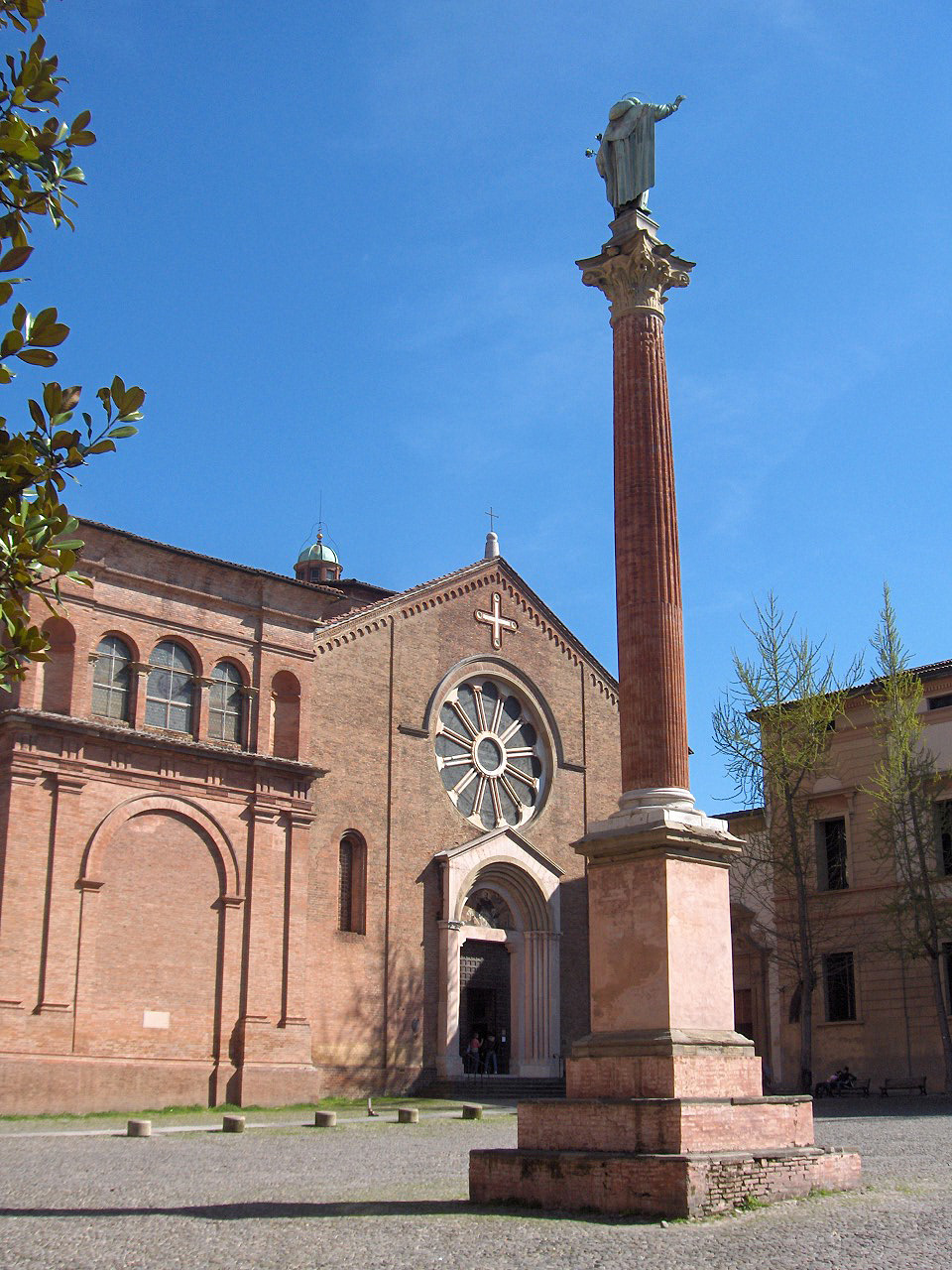
A monument that contains the remains of
St. Dominic, located in Dominic's chapel,
Basilica of St. Dominic, Bologna, Italy |
Unlike the lives of other saints, such as Sts. Augustine or Francis of Assisi, whose dramatic conversions shattered their previous lives, St. Dominic is one of those saints who came from a very holy family. He not only had two devout parents who lived virtuous lives, but two holy brothers; one of whom also joined the Order of Preachers, and the other gave himself up entirely to the service of the poor by works of mercy in a hospital.
In an effort to capture the essence of who Saint Dominic was, I selected certain chapters from the legends that includes: the miracles wrought by his fervent prayers; some of the many gifts bestowed upon him; his humility, charity, and patience in striving to win souls for God; some of the more dramatic moments of his battles with the devil and his demons; and the deliverance of individuals from demonic possession.
Conversion of a Heretic by His Joyful Patience
Saint Dominic was a man of great humility and patience. During his time there were many heretics, and on this one particular occasion, a debate with them was agreed upon. The local bishop desired to arrive with a "pompous retinue," but St. Dominic suggested otherwise that, "...[W]e should rather strive to win them over by our humility and virtuous example, than by mere show and display or by contentious words: and since the present meeting is not without its fears, let us arm ourselves with humility and go thither barefooted.' (74)
Not knowing how to get to the meeting place, enquiries were made with a man, who they assumed to be Catholic, but was in fact a heretic, whose intention was to lead them astray. Seeing that the brethren were barefoot, he lead them among thorns and brambles so that their feet and ankles became covered in blood.
As to how St. Dominic responded to all this. Here is the official account:
All this the servant of God bore all this with unruffled patience, breaking forth joyfully at times into the divine praises, and exhorting the others to do the same. 'Be of good cheer, dearest brethren,' he would say, 'put all your trust in God, for our sins have now been all wiped out in our blood, and the victory will surely be ours.' The heretic, seeing his marvellous endurance, and the joyful forbearance of the whole company, and feeling touched by his words, became changed in heart, confessed his cruel deceit, and abjured his errors before them. (75)
His Gift of Tongues
In reading this particular story, I could not help but be amazed at God's generosity in granting St. Dominic and another brother he was travelling with, the gift of speaking fluent German.
While travelling from Toulouse to Paris in the company of Brother Bertrand de Garrigue, St. Dominic met a band of pilgrims from Germany. Hearing them reciting the Psalms and Litanies, they both joined them, and upon arrival at the next town, remained with them for three days.
Saint Dominic was troubled by the fact that the brothers received material good things from the German pilgrims, yet could not provide spiritual ones in return. Saint Dominic suggested that he and Br. Bertrand kneel down and pray so that God would, in St. Dominic's own words, "...[E]nable us to understand their tongue, that we may preach Jesus to them." (81)
To the bewilderment of the pilgrims, they began to speak fluent German. For the next four days, St. Dominic and Br. Bertrand conversed with them about Jesus.
In all humility, St. Dominic stated the following to Br. Bertrand:
'Brother, we are now going to enter Paris, and if our brethren here only knew of that miracle which God wrought in us they would repute us to be saints, whereas we are but sinners, and if it got rumoured abroad we should be liable to vanity: wherefore, in virtue of holy obedience I forbid you to mention it to a soul until after my death.' (82)
As commanded upon him, Br. Bertrand did not divulge this information to the brethren until after St. Dominic's death.
How He Met The Devil Prowling Round The Convent
There are several stories of St. Dominic's confrontation with the devil and his demons. This particular story is perhaps the most dramatic of all.
On one occasion when St. Dominic, who like a watchful sentinel, was making his rounds throughout the convent, one night met the devil. Here is the account of what the two communicated:
...[A]nd bidding him stand still, the holy father accosted him thus: 'Why are you prowling in this fashion?' 'I do so,' said the other, 'on account of the profits I reap hereby."And what do you gain in the dormitory, may I ask?' said St Dominic. 'I keep the brethren from enjoying their rest, and then tempt them not to rise for matins, and when this does not work, I send them foul dreams and illusions.' Then taking him to the choir, the holy father continued: 'And what do you gain in this holy place?' 'I make them come late and retire soon, and busy them with distractions.' On questioning him about the refectory, he made answer, 'Who is there who does not either eat more or less than he should" When brought to the parlour he chuckled with glee: 'Ho, ho! this is my spot, this is the place for laughter, and folly, and idle talk.' But when they came to the chapter house the devil tried to make off: 'I loathe this place, for I lose here whatever I may have gained elsewhere, since the brethren are here told of their faults, correct one another, do penance, and are absolved.' (86)
He Snatches A Paper From The Devil
On another occasion, Saint Dominic had spied on the devil in the church at midnight, holding a piece of paper, trying to read it by the light of one of the lamps.
Saint Dominic confronted the devil, and had asked him what he was looking at. The devil's reply, " 'I am reading over your brethren's sins.' " (87)
Determined to take the paper, St. Dominic seized hold of, but the devil would not let go. He bid the devil, in God's name, to release it. Written on the paper were some faults of the brethren, whom St. Dominic corrected accordingly.
He Delivers a Glutton Possessed by the Devil
One of the brothers, in charge of the sick, had without permission, been eating leftover meat. One evening the devil entered into him and bellowed horribly. Saint Dominic had come to the spot where the rest of the brethren had rushed to the brother's assistance. He then asked the devil why he had gone into him. The following is the exchange between St. Dominic and the demon:
I hold possession of him since he richly deserves it, for contrary to the letter of your constitutions, and without leave, he has been in the habit of eating the meat left by the sick.' On hearing this the tender father replied: 'And I, by the authority of our Lord Jesus Christ, do absolve him from his sin, and command you in the name of the same Jesus, that you go out of him and vex him no longer'; and at once the brother was freed from his tormentor. (90)
He Beholds Angels Guarding His Brethren
A citizen from Bologna, a lawyer by profession, joined the Order of Preachers, much to the chagrin of his family and friends. A plan was set in motion to forcibly remove the new brother. Terrified of the anticipated violence, the brethren sought to call upon men-at-arms to guard their enclosure. Such measures proved to be completely unnecessary as St. Dominic assured them that, " 'We require no such protection, for at this very moment I see more than two hundred angels ranked round the church and convent who have been sent to guard us.' " (89) At the same moment their assailants fled panic-stricken and in confusion, and the novice summoned up enough courage to remain and persevere in the Order.
How St. Dominic Helped Calm a Storm
A ship on its way from Trapani, Sicily to the coastal city of Genoa, Italy, was overtaken by a violent storm, that threatened its destruction, and all on board. So severe was the storm that the masts and sails had been swept away; the ship was drifting at the mercy of the wind and waves.
Some passengers endeavoured to ease the load by throwing the cargo overboard, while others were making their last confession. Pleading for help, everyone was invoking their patron saints.
On board was a Dominican brother, William of Valencia, a very devout man who always put his trust in God. Hearing no mention of anyone invoking St. Dominic, he urged everyone to call upon him from their hearts, assuring them of the certainty of St. Dominic's assistance. Here is the official account of what followed:
...At this, every soul present pledged himself that if St Dominic stood by them they would go barefoot to his church carrying lighted tapers directly they touched land. Their vows made, and while they were all yet crying out at the top of their voices, ' O St Dominic, do come to our assistance!' the sky suddenly brightened, the storm hushed, the sea grew calm, and the whole face of the deep lay rippling in the sunbeams. Joy took the place of despair, moanings became shouts of joy, hearty thanks were poured out, and the name of Dominic extolled. Nor were they slow in redeeming their promise on reaching Genoa, but straightway all walked in procession behind our brethren, in the way they had promised, until they came to our church, and there devoutly prostrated themselves before his altar. (97)
How He Rid a Woman of Seven Devils
During the second Sunday of Lent, St. Dominic set out to preach at St. Sixtus Church in Rome, where Benedictine sisters had taken up residence near by.
A great crowd had gathered, and St. Dominic stood by the grating so the Sisters could both hear and see him preaching the word of God. Amongst the great crowd of men and women, was a woman possessed of seven demons, who began to disturb his preaching shouting, " 'Knave and fool, thou hast already robbed me of four persons who were mine, thou hast robbed me of my own'..." (119) The demons kept calling St. Dominic "knave," which means "dishonest man."
The crowd became increasingly disturbed by this woman, so St. Dominic directed the demons to "Hold your tongue," but to no avail. The demons responded, " 'Thou shalt not turn us out, for she is ours, and we refuse to leave her.' " (119) The demons also revealed how they possessed her.
As the confusion grew from this disturbance, St. Dominic lifted up his hand, and made a sign of the cross over her, saying, "In the name of our Lord Jesus Christ I command you to go out of her, and not to torment her any longer." (120) Instantly the woman began to vomit up a quantity of coals, and a tremendous amount of blood. Saint Dominic had her brought to a house close by, with orders that she be cared for until her recovery.
After a long time had passed, when this woman recovered, and was on her way to the shrine of St. James the Apostle, she saw a group of Sisters who were on their way to St. Agnes convent in Bologna. Being quite well and in sound health, she conversed with them pleasantly.
How The Blessed Virgin Mary Appeared to Him While at Prayer, and Showed Him The Care She Takes or the Order
Once when St. Dominic was passing the night in prayer in the church, it was around midnight that he went to the dormitory. After looking in on his brethren, he resumed his prayer at the entrance.
Standing erect in prayer, he saw at the other end of the dormitory, three very pleasant looking women advancing toward him. The central figure seemed to be more dignified, and of higher rank than the others.
One of the two attendants carried a beautiful and resplendent vessel of holy water, and the other a sprinkler, which she presented to the third, who was between them.
The middle woman sprinkled the brethren, who were asleep, except for one, which caught the attention of St. Dominic.
Eventually St. Dominic threw himself down at her feet, and begged her to reveal who she was, although he knew all along it was the Blessed Virgin Mary. She replied, "I am she whom you greet every evening, and when you say 'Turn then our Advocate,' I prostate myself before my Son for the preservation of the Order.' " (124) As to the brother who did not receive the blessing, Our Lady replied," Simply because he was unworthy of it." (125) Sprinkling the remaining friars, she then went away. What happened next to Saint Dominic is best described by the account from Lives of The Brethren:
St Dominic returned to his prayers, and was caught up in spirit from where he was standing to the throne of God, and there he beheld our Lord, and the Blessed Virgin sitting on his right hand, whilst she appeared to our holy father to be wearing a mantle of deep blue colour. As lie gazed round he saw religious men of every Order in the Church standing in God's presence, but not one of his own family, so he began to weep bitterly and would not presume to come near our Lord and leis holy mother. Thereupon she made a sign with her hand for him to draw nigh, but still he did not dare to do so until our Lord also beckoned to him; then he came up and threw himself down before them, weeping as if his heart would break. Then Christ bade him arise, and asked him gently: 'Why weepest thou thus sorrowfully?' 'I am grieving,' said St Dominic, 'because I see here members of every religious Order, but of my own not one.' Then our Lord said: 'And would you see your Order?' To this the saint answered trembling: 'Yes, Lord, of a surety I would.' Placing his hand lovingly on the Blessed Virgin's shoulder, Christ replied: 'I have given over your Order to my mother's care.' At this the Blessed Virgin drew back her mantle, and opening it wide before St Dominic, it seemed to enclose nearly the whole of that heavenly country, so vast was it, and beneath it he saw a great host of his brethren. Casting himself down, St Dominic returned right hearty thanks to Christ and his holy mother; soon the vision passed away, and once again regaining his natural consciousness he rang the bell for matins. When the morning office was over he summoned the brethren to the chapter-house, and there spoke to them with burning words, exhorting them to love and reverence ever the blessed Virgin, and amongst the rest he told them of his vision. When the chapter was over he called aside the friar whom our blessed Lady had neither sprinkled nor blessed, and tried by gentle speech to discover whether there was not some secret sin which he had not confessed, for the brother had made a general confession to St Dominic. The brother made this reply: 'Holy father, I have nothing to reproach myself with in conscience except this, that on that night I retired to rest without being dressed according to rule.' St Dominic recounted this vision to Sister Cecilia and the other sisters of St Sixtus, yet as if it had befallen someone else, but the brethren present then, who had heard him relate it before, gave the sisters to understand that the person was none other than himself. It was on this account that St Dominic made it a rule that all his brethren should sleep in tunic and girdle wherever they might be.
How St. Dominic Founded The Convent at St. Sixtus
At the request of Pope Honorius, St. Dominic had gathered nuns scattered from various monasteries in the city, in order to unite them at St. Sixtus, where the brethren dwelt at the time.
Amongst all the nuns was Sister Cecilia, and the abbess of St. Mary's, where a picture of St. Mary stood. All but one, made their profession into St. Dominic's hands, and entered his enclosure, upon the condition that Our Lady's picture stayed with them at St. Sixtus. If this condition was not met, and the picture was returned to its former resting place, then all the nuns would be dispensed from their vows. Saint Domenic agreed.
Once the professions were made, St. Dominic told the nuns that they were not permitted to go outside the enclosure anymore to see family and friends. When this became known, some of their family and friends became angry for what they thought would be the destruction of a monastery, and for placing themselves into the hands of a man no one knew anything about.
As a result, some of the nuns regretted their profession, but St. Dominic knowing all this by the light of the Holy Spirit went to the nuns and addressed them with the following words, "My daughters, are you changing so soon, and do you want to go back from the way of the Lord? I want every one who means to enter of her own free will now to renew her profession." (133) In response, all the nuns renewed their profession.
Saint Dominic took all the monastery keys, and entrusted its safety to lay-brothers to guard it day and night, and provide provisions for the nuns.
As for the picture of Our Lady, St. Dominic and two assistants carried it from its original location to St. Sixtus, secretly in the night. They did this at night to avoid any hindrance from the citizens of Rome, who did not wish to see it leave because they had better access to it where it was. Bare foot, and with tapers (slender candles) to light their way, St. Dominic and his assistants transferred the picture to St. Sixtus with great devotion and due reverence to Our Lady.
The picture of Our Lady remains at St. Sixtus to this day.
Concluding Thoughts
Reading Lives of The Brethren is time well spent; an encouragement to a live a holy life. It certainly challenges the reader to examine his or her own life, and seek understanding and clarity as to what needs to be improved upon and what is missing.
As to the numerous lessons that can be drawn from the many stories, it really is a function of each individual's faith journey, and how each one responds to God's love, mercy, forgiveness, graces, and blessings.
However, there are some lessons that each individual can benefit from, no matter where you are in your faith journey: the need to discover, recognize, and acknowledge our faults and defects; the necessity for a daily examination of conscience, and to strive for compunction of heart; frequent confession and Mass attendance; the importance of silence after Evening Prayer (Liturgy of the Hours); a new or renewed understanding of the spiritual combat against the Evil One and his demons; the importance of prayer; the need to place complete trust in God, and Our Lady's intercession in our lives; the much needed reminder to be always on guard against temptations, in its many forms and disguises; and how the beginning and growth in the virtuous life, often comes by way of hardships, difficulties, and chastisements.
It is my hope that you found today's post an intriguing read, that will encourage you to read, Lives of The Brethren, in its entirety.