Showing posts with label Vatican. Show all posts

Monday, March 26, 2018

Rerum Novarum: Pope Leo XIII's Encyclical on Capital and Labour

A photomontage of Pope Leo XIII and his encyclical "Rerum Novarum"
Pope Leo XIII and the encyclical Rerum Novarum.

Having recently read Pope Leo XIII's Rerum Novarum, it is not surprising that this encyclical has been given much attention over the many decades since its release in 1891. It not only highlights the intelligence and wisdom of Pope Leo XIII, but also illustrates the great effort he put forth to detail and explain the condition of the working classes. In doing so, Pope Leo XIII identified the many issues and problems of late nineteenth century's economic and political life, to which he responded with guidelines and solutions based on the principles of truth and justice as proposed by the Church.

Many know of Pope Leo XIII as the "Rosary Pope"—due to his many writings on devotion to the Rosary and its efficaciousness as a remedy to the evils of the world—or from the fact that the Church received the St. Michael the Archangel prayer through a vision he had after having celebrated Mass. What may not be so well known is the fact that it was during Pope Leo XIII's papacy (1878-1903) that the Church made a transition from Counter-Reformation Catholicism to Evangelical Catholicism.

During his papacy Pope Leo XIII set out to create the conditions for a new Catholic engagement with modern culture in the political, economic, and social life; the launching of the Church's modern social doctrine in Rerum Novarumas its title ("new things") suggests, was part of that engagement with modernity.

Rerum Novarum continues to remain relevant today as a valuable resource to draw from especially in those parts of the world where the condition of the working classes mirrors those during Pope Leo XIII's time: the exploitation of workers who, due to their vulnerability, are subjected to conditions that reflect a lack of respect for the dignity of the human person.

Pope Leo XIII characterized the times he was living in as one of "revolutionary change," where the "elements of conflict" were raging: the vast expansion of industrial pursuits; marvellous discoveries of science; a noticeable change in the relationship between masters and workman; enormous fortunes had accumulated in the hands of a few leaving the masses in utter poverty; increased self reliance; the closer, mutual combination of the working classes; and a prevailing moral degeneracy had taken root in society. (1)

At thirty pages, Pope Leo XIII provided a thorough analysis that included: the realities that brought misery and wretchedness upon the working classes; a lengthy critique of socialism's false solutions; the inviolability of private property to alleviate the condition of the masses; that no practical solution can be found apart from the intervention of religion and the Church; human society can only be healed by a return to Christian life and Christian institutions; the responsibilities of the State; the importance of man's spiritual dimension and how it relates to work; putting God first in any association or organization; and the need to re-establish Christian morals to destroy every evil at its root.

Part of what brought on the "misery and wretchedness" upon the working classes was the fact that workingmen's guilds had been abolished in the previous century with no other protective replacement, and public institutions and laws had discarded religion. Pope Leo XIII noted that as a result working men, who had become isolated and helpless, were in effect "surrendered" to hard-hearted employers. Making matters worse was the greed of unchecked competition, the increase in "rapacious usury," and the hiring of labour controlled by the "hands of comparatively few." The pope referred to such conditions as being slightly better than slavery.

Making the point that socialism was not the answer to society's problems, Pope Leo XIII dedicated several sections (four to fifteen) to dismantling the "solutions" of socialism—which at its core sought to do away with private property as individual possessions would become the common property of all—in which he noted that if ever the "solutions" of socialism were to be implemented, the working man would be the first to suffer. Moreover, he stated that the contentions of socialism are, "...[E]mphatically unjust, for they would rob the lawful possessor, distort the functions of the State, and create utter confusion in the community." (4)

The solutions needed to remedy the "misery and wretchedness" of the working classes—to which the overwhelming majority of people belong—must include the opportunity to own private property. The "inviolability of private property" the pope argued is the first and foremost fundamental principal to alleviate the condition of the masses. From section sixteen until the end of the encyclical, Pope Leo XIII detailed the Church's proposal on how that remedy is to be found.

If there was going to be any practical solution to the problems of his times, Pope Leo XIII made it clear that it can only be achieved through the intervention of religion and the Church:
But We affirm without hesitation that all the striving of men will be vain if they leave out the Church. It is the Church that insists, on the authority of the Gospel, upon those teachings whereby the conflict can be brought to an end, or rendered, at least, far less bitter; the Church uses her efforts not only to enlighten the mind, but to direct by her precepts the life and conduct of each and all; the Church improves and betters the condition of the working man by means of numerous organizations; does her best to enlist the services of all classes in discussing and endeavoring to further in the most practical way, the interests of the working classes; and considers that for this purpose recourse should be had, in due measure and degree, to the intervention of the law and of State authority. (16) 
The pope went on to state that when it came to the need of an intermediary between the rich and the working class, there is none more powerful than the Church to remind each of its duties to the other and of the obligations of justice. (19) Of the many duties of workers, Pope Leo XIII stated: 
Of these duties, the following bind the proletarian and the worker: fully and faithfully to perform the work which has been freely and equitably agreed upon; never to injure the property, nor to outrage the person, of an employer; never to resort to violence in defending their own cause, nor to engage in riot or disorder; and to have nothing to do with men of evil principles, who work upon the people with artful promises of great results, and excite foolish hopes which usually end in useless regrets and grievous loss. (20)
As to the duties of the wealthy and employers, Pope Leo XIII stated: 
The following duties bind the wealthy owner and the employer: not to look upon their work people as their bondsmen, but to respect in every man his dignity as a person ennobled by Christian character. They are reminded that, according to natural reason and Christian philosophy, working for gain is creditable, not shameful, to a man, since it enables him to earn an honorable livelihood; but to misuse men as though they were things in the pursuit of gain, or to value them solely for their physical powers - that is truly shameful and inhuman. Again justice demands that, in dealing with the working man, religion and the good of his soul must be kept in mind. Hence, the employer is bound to see that the worker has time for his religious duties; that he be not exposed to corrupting influences and dangerous occasions; and that he be not led away to neglect his home and family, or to squander his earnings. (20) 
Citing from scripture Pope Leo XIII provided a stern warning to the wealthy and employers with regard to the defrauding of anyone's wages, that such is a "great crime" which cries to Heaven for vengeance (James 5:4).

In another warning to whom "fortune favors," Pope Leo XIII stated that, "...[R]iches do not bring freedom from sorrow and are of no avail for eternal happiness, but rather are obstacles; that the rich should tremble at the threatenings of Jesus Christ..." (22)

Private ownership, Pope Leo XIII contends, is a natural right of man, and for man to exercise that right is not only lawful, but necessary for his existence. Reinforcing this point the pope referred to St. Thomas Aquinas's Summa Theologica, " 'It is lawful,' says St. Thomas Aquinas, 'for a man to hold private property; and it is also necessary for the carrying on of human existence.' " (22) As to what should be the proper understanding of man's possessions and their use, Pope Leo XIII again cited from Summa Theologica, "But if the question be asked: How must one's possessions be used? - the Church replies without hesitation in the words of the same holy Doctor: 'Man should not consider his material possessions as his own, but as common to all, so as to share them without hesitation when others are in need.' " (22)

Regarding man's true worth, Pope Leo XIII pointed out that it is not based on his material possession, but in his moral qualities; that is, in virtue which is the common inheritance of men, "...[E]qually within the reach of high and low, rich and poor; and that virtue, and virtue alone, wherever found, will be followed by the rewards of everlasting happiness." (24)

At section twenty-six, Pope Leo XIII stated that the Church is not content with simply pointing out the remedies for the working classes, but with their implementation as well. Part of that implementation comes in the form of the training and education of men so they will diffuse the teachings of the Church to everyone; striving to influence the hearts and minds of all, formed and guided by the commandments of God.

Drawing upon history, Pope Leo XIII emphasized that it was through the Church and its institutions that the human race was "renovated," strengthened, and renewed. If human society is to be healed it can only happen, as the pope stated, by a return to Christian life and through the help of Christian institutions. (27)

Pope Leo XIII emphasized that the Church is not only concerned with the spiritual dimension of man's existence, but his temporal and earthly interests; and especially the poor, that they rise above their poverty to a better condition in life. Calling men to live a virtuous life encourages that rise:
Christian morality, when adequately and completely practiced, leads of itself to temporal prosperity, for it merits the blessing of that God who is the source of all blessings; it powerfully restrains the greed of possession and the thirst for pleasure-twin plagues, which too often make a man who is void of self-restraint miserable in the midst of abundance; it makes men supply for the lack of means through economy, teaching them to be content with frugal living, and further, keeping them out of the reach of those vices which devour not small incomes merely, but large fortunes, and dissipate many a goodly inheritance. (28)
The responsibilities of the State was given much attention in Rerum Novarum, to which Pope Leo XIII dedicated several sections. The foremost duty of the State, as the pope pointed out was to, "...[M]ake sure that the laws and institutions, the general character and administration of the commonwealth, shall be such as of themselves to realize public well-being and private prosperity." (32) Moreover, he stated that a State prospers and thrives, "...[T]hrough moral rule, well-regulated family life, respect for religion and justice, the moderation and fair imposing of public taxes, the progress of the arts and of trade, the abundant yield of the land-through everything, in fact, which makes the citizens better and happier." (32)

Pope Leo XIII stressed that there was something deeper that "must not be lost sight of": the State should consider the interests of all as equal, and since the majority are the working class, it is incumbent upon the State to provide for their welfare and comfort. To do otherwise as the pope pointed out, would violate the law of justice. (33)

The State's primary responsibility is to ensure the safety and security of the citizenry. Pope Leo XIII emphasized this very point, "Rulers should, nevertheless, anxiously safeguard the community and all its members; the community, because the conservation thereof is so emphatically the business of the supreme power, that the safety of the commonwealth is not only the first law, but it is a government's whole reason of existence..." (35) 

At section thirty-six, addressing the threats to the general interest or the suffering of any particular class, Pope Leo XIII wrote that it is the duty of the public authority to intervene should it be a matter that cannot be met and prevented

As for the establishment of peace and good order—which is in the interest of the community and the individual—Pope Leo XIII stressed that it should be done in accordance with God's laws and those of nature. Elaborating on the specifics, he stated: 
...[T]he discipline of family life should be observed and that religion should be obeyed; that a high standard of morality should prevail, both in public and private life; that justice should be held sacred and that no one should injure another with impunity; that the members of the commonwealth should grow up to man's estate strong and robust, and capable, if need be, of guarding and defending their country. If by a strike of workers or concerted interruption of work there should be imminent danger of disturbance to the public peace; or if circumstances were such as that among the working class the ties of family life were relaxed; if religion were found to suffer through the workers not having time and opportunity afforded them to practice its duties; if in workshops and factories there were danger to morals through the mixing of the sexes or from other harmful occasions of evil; or if employers laid burdens upon their workmen which were unjust, or degraded them with conditions repugnant to their dignity as human beings; finally, if health were endangered by excessive labor, or by work unsuited to sex or age - in such cases, there can be no question but that, within certain limits, it would be right to invoke the aid and authority of the law. The limits must be determined by the nature of the occasion which calls for the law's interference - the principle being that the law must not undertake more, nor proceed further, than is required for the remedy of the evil or the removal of the mischief. (36)
In the interests of the working man's soul, Pope Leo XIII dedicated section forty-one to the importance of keeping the Lord's Day holy. Work as he went on to write should not be performed on Sundays and certain holy days. Sundays the pope emphasized are not just days of rest, but rest that is hallowed by religion: rest together with religious observances disposes a man to forget about the concerns of everyday life and turn his attention to heavenly things. (41) 

At section forty-two, Pope Leo XIII warned against greed and the exploitation of women and children. He also highlighted the need for proper rest so that men are not ground down with excessive labour that will stupefy their minds and wear out their bodies. 

On the subject of wages, Pope Leo XIII dedicated sections forty-three to forty-six, in which he wrote about the free consent between employers and workers and how injustice would result if employers failed to pay the full amount of wages or if workmen did not complete assigned work. Under such circumstances, the pope considered it necessary for the "public authority" to intervene, so as to ensure that each party "obtains his due."

There are two considerations of man's labour that Pope Leo XIII highlighted, "First of all, it is personal, inasmuch as the force which acts is bound up with the personality and is the exclusive property of him who acts, and, further, was given to him for his advantage. Secondly, man's labor is necessary; for without the result of labor a man cannot live, and self-preservation is a law of nature, which it is wrong to disobey." (44)

With respect to the agreements between employers and workers, Pope Leo XIII stressed that due consideration should be given to workers so that "...[W]ages ought not to be insufficient to support a frugal and well-behaved wage-earner." (45) 

Pope Leo XIII warned that if workers—through necessity or fear—were subjected to miserable working conditions and if employers refused to alleviate that misery, workers would rightly be considered victims of force and injustice.

To help ensure the safeguarding and interests of wage-earners, Pope Leo XIII recommended the establishment of "societies or boards" that would deal with proper hours of labour, sanitary precautions in factories and workshops, and other matters pertaining to working conditions as a way to supersede "undue interference on the part of the State." (45) 

As workmen build up savings from wages that afford them to comfortably provide for themselves and their families, Pope Leo XIII emphasized that the law should favour, "...[O]wnership, and its policy should be to induce as many as possible of the people to become owners." (46)

Ownership of property Pope Leo XIII argued, will lead to many "excellent results." First, property will become more equitably divided as more and more workman acquire it; thus, reducing the "wide chasm" separating the wealthy and the working classes. As a direct result the two classes will be brought nearer to one another. Second, ownership will encourage and result in the "great abundance of the fruits of the earth." Elaborating on this second point, Pope Leo XIII stated:
Men always work harder and more readily when they work on that which belongs to them; nay, they learn to love the very soil that yields in response to the labor of their hands, not only food to eat, but an abundance of good things for themselves and those that are dear to them. That such a spirit of willing labor would add to the produce of the earth and to the wealth of the community is self evident. (47)
A third advantage of ownership of property is that men that own land will for the most part remain in their country. As Pope Leo XIII noted, "...[N]o one would exchange his country for a foreign land if his own afforded him the means of living a decent and happy life." (47)

The three excellent results would be dependent upon the State's duty and responsibility not to burden the working classes with excessive taxation:
These three important benefits, however, can be reckoned on only provided that a man's means be not drained and exhausted by excessive taxation. The right to possess private property is derived from nature, not from man; and the State has the right to control its use in the interests of the public good alone, but by no means to absorb it altogether. The State would therefore be unjust and cruel if under the name of taxation it were to deprive the private owner of more than is fair. (47)
Pope Leo XIII went on to write about the support for the working classes that can be acquired through associations, organizations, and unions to which he dedicated sections forty-eight and forty-nine.

Most noteworthy was section fifty, where Pope Leo XIII emphasized that man needs help and he is not alone in seeking it. Quoting from two scriptural passages he wrote, " 'It is better that two should be together than one; for they have the advantage of their society. If one fall he shall be supported by the other. Woe to him that is alone, for when he falleth he hath none to lift him up' [Eccle 4:9-10]...A brother that is helped by his brother is like a strong city' [Prov 18:19]." (50) Pope Leo XIII went on to mention and elaborate on the options of "private societies," confraternities, religious orders, and organizations that help to ensure that man is not alone. 

Solutions to the condition of the working classes, as the pope went on to point out, can be easily provided and implemented if Christian working men form associations, select wise individuals, and follow the path of previous generations that was advantageous to the common good. With respect to the integrity of associations and putting God first, Pope Leo XIII provided details on the specifics of the "general and lasting law":
To sum up, then, We may lay it down as a general and lasting law that working men's associations should be so organized and governed as to furnish the best and most suitable means for attaining what is aimed at, that is to say, for helping each individual member to better his condition to the utmost in body, soul, and property. It is clear that they must pay special and chief attention to the duties of religion and morality, and that social betterment should have this chiefly in view; otherwise they would lose wholly their special character, and end by becoming little better than those societies which take no account whatever of religion. What advantage can it be to a working man to obtain by means of a society material well-being, if he endangers his soul for lack of spiritual food? "What doth it profit a man, if he gain the whole world and suffer the loss of his soul?"(39)This, as our Lord teaches, is the mark or character that distinguishes the Christian from the heathen. "After all these things do the heathen seek . . . Seek ye first the Kingdom of God and His justice: and all these things shall be added unto you."(40)Let our associations, then, look first and before all things to God; let religious instruction have therein the foremost place, each one being carefully taught what is his duty to God, what he has to believe, what to hope for, and how he is to work out his salvation; and let all be warned and strengthened with special care against wrong principles and false teaching. Let the working man be urged and led to the worship of God, to the earnest practice of religion, and, among other things, to the keeping holy of Sundays and holy days. Let him learn to reverence and love holy Church, the common Mother of us all; and hence to obey the precepts of the Church, and to frequent the sacraments, since they are the means ordained by God for obtaining forgiveness of sin and fox leading a holy life. (57)
Near the end of the encyclical at section sixty, the pope reiterated that the condition of the working classes is the pressing matter of the time and that, "...[N]othing can be of higher interest to all classes of the State than that it should be rightly and reasonably settled." (60) It was a reiteration from a point he made at the beginning of the encyclical that set the tone for its reading, "But in the present letter, the responsibility of the apostolic office urges Us to treat the question of set purpose [the condition of the working classes] and in detail, in order that no misapprehension may exist as to the principles which truth and justice dictate for its settlement." (2)

It is at the very end of this encyclical that Pope Leo XIII reminded both the wealthy and the working classes of doing their part to ensure the remedies to the condition of the working classes can and will be implemented, "Every one should put his hand to the work which falls to his share, and that at once and straightway, lest the evil which is already so great become through delay absolutely beyond remedy." (62) Addressing the evil in society, Pope Leo XIII made it crystal clear that it is religion alone that can destroy evil at its root, and as such, "...[A]ll men should rest persuaded that main thing needed is to re-establish Christian morals, apart which all the plans and devices of the wisest will prove of little avail." (62)

Rerum Novarum is one of many of Pope Leo XIII's writings that are available at the Vatican's dedicated Pope Leo XIII page. I hope that today's post will encourage you to visit that page: doing so will be time well spent.




Friday, February 23, 2018

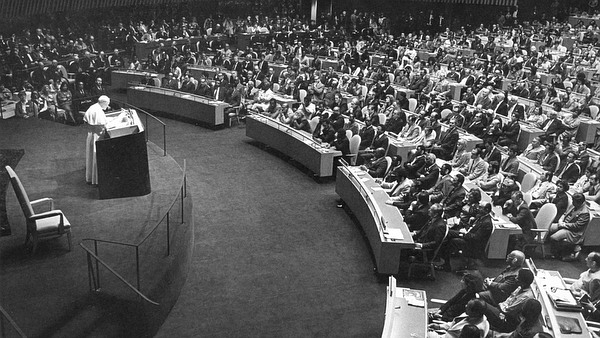
St. John Paul II's Address to the United Nations in 1979: A "Stunning Speech" Indeed

A black and white photo of St. John Paul II giving his address to the UN in 1979.
St. John Paul II during his address at the United Nations in 1979. Photo: Catholic News Service via Salt and Light Media

Recently I had finished reading George Weigel's book, Lessons in Hope: My Unexpected Life With St. John Paul II, where he described Saint John Paul II's address to the United Nations (UN) in 1979, as a "stunning speech." As with many of Weigel's writings on St. John Paul II, they lead to further readings from his many references, citations, extensive endnotes, and bibliographies. Being somewhat intrigued by that description, I had decided to add the speech to my blog-draft list. 

The speech is twelve pages printed and like so many of Saint John Paul II's writings, it contains a dense amount of
information that requires the reader's full and undivided attention. After having read it twice, I completely agree with Weigel's description: it is indeed a stunning speech!

At the core of Saint John Paul II's speech is the human person: the importance of each individual's dignity and inalienable rights, and how all threats to peace can ultimately be identified and measured by the manner in which States fail to safeguard and ensure man's freedom and ability to live his human dimension to the fullest.

The hour-long speech began with Saint John Paul II's gratitude to the general assembly and in particular to the Secretary-General of the United Nations Organization, Dr. Kurt Waldheim, for inviting him to address the thirty-fourth general assembly. Saint John Paul II then segued into the formal reason for his intervention: the special bond of cooperation that links the Apostolic See with the United Nations—indicated by the presence of the Holy See's Permanent Observer—one that is held in high esteem by the Holy See.

In addition to that bond, Saint John Paul II highlighted the Apostolic See's esteem for the United Nations as a "supreme forum for international life of humanity today," which received much attention in papal messages, encyclicals, in documents of the Catholic episcopate, and in the Second Vatican Council. 

Drawing upon his predecessors' (Popes John XXIII and Paul VI) "look of confidence" on the UN as a "promising sign of our times," Saint John Paul II reinforced that confidence and conviction, which as he stated did not stem from merely political reasons, but of the ...[R]eligious and moral character of the mission of the Roman Catholic Church." (4)

Moreover, Saint John Paul II pointed out the Catholic Church, as a universal community of faithful that exists in almost all countries and continents, "...[I]s deeply interested in the existence and activity of the Organization whose very name tells us that it unites and associates nations and States." (4) Elaborating further, he stated, "It seeks out the ways for understanding and peaceful collaboration, and endeavours with the means at its disposal and the methods in its power to exclude war, division, and mutual destruction within the great family of humanity today." (4)

This was the "real reason, the essential reason" for Saint John Paul II's presence at the UN that day in October 1979. 

The speech was not without scriptural passages. Referring to the occasion when Jesus was before the tribunal of the Roman judge Pilate, where He declared that the purpose of His existence in the world was to bear witness to the truth (John 18:37), Saint John Paul II made it clear that, as the Vicar of Christ, his mission was to do likewise.

Saint John Paul II expressed his gratitude once again and then congratulated the general assembly for the opportunity to speak that day, which as he stated, "...[S]hows that the United Nations Organization accepts and respects the religious and moral dimension of those human problems that the Church attends to, in view of the message of truth and love that it is her duty to bring to the world." (5)

By no means was the address limited to those in the UN General Assembly building. Saint John Paul II extended his greetings to all men and women living on the planet; a greeting that placed an important focus on the human person.

Highlighting the importance of the human person, Saint John Paul II emphasized that although members of the UN represent a particular State, system, and political structure, they represent above all "individual human beings," of which each one is endowed with dignity as a human person, with "...[H]is or her own culture, experiences and aspirations, tensions and sufferings, and legitimate expectations." (6)

Saint John Paul II reminded the representatives that political activity "comes from man, is exercised by man and is for man," and what justifies any political activity is service to man; one that has a responsibility and concern for the essential problems and duties of "...[H]is earthly existence in its social dimension and significance, on which also the good of each person depends." (6)

Several minutes (almost two pages worth) was dedicated to the UN's Universal Declaration of Human Rights, in which Saint John Paul II referred to it not only as a "fundamental document," but a "real milestone on the path of the moral progress of humanity." (7) Defining progress, he went on to state that, "The progress of humanity must be measured not only by the progress of science and technology, which shows man's uniqueness with regard to nature, but also and chiefly by the primacy given to spiritual values and by the progress of moral life." (7)

Acknowledging the importance of unity, Saint John Paul II highlighted how nations have understood that if they are not to go to war, they must unite and associate with each other. Moreover, he stressed that the "real and fundamental way" to achieve this was through "...[E]ach human being, through the definition and recognition of and respect for the inalienable rights of individuals and of the communities of peoples. (7)

Saint John Paul II also provided what has proven to be a prophetic warning; that is, if the truths and principles contained in the Universal Declaration of Human Rights were forgotten or ignored, the UN would be faced with the threat of a new destruction. Elaborating on how this new destruction would come about he stated:
This is what would happen if the simple yet powerful eloquence of the Universal Declaration of Human Rights were decisively subjugated by what is wrongly called political interest, but often really means no more than one-sided gain and advantage to the detriment of others, or a thirst for power regardless of the needs of others—everything which by its nature is opposed to the spirit of the Declaration. 'Political interest' understood in this sense, if you pardon me, ladies and gentlemen, dishonours the noble and difficult mission of your service for the good of your countries and of all humanity. (9)
"No more war, war never again!" Saint John Paul II spoke these words, citing from his predecessor, Pope Paul VI, who fourteen years earlier addressed the UN from the same podium. In 1979, there was great cause for concern of war breaking out throughout the world: it was only in 1978—through direct intervention from the Vatican that successfully mediated a solution to the Beagle Channel boundary dispute—that a war was averted between Argentina and Chile; not to mention the Middle East crises which not only persist to this day, but have increased.

Saint John Paul II's concern about the possibilities of wars breaking out was also merited by "troubling reports" of weaponry being developed beyond the size and means of war, and how such realities seriously endangered humanity by the threat of destruction.

Avoiding war requires energetic and continuous efforts to ensure that attitudes, convictions, intentions, and aspirations of governments are not geared toward the possibility of provoking war. Saint John Paul II reminded the UN that this is a duty for every society, regime, and government.

The Universal Declaration of Human Rights as Saint John Paul II pointed out, "...[S]truck a real blow against the many deep roots of war, since the spirit of war, in its basic primordial meaning, springs up and grows to maturity where the inalienable rights of man are violated." (11)

Examining the principle tensions that can weaken peace, Saint John Paul II made what is perhaps one of "the" most salient points in the speech, "Every analysis must necessarily start from the premise that—although each person lives in a particular concrete social historical context—every human being is endowed with a dignity that must never be lessened, impaired or destroyed but must instead be respected and safeguarded, if peace is really to be built up." (12)

As to the many inalienable rights Saint John Paul II enumerated some of the most important ones that are universally recognized:
...[T]he right to life, liberty and security of person; the right to food, clothing, housing, sufficient health care, rest and leisure; the right to freedom of expression, education and culture; the right to freedom of thought, conscience and religion, and the right to manifest one's religion either individually or in community, in public or in private; the right to choose a state of life, to found a family and to enjoy all conditions necessary for family life; the right to property and work, to adequate working conditions and a just wage; the right of assembly and association; the right to freedom of movement, to internal and external migration; the right to nationality and residence; the right to political participation and the right to participate in the free choice of the political system of the people to which one belongs. (13)
Moreover, Saint John Paul II pointed out that these human rights are, "...[I]n keeping with the substance of the dignity of the human being, understood in his entirety, not as reduced to one dimension only. These rights concern the satisfaction of man's essential needs, the exercise of his freedoms, and his relationship with others; but always and everywhere they concern man, they concern man's full human dimension. (13)

Saint John Paul II reminded the general assembly that man lives in the world with both material and spiritual values with the latter having a "pre-eminence": the values of the spirit define the proper sense of earthly material goods and the way to use them. When material and technical development, and the development of civilization as a whole are guided by the pre-eminence of spiritual values, they not only serve what constitutes man, but form the basis of a just peace. (14)

Having distinguished material and spiritual values, Saint John Paul II then proceeded with a critical analysis of our modern civilization, in which he not only highlighted how the world has experienced the development of material goods as has never seen before, but also pointed to the rise in attitudes of "insensitivity to the spiritual dimension of human existence." (15) In his analysis, Saint John Paul II identified two main systematic threats against human rights: the distribution of material goods, and the various forms of injustice in the field of the spirit.

The distribution of goods as Saint John Paul II pointed out, is "...[F]requently unjust both within individual societies and on the planet as a whole." (17) Nature's bounty allows man to possess and enjoy many goods but when the inequality of possession of material goods occurs (and in their enjoyment), it can result in injustice and social injury. (17)

Saint John Paul II then went on to describe how economic tensions between States and even entire continents, can contain "substantial elements" that can "restrict or violate human rights." Expanding on this point, he stated:
Such elements are the exploitation of labour and many other abuses that affect the dignity of the human person. It follows that the fundamental criterion for comparing social, economic and political systems is not, and cannot be, the criterion of hegemony and imperialism; it can be, and indeed it must be, the humanistic criterion, namely the measure in which each system is really capable of reducing, restraining and eliminating as far as possible the various forms of exploitation of man and of ensuring for him, through work, not only the just distribution of the indispensable material goods, but also a participation, in keeping with his dignity, in the whole process of production and in the social life that grows up around that process. Let us not forget that, although man depends on the resources of the material world for his life, he cannot be their slave, but he must be their master. The words of the book of Genesis, "Fill the earth and subdue it" (Gen 1 :28), are in a sense a primary and essential directive in the field of economy and of labour policy. (17)
Another aspect of this first systematic threat against human rights is the "frightful disparities" between the excessively rich and those who are extremely poor, even destitute. Saint John Paul II referred to this disparity as an "abyss" which is not only a grave symptom in the life of any society, but also separates countries and regions of the earth.

To remedy such disparities will require a unified and coordinated effort by all countries that must be based on what Saint John Paul II referred to as "an authentic perspective of peace":
Everything will depend on whether these differences and contrasts in the sphere of the "possession" of goods will be systematically reduced through truly effective means, on whether the belts of hunger, malnutrition, destitution, underdevelopment, disease and illiteracy will disappear from the economic map of the earth, and on whether peaceful cooperation will avoid imposing conditions of exploitation and economic or political dependence, which would only be a form of neocolonialism. (18)
With regard to the second, main systemic threat to human rights in the modern world—the various forms of injustice in the field of the spirit—Saint John Paul II focussed on how man can be wounded in his inner relationship with truth: in his conscience; in his most personal belief; his view of the world; in his religious faith; and in the sphere of civil liberties.

Fundamental to civil liberties is the equality of rights without discrimination—on the grounds of origin, race, religion, nationality, sex, and political convictions—which Saint John Paul II went on to define as, "...[T]he exclusion of the various forms of privilege for some and discrimination against others, whether they are people born in the same country or people from different backgrounds of history, nationality, race and ideology." (19) He also point out that despite the "thrust of civilization" giving life to political societies that safeguard the objective rights of the spirit—human conscience and creativity, and man's relationship with God—there are recurring threats and violations against these rights, often with, "...[No] possibility of appealing to a higher authority or of obtaining an effective remedy." (19)

Drawing attention to another problem with political systems that safeguard freedom of the spirit (freedom of thought, expression, conscience, and religious freedom) Saint John Paul II stressed that within those systems exist social structures that "condemns" man to become a second-class or third-class citizen, which can be identified by compromised advancement in the social and professional life, and in the inability of families to freely educate their children. Moreover, he stated, "It is a question of the highest importance that in internal social life, as well as in international life, all human beings in every nation and country should be able to enjoy effectively their full rights under any political regime or system." (19)

Religious freedom is absolutely essential to the cause of peace. Highlighting the importance of religious freedom, Saint John Paul II cited from the Second Vatican Council's Declaration, Dignitatis Humanae (on the right of the person and communities to social and civil freedoms in matters religious):
In accordance with their dignity, all human beings, because they are persons, that is, beings endowed with reason and free will and therefore bearing personal responsibility, are both impelled by their nature and bound by a moral obligation to seek the truth, especially religious truth. They are also bound to adhere to the truth once they come to know it and to direct their whole lives in accordance with its demands (Dignitatis Humanae, 2). (20)
The United Nations proclaimed 1979, to be the "Year of the Child." Saint John Paul II expressed his joy on the subject of children. He also reminded the delegates that a child's life begins at conception, "Concern for the child, even before birth, from the first moment of conception and then throughout the years of infancy and youth, is the primary and fundamental test of the relationship of one human being to another." (21) He went on to further state, "And so, what better wish can I express for every nation and the whole of mankind, and for all the children of the world than a better future in which respect for human rights will become a complete reality throughout the third millennium, which is drawing near." (21)

At the close of his address, Saint John Paul II expressed his hope for peace, justice, and freedom for all peoples of the world, and that the United Nations would continue to be, "...[A]n authentic seat of freedom of peoples and individuals in their longing for a better future. (23)

Attending the thirty-fourth general assembly must have been quite the experience for State representatives, the press, and others. George Weigel was one such individual—a "newbie columnist" on his first major assignment: Saint John Paul II's papal pilgrimage to the United States in October 1979. It was a speech that Weigel would come to analyze and write about twenty years later.

In Witness to Hope, the first of three seminal works on the life and papacy of Saint John Paul II, Weigel dedicated three and a half pages (chapter ten, The Ways of Freedom) to Saint John Paul II's 1979 UN address. Although it was written and published many years prior to Lessons in Hope, that information and in particular the concluding paragraph serves as another resource of just how stunning a speech it truly was:
The delegates to the General Assembly had listened to John Paul's address in silence. No one had wandered about the floor of the General Assembly, as often happened during normal business. However they construed its meaning, the representatives of the worlds of power knew that they had been listening to a force to be reckoned with. (350)
Saint John Paul II's speech is perhaps more relevant today than when it was first delivered in 1979. If one reads the Universal Declaration of Human Rights and compares it to the many UN resolutions passed and the initiatives undertaken over the past few decades it will not take much time or effort to conclude that the United Nations has significantly deviated from its origins. What was once an international forum that staunchly defended the human person, and each individual's dignity and inalienable rights has today become a battlefield for the social engineering of States—heavily influenced by non-governmental organizations (NGO) and lobbyists, funded by globalist billionaires—with agendas that bring about a moral disorder in society and a Culture of Death.

The details of what the United Nations has become today can be read at C-Fam: Center for Family and Human Rights.

Saint John Paul II's address is a treasure trove of clarity, knowledge, and understanding about the truth of the human person and how each individual's dignity and inalienable rights are inseparable from freedom and peace in the world.


Thursday, December 31, 2015

Discerning The Spirits: Principles of Discernment, the Holy Spirit vs. Demonic Spirit, Pastoral Care and Guidelines on Prayers for Healing

A dove, representing the Holy Spirit, and a Catholic Healing Mass

The publishing of today's post is the third and final post in a series of posts dedicated to the subject of, Discerning The Spirits, and is based on a book, Spiritual Deceptions in the Church and the Culture: A Comprehensive Guide to Discernment, written by Moira Noonan OSB, Oblate and Anne Feaster. The title of the book does justice to its content; it truly is a comprehensive guide. For those of you who have read this book, I know you need no convincing of this fact. For those yet to read it, a wealth of information awaits you. This book is one of "the" resources to purchase for anyone who is serious about understanding the subject matter.

As members of the Mystical Body of Christ (clergy, religious and laity), we all need to become better informed about the obstacles we face in our efforts to follow Christ. Our earthly pilgrimage isn't just about following Christ, it's also about knowing and understanding what is working against us and how the Evil One and his demons try to interfere with our journey, attempting to draw us away from God and into their deceptive world of darkness. Noonan and Feaster's book sheds light on many aspects of "the battle."

What follows is selected content from chapter eight, Discerning the Spirits: principles of discernment that includes references to St. Thomas Aquinas' Summa Theologica and the Catechism of the Catholic Church; a comparison between the Holy Spirit and the demonic spirit; pastoral care and recommendations that challenges the Church to a new level of awareness and evangelization; and guidelines on prayers for healing that includes a few key Vatican documents.

Principles of Discernment

The authors begin this section of chapter eight by spotlighting the main principle of discernment so often heard by the faithful; that is, the scriptural reference, "By their fruits you will know them." (Mt 7:15-20) Noonan and Feaster ask a very important and intriguing question, "But what do we do if the fruit seems good, as it did to Adam and Eve?" (152) The authors provide resources to help the reader discern the answer to that question that includes: explanations from St. Thomas Aquinas' Summa Theologica, the Catechism of the Catholic Church, which they help clarify with the example of Reiki, scripture and a quote from Saint Pope John Paul II.

The authors begin by reminding the reader that Satan has the ability to confuse and deceive us in two ways: either he tries to convince us that what he proposes is good, or even worse, that his ways are better than God's.

To further explain the deception of Satan, Noonan and Feaster continue to draw from St. Thomas Aquinas' Summa Theologica, spotlighting in the process how the counterfeit gifts of the New Age and occult can appear to be good and even miraculous. Saint Thomas Aquinas has stated demons can appear to work miracles, but cannot do so in the strict sense of the word because a miracle is something done outside the order of the entire created nature, under which order every power of a creature is contained. Only God can work miracles, which is some times misunderstood. To clarify this, the authors quote St. Thomas Aquinas:
But sometimes [the word] miracle may be taken in a wide sense, for whatever exceeds the human power and experience. And thus demons can work miracles, that is, things which rouse man's astonishment, by reason of their being beyond his power and outside his sphere of knowledge. For even a man by doing what is beyond the power and knowledge of another, leads him to marvel at what he has done, so that in a way he seems to that man to have worked a miracle. (152)
To help readers differentiate between real miracles and demonic signs, the authors continue to quote from St. Thomas Aquinas' Summa Theologica
When magicians do what holy men do, they do if for a different end and by a different right. The former do it for their own glory; the latter, for the glory of God: the former, by certain private compacts; the latter by the evident assistance and command of God, to Whom every creature is subject. (152)
The Catechism of the Catholic Church is often referred to throughout this book, and the authors make no exception in chapter eight, including it as another important source in the discernment process. Prior to citing references from Article 4 The Morality of Human Acts, the authors intrigue readers with two well known expressions, "The road to hell is paved with good intentions," and "The end justify the means." As Noonan and Feaster point out, these popular expressions are rooted in Catholic moral theology.

Article 4 The Morality of Human Acts, begins by stating that, "Freedom makes man a moral subject. When he acts deliberately, man is, so to speak, the father of his acts. Human acts, that is, acts that are freely chosen in consequence of a judgement of conscience, can be morally evaluated. They are either good or evil. (1732)

The morality of human acts depends upon three constitutive elements: the first, the object chosen; the second, the end in view or the intention; and the third, the circumstances of the action. 

The catechism states regarding the object chosen, "The object chosen is a good toward which the will deliberately directs itself. It is the matter of a human act. The object chosen morally specifies the act of the will, insofar as reason recognizes and judges it to be or not to be in conformity with the true good." (1751) Noonan and Feaster have used the practice of Reiki, as an example to clarify the explanations provided in the catechism.

With regard to the "end in view or the intention," the catechism states the following:
In contrast to the object, the intention resides in the acting subject. Because it lies at the voluntary source of an action and determines it by its end, intention is an element essential to the moral evaluation of an action. The end is the first goal of the intention and indicates the purpose pursued in the action. The intention is a movement of the will toward the end: it is concerned with the goal of the activity. It aims at the good anticipated from the action undertaken. Intention is not limited to directing individual actions, but can guide several actions toward one and the same purpose; it can orient one's whole life toward its ultimate end. For example, a service done with the end of helping one's neighbor can at the same time be inspired by the love of God as the ultimate end of all our actions. One and the same action can also be inspired by several intentions, such as performing a service in order to obtain a favor or to boast about it.   
A good intention (for example, that of helping one's neighbor) does not make behavior that is intrinsically disordered, such as lying and calumny, good or just. The end does not justify the means. Thus the condemnation of an innocent person cannot be justified as a legitimate means of saving the nation. On the other hand, an added bad intention (such as vainglory) makes an act evil that, in and of itself, can be good (such as almsgiving). (1752-1753)
Following the authors' example of Reiki, the end in view or the intention would be the achievement of good health, relief from pain or something similar.

As to the circumstances, here is what the catechism tell us:
The circumstances, including the consequences, are secondary elements of a moral act. They contribute to increasing or diminishing the moral goodness or evil of human acts (for example, the amount of a theft). They can also diminish or increase the agent's responsibility (such as acting out of a fear of death). Circumstances of themselves cannot change the moral quality of acts themselves; they can make neither good nor right an action that is in itself evil. (1754)
Applying this third constitutive element to the example of Reiki, the authors include how some might choose Reiki after conventional medicine failed or the person could not afford a health plan or some other circumstance that attempts to rationalize the practice of Reiki.

In order for a human act to be morally good, it must satisfy all three constitutive elements, which the catechism clearly confirms, "A morally good act requires the goodness of the object, of the end, and of the circumstances together." (1755)

As the authors note in the case of Reiki:
"...[T]he object or practice of Reiki in itself is evil. In principle, it relies on diabolical sources, or spirit guides, which are not from God. It goes directly against the First Commandment. The good intention of health or relief from pain can never justify the intrinsic evil of calling on spirit guides for healing, 'even if this were for the sake of restoring their health.' (CCC, 2117) If we consider the consequences, Reiki may offer some temporary, illusory healing but in the long run people will be worse off physically and spiritually, since they have opened themselves to demonic influence. (153)
In essence what Noonan and Feaster have expressed regarding Reiki is that this human act is immoral, regardless of the intention and circumstance, which is completely in line with the teachings of the Church. Here is what the catechism states regarding this:
It is therefore an error to judge the morality of human acts by considering only the intention that inspires them or the circumstances (environment, social pressure, duress or emergency, etc.) which supply their context. There are acts which, in and of themselves, independently of circumstances and intentions, are always gravely illicit by reason of their object; such as blasphemy and perjury, murder and adultery. One may not do evil so that good may result from it. (1756)
Concluding the section on Principles of Discernment, Noonan and Feaster stress that it is important not to judge the state of anyone's soul, but at the same time we do need to be prudent. Quoting from scripture, the authors state that we can seek evidence of what fruit will be produced by looking at the "tree" of a person's life, "For from thorns men do not gather figs, neither from a bramble do they harvest grapes." (Lk 6:44)

Noonan and Feaster put a fine point on discernment by quoting from Saint Pope John Paul II's document, Veritatis Splendor, "The Spirit of Jesus, received by the humble and docile heart of the believer, brings about the flourishing of Christian moral life and the witness of holiness." (153)

Holy Spirit vs. Demonic Spirit

In this section of Discerning The Spirits, the authors have dedicated three pages to explaining the Holy Spirit and identifying how he works in our lives. With the many examples they provide, the authors also contrast the work of the Holy Spirit to that of the demonic spirit. 

Noonan and Feaster begin this section by spotlighting one of the fundamental differences between the Holy Spirit and demonic spirit. The Holy Spirit, the third Person of the Holy Trinity, will only lead us to the truth and brings clarity to our lives. In direct opposition to the Holy Spirit and our sanctification is Satan, the father of lies, who seeks to lead people away from God and deeper into sin.

A sincere surrender to the Holy Spirit brings humility into the life of the person He indwells, giving glory to Jesus in the process. Demonic spirits hate Jesus and human beings, and bring people to a self-glorification. Demons take the glorification of self, and eventually lead people to a worship of Satan. Pride is the underlying character trait of demonic spirits, which is directly opposite to the virtue of humility.

The Holy Spirit respects human free will. The Holy Spirit never attempts to empty our minds, as is the case with the New Age practices such as yoga and other Eastern meditative techniques. The Holy Spirit will at times choose to bless us with consoling and holy thoughts, but He never takes control of our mind, never interfering with our free will. The Holy Spirit always wants us to actively cooperate with Him; we never have to empty our minds for the Holy Spirit to speak to us. Our busy and active minds do not present a barrier to the Holy Spirit's love and ability to move our souls. It is our responsibility to decide to pay heed to His voice and discern what He is telling us. Demons have absolutely no respect for human free will and desire to completely control our minds. The authors identify one of ways in which the demonic try to override an active an strong mind; that is, "...[T]o encourage periods of mental passivity, such as those of Eastern meditations and occult practices." (154)

The Holy Spirit convicts us of our sins. The Holy Spirit leads us to repentance, forgiveness, redemption and peace. Demons attempt to have us rationalize our sins, and justify them in some way. Demons also attempt to remove hope in God's love, mercy, and forgiveness with attacks of crushing guilt of our sins, tempting individuals with despair in the process.

The Holy Spirit will never give us any communication that contradicts God's Work in the Bible. Demons will twist and turn God's Word, and take it out of context to justify sin. A prime example that the authors refer to, and one that I have included in my previous post, is the New Age courseA Course in Miracles. Perhaps you may have heard of it. This course has deceived many people including well known public figures such as Oprah Winfrey and Shirley MacLaine. 

The Holy Spirit uses us as He chooses. Demonic spirits will come upon the summoning of individuals with New Age and occult practices such as channeling, necromancy, and calling up spirit guides, and are at the disposal for those who use them for counterfeit healing such as Reiki and energy healing.

The Holy Spirit never goes against our free will. God does not want us to be puppets; instead He patiently awaits for us to respond to His love with our free response of love. Demons seek to immediately take control of our free will with the end goal of destroying our souls. Once demons control our free will, they are swift to retaliate against anyone who defies them. 

The Holy Spirit loves us and desires to bring us to eternal salvation. Demons hate us and desire to bring us to eternal damnation.

The Holy Spirit leads those whom He indwells with the desire to read Sacred Scripture. Demons seek to discourage and even harass people from reading scripture. The Holy Spirit helps us to understand scripture, demons try to block people from seeking the Church's interpretation of scripture.

The Holy Spirit gives us a yearning to pray. Demons seek to obstruct prayer. In the Catechism of the Catholic Church, it states that "Prayer is a battle." Against whom? Against ourselves and against the wiles of the tempter who does all he can to turn man away from prayer, away from union with God." (2725) Quoting Pope Emeritus Benedict XVI, the authors include his prayer recommendation from the 2005 International Congress commemorating Dei Verbum, in which stated:
I would like in particular to recall and recommend the ancient tradition of Lectio Divina: the diligent reading of Sacred Scripture accompanied by prayer brings about the intimate dialogue in which the person reading hears God who is speaking, and in praying, responds to him with trusting openness of heart. If it is effectively promoted, this practice will bring to the Church---I am convinced of it---a new spiritual springtime. (155)
The Lord promised to send us the Paraclete, a Consoler, the Spirit of Truth. We become open to the gift of discernment from the Holy Spirit, to discern the truth, when we are right with God. The Holy Spirit protects us from spiritual deceptions.

Noonan and Feaster conclude this section with a recommendation and a few reminders: that we consecrate ourselves to the Holy Spirit in order to remain close to Him; to remember as St. Paul tells us, to pray for the gifts of the Holy Spirit, and to earnestly desire them (1 Cor 14:1); that the gifts of the Holy Spirit flow from grace, which enables us to collaborate in the salvation of others, and in the growth of the Mystical Body of Christ, the Church; and how the principle ways of obtaining grace are through prayer and the sacraments (especially the Holy Eucharist). (155)

Pastoral Care and Recommendations

Noonan and Feaster begin this section with an emphasis on mercy; mercy that needs to be extended in particular to those who have been spiritually wounded by their time in the New Age and occult practices. It a mercy that should be accompanied by a compassionate and loving approach that will surely be well received by those in need of healing.

The authors suggest that what is needed in this "spiritual battlefield," is for greater training and ongoing formation in the areas of exorcism, inner healing, and deliverance in every diocese, in seminaries, and at bishops' conferences. With the ever increasing use of the New Age and occult practices, there is a growing need for priests trained in exorcism and spiritual direction.

Many of the laity who have come to realize the need for a spiritual dimension in their lives, have sadly sought New Age spirituality to help fill the void. Noonan and Feaster quickly point out that the, "Leaders in the New Age movement are only too happy to fill the gap, whether they call themselves counselors, life coaches, spirit guides, or even prayer therapy groups." (156)

The authors emphasize the great need for Catholic spiritual direction due to the fact that many have not received the proper Christian formation in their lives, nor are they gifted with the charism of discernment of spirits. Two great saints, St. Teresa of Avila, and St. Frances de Sales, confirm the need for spiritual direction; that it is a necessary inclusion in the spiritual path of those who are serious about growth in the spiritual life. Noonan and Feaster further emphasize the importance of spiritual direction by quoting from Pope Emeritus Benedict XVI, who while addressing members of the Pontifical Theological Faculty Teresianum on the occasion of their 75th anniversary, recommended spiritual direction for all the faithful:
As she has never failed to do, again the Church continues to recommend the practice of spiritual direction, not only to all those who wish to follow the Lord up close, but to every Christian who wishes to live responsibly his baptism, that is, the new life in Christ...Everyone, in fact, and in a particular way all those who have received the divine call to a closer following, needs to be supported personally by a sure guide in doctrine and expert in the things of God. (157)
Drawing from Cardinal Norberto Rivera Carrera, Archbishop of Mexico, the authors have included what they refer to as "excellent recommendations," as noted in the Cardinal's document, A Call to Vigilance---Pastoral Instructions on the New Age. Noonan and Feaster stress how important it is to become informed about the New Age, its philosophies and practices. They actually refer to this as an obligation, which I wholeheartedly agree with. It is with knowledge and understanding that we will be able to identify the anti-Christian philosophies and practices of the New Age. The authors especially call upon parents and Catholic educators to be "...[V]igilant about the ideas and fashions promulgated by the New Age, especially in the media." (157) What follows is a summary of Cardinal Carrera's recommendations.

All Catholics must become active in the defence of the Catholic faith and values. Catholics can put faith into action by: not participating in the activities of institutions and businesses that promote the New Age; not watching television programs that spread the New Age ideas, and not purchasing products from sponsors; and challenging public figures, educators, and politicians who publicly support New Age practices or ideas, by writing letters, and articles in the press.

Parishes and Catholic educational institutions can offer courses and conferences on the most controversial themes of the New Age; and establish awareness efforts that boldly and effective disseminate information to communities.

Priests, as shepherds of our soul, can renew their efforts to evangelize in the work of education, awareness and defence of the faith. I consider the following an especially important point for priests:
Pastors must confront the expression and aggressiveness of the New Age Movement as in John Paul II's exhortation at the inauguration of the IV General Conference of the Latin American Bishops in Santo Domingo: 'After the example of the Good Shepherd, you must pasture the flock that has been entrusted to you and defend it from ravenous wolves,' which the Pope referred to as 'pseudo-spiritual' movements. (158)
Pastors are obliged to pursue a continuous formation so as to understand the New Age and its attraction. Here is what the authors included regarding the Cardinal's thoughts on this:
We must 'give witness to and preach the inexhaustible richness and penetrating truth of the Catholic faith in an increasingly accessible and attractive way to all those who ask us about the reason for our hope. May the Catholic faithful, with our help, discover that everything they yearn for (a real spiritual life, inner healing, forgiveness and reconciliation, an encounter with the unfathomable mystery of the one true God and his saving plan) is already incomparably present in the Catholic faith, into which they were initiated at baptism...Our faith is deep...A Catholic who experiences his faith, knows it, and lives it in all its greatness, will never feel the need to beg for New Age's vain promises and half-truths. (158)
Catholics must always remain faithful to our history and identity, to Christ, who continues to be our hope and our goal; and to our Blessed Mother, the protectress of our people and an example of Christian life.

The universal Church can confront the New Age Movement through education, prayer, and fasting. Fasting may not be so well practiced and understood, but the authors make clear how important this spiritual weapon is in the spiritual battle against the New Age. Citing the example when the Apostles approached Jesus as to why they could not drive out a demonic spirit from a boy, Jesus replied, "This kind can be cast out in no way except by prayer and fasting." (Mk 9:29) As for various forms of prayer, the Eucharist is the most powerful, followed by the Rosary. These as well as Holy Hours of Adoration and novenas can all be offered up for those entrapped in the New Age Movement.

Noonan and Feaster note that the most important way to draw people back to the faith is by our Christian witness. In support of this point, the authors cite from the Vatican document, Jesus Christ the Bearer of the Water of Life: A Christian Reflection on the New Age:
To those shopping around in the world's fair of religious proposals, the appeal of Christianity will be felt first of all in the witness of the members of the Church, in their trust, calm, patience and cheerfulness, and in their concrete love of neighbour, all the fruit of their faith nourished in authentic personal prayer. (158)
There are so many references included in this book that are sure to spawn additional reading. One such reading that I highly recommend is the aforementioned Vatican document, which I have written about in three posts, beginning with The New Age - A Basic Introduction.
Guidelines on Prayers for Healing

Although included in an earlier part of the chapter, I thought it fitting to end the series of posts on Discerning The Spirits, with this section on Guidelines on Prayers for Healing
Noonan and Feaster begin this section with a bit of a historical account as to how the guidelines were formed and also draw from the Second Vatican Council's teaching which was incorporated into the guidelines.

The Pontifical Council for the Laity in 2001 organized a colloquium together with the International Catholic Charismatic Renewal Services (ICCRS). The two formed a Doctrinal Commission for the purpose of establishing practical guidelines for healing ministry, based on the Congregation for the Doctrine of the Faith's document, Instruction on Prayers for Healing. The commission produced a new document, Guidelines on Prayers for Healing. What follows are selected main points from this document, which as the authors note, may be applied to the discernment of all charisms. 

The first point is the acknowledgement that suffering has increased in the world, which has brought with it an increased need for physical, emotional and spiritual healing.

The second point, a historical reference, the authors note how the Second Vatican Council made a decision, under the influence of Cardinal Suenens, to include teachings on charisms in the document, Lumen Gentium, the Constitution of the Church. The guidelines from this Vatican document were incorporated into the CDF's Instruction on Prayers for Healing. 

Citing from the ICCRS' document, Guidelines on Prayers for Healing, here is what Noonan and Feaster include regarding what is to be understood about healing:
Healing ministry should be practiced within the context of evangelization. Healings should not be considered isolated, individual events, but rather as moments of grace within a process of conversion. 'Those who exercise healing prayer ministry should always seek to lead the recipients, especially non-believers, toward the fullness of healing, which is salvation in Christ through faith and baptism. (144)
Charisms are not to be attributed to any class of people, be it clergy, prayer group leaders or the laity. The authors quote from Lumen Gentium (12) to help readers understand what is correct about charisms, "...[T]he spirit, 'allotting his gifts to everyone according as he wills...distributes special graces among the faithful of every rank.' " (144)
The authors quote another important section from the ICCRS's document:
A charism of healing is 'never to be treated as a personal possession or used to draw attention to the individual. Those gifted with charisms of healing must place them entirely at the disposal of the Lord for the building up of his Church, and exercise them in a spirit of obedience to ecclesial authority...They should also continuously strive for humility and personal holiness, and seek to draw attention away from themselves and toward Jesus, the source of all healing.' (145)
The final point the authors make answers the question of why God allows suffering. Here is what the authors had this to say about this, "It is important to remember that there are times when God allows suffering for purposes known only to Him. These sufferings, when accepted in faith and united to the Cross of Christ, make us participants in the redemptive suffering of Christ." (145)

I hope that the series of posts on Discerning The Spirits, will bring many people to a new level of awareness. Sadly, many individuals remain unaware that the practices mentioned in these posts are in fact anti-Christian. In that lack of awareness and understanding, I often wonder how many intend to continue with the New Age and occult practices, such as: yoga, acupuncture, kinesiology, tarot card readings, attend seances, "play" with the ouija board, and read horoscopes at coffee breaks, and yet, still go to Mass without having gone to confession first.

With the New Age and occult having gone mainstream, together with so many Catholics having waned in their faith or all together abandoned it, would it really surprise anyone to know that many in "this group" are within your own family, circle of friends, neighbours, those who you communicate and come into contact with, and colleagues at work.

I pray that 2016 will bring with it a new awareness level for Catholics, and the moral courage and certitude to reject all that is anti-Christian, and in so doing, to make no compromises against the truth.